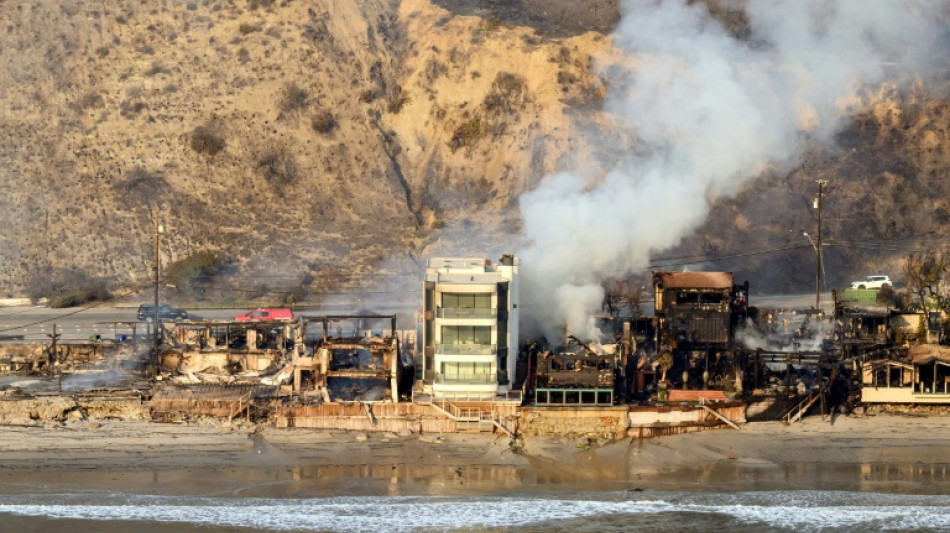
Scrapped by Trump, revived US climate-disaster database reveals record losses / Photo: JOSH EDELSON - AFP/File

 South Africa arrests three more suspects, after nine women murdered

 Paramount settles with US states to clear Warner Bros. mega-merger
 Climate crisis a job for world leaders, not just activists: UK FM

 COP31 host says AI's climate footprint to be a summit priority

 EU proposes energy rating for data centres

 TradersYard Shifts Focus to Futures Trading

 Indonesia doing 'everything' but struggling to curb fires

 FQ-42 Vengeance Finds New Home at Creech Air Force Base

 Multi-Asset Trading Venue Monochrome Exchange Announces IEO of Its Native Token, $MCR

 Data centre command hub keeps AI up and running

 Leo XIV, first US pope transcends his restrained style

 France's debt climbs to highest since 1978: ministry

 Thousands protest inaction over climate crisis in Switzerland

 UK actor Naomi Watts honoured at Spain film festival
 Trump signs bill authorizing sweeping Russia sanctions

 Anthropic picks Accenture for in-house AI safety evaluation

 Hushing and hedging: US companies retreat on climate

 Crisis-wracked Volkswagen warns of 10-bn-euro hit to profits

 Shakira to cap off world tour with Madrid 12-gig run

 Isolated Syrian-Druze city shortages

 UNESCO can be 'moderator' in AI debate: chief to AFP

 Russia seizes assets of Nestle, French firms

 Anthropic says AI systems moving towards building themselves

 Asian stocks boosted by falling oil, yen weakens after BoJ rate hike

 Afghan medical students in Pakistan hope court stops college expulsions

A flagship US climate-disaster database killed by President Donald Trump's administration has been brought back to life by its former lead scientist -- revealing that extreme weather inflicted a record $101 billion in damages in just the first half of 2025.
The Billion-Dollar Weather and Climate Disasters tracker, long maintained by the National Oceanic and Atmospheric Administration (NOAA), chronicled major US catastrophes from 1980 to 2024 before it was abruptly shut down in May amid sweeping budget cuts that critics decried as an ideologically driven attack on science.
"This dataset was simply too important to stop being updated, and the demand for its revival came from every sector of society," Adam Smith, an applied climatologist who helmed the database for 15 years before resigning in May, told AFP.
Among those calling for its return were groups such as the American Academy of Actuaries, who argued the list was a vital tool for tracking the rising costs of climate-fueled disasters, from wildfires to floods, that threaten homeowners, insurers, and mortgage markets.
Congressional Democrats have also sought to restore the program within NOAA, introducing a bill last month that has yet to advance.
Now based at the nonprofit Climate Central, Smith said he worked with an interdisciplinary team of experts in meteorology, economics, risk management, communication, and web design over recent months to recreate the dataset using the same public and private data sources and methodologies.
The new findings, he said, show that "the year started out with a bang": the Los Angeles wildfires were likely the costliest in history, with insured losses reaching an estimated $60 billion.
That was followed by a barrage of spring storms across the central and southern United States, including several destructive tornadoes.
Altogether, 14 separate billion-dollar weather and climate disasters between January and June caused $101.4 billion in inflation-adjusted damages -- though 2025 as a whole may fall short of a record, thanks to a milder-than-usual Atlantic hurricane season.
Smith said his decision to leave NOAA stemmed from his realization that "the current environment to do science, across the board, is becoming more difficult, and that's likely an understatement."
But he added he was happy to give the dataset a new home so it can remain a "public good" and continue to publish updates at regular intervals.
Looking ahead, the team plans to broaden the scope of the tracker to include events causing at least $100 million in losses -- to capture the smaller and mid-sized disasters that still have "life-changing impacts to lives and livelihoods."
P.Kolisnyk--CPN