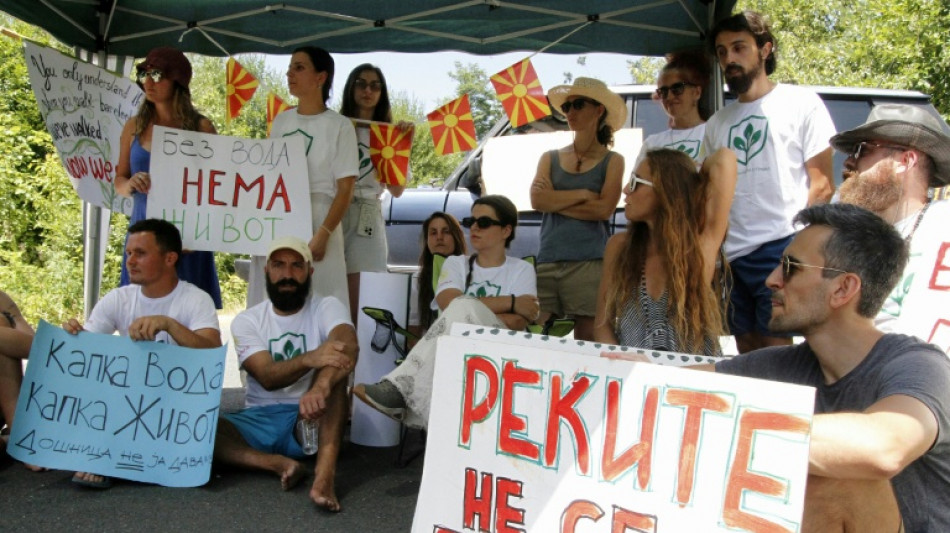
'Not backing down': activists block hydro plants in N.Macedonia / Photo: Darko DURIDANSKI - AFP

 As Moscow steps up attacks, Kyiv residents brace for harsh winter

 Markets mixed as China's Xi arrives for US talks

 Archaeological 'breakthrough' could confirm origins of Paris

 Australian PM says OpenAI hacked government health website

 Rio breaks record for rainiest September amid powerful El Nino
 Mandela Digital Extends Early Access Programme to 11 February 2027 Following Strong Response

 McDonald's to boost franchisees as inflation weighs on consumers
 Archaelogical 'breakthrough' could confirm origins of Paris

 Fendi brings disco bling, Italian style, to Milan Fashion Week
 アレックス・ボディ氏とシュテファン・ハウプト教授、ルーマニアの伝説的な美術コレクションをめぐり提携に合意
 Stocks dip, oil rises as traders eye chances of Iran deal

 Oil falls, stocks steady as Trump hails 'good' Iran talks

 Canada judge to decide prison term for suicide poison seller

 Meta leans into AI, smart glasses amid privacy pushback
 Oil prices fall after Trump hails 'good' talks with Iran

 AI political ads warp reality ahead of US midterms

 Oil prices retreat as markets welcome US-Iran talks
 French prosecutors probe secret filming of women with smart glasses

 Trump renames AI "super intelligence," rejects international oversight

 How is the EU approaching record fuel prices?

 11 hurt as teen opens fire outside school in western Turkey

 UN chief says 'Big Oil' treats atmosphere as open sewer

 Memoir by Diana's brother goes on sale after rocking UK monarchy
 Stocks climb as oil slides, AI buzz returns

 MEXC Launches “Real Stocks, Real Friends” with Rewards for Bringing Friends to Wall Street

Deep in the rugged forests of North Macedonia, small-hydropower developers are facing off with activists who warn that a thirst for lucrative green energy contracts is threatening the country's rivers.
For over a month, protesters have blocked roads into Hydro Dosnica's remote construction sites on Mount Kozuf, where two small hydroelectric power plants are proposed on what activists claim is one of the last healthy rivers in the country.
"Until the licenses are cancelled and all machines are removed from the river Dosnica, we will not move," environmental activist Marina Tomova told AFP at her mountainous campsite near the southern border with Greece.
Opponents have been fighting developers for years, fearing the plants will ruin a vital ecosystem in a basin already stretched by decreasing rainfall and hotter summers.
Hydro Dosnica has rejected the allegations of damaging the river, and said the project follows environmental standards.
In recent years, Balkan governments have welcomed hundreds of hydro developments with lucrative subsidies, drawing a flood of investors who promise to harness a potentially reliable and renewable energy source.
According to a 2024 report from conservation groups EuroNatur and Riverwatch, the Balkans have around 1,800 hydropower plants and over 3,000 planned.
The vast majority are small-scale plants like those being built on the Dosnica.
In response, protest movements have sprung up too, arguing that the ecological footprint and impact for those living on the rivers far outweighs the output from the small plants.
But the report also notes that hundreds of slated plants have since been axed and the booming number of planned builds has slowed slightly since its 2022 peak.
North Macedonia has around 125 small plants, with plans to almost double that, according to the report.
Much smaller than huge hydroelectric dams, the stations divert water through a pipe into a turbine kilometres downstream.
- An 'extinct' river -
On Mount Kozuf, protesters accuse Hydro Dosnica of breaching its licence by illegally felling swathes of forest and irreparably damaging the river's upper basin.
Protester Kiril Ruzinov said that during summer months, the river's flow slows and any redirection of the stream would run it dry.
"It is too small; it cannot fill a tenth of the pipe. If it is put into a pipe, the whole riverbed will be extinct," the 65-year-old told AFP.
The law requires developers to leave at least 10 percent of the stream to flow naturally.
The developer Hydro Dosnica, in a statement to AFP, said the activist's allegations were "incorrect and tendentious" and the project was "being carried out transparently, respecting all environmental and technical standards".
The firm said it was ready to engage with environmental experts and institutions regarding any new findings at the site.
The environment ministry did not respond to requests for comment.
These small plants, with a capacity up to 10 megawatts each, accounted for just four percent of North Macedonia's overall energy production in 2020, according to the latest available data from the state audit service.
At the time it had around 90 small hydro plants already in operation, according to EuroNatur and Riverwatch.
Hotter, drier summers coupled with more extreme flooding events driven by climate change are posing a challenge to hydropower generation around the world.
A 2023 study of a different river basin, which begins in North Macedonia and flows into Albania and Montenegro, found that climate change could cut yearly hydropower generation there by up to 52 percent by 2050.
The research, funded by the United Nations Economic Commission for Europe, warned that hydro-reliant Albania would be worst impacted by changes in the Drina basin and suggested investing in other renewable sources to secure its grid.
- 'Not backing down' -
One of the few rivers in North Macedonia still clean enough to drink from, the Dosnica is a small tributary to the Vardar, which flows into Greece.
It is home to "exceptionally" valuable animals -- including several protected species, according to environmental non-profit Eko Svest.
Along with a group of prominent scientists, the NGO has appealed to the government to officially protect the river.
In a previous statement published online, the government said it was "closely monitoring public reactions and is ready to encourage an open and constructive dialogue with all stakeholders".
The government recently extended the license for the development until April 2026.
"The devastating projects here have to stop," Risto Kamov, from environmental activist group Changemakers4All, told AFP.
"We are not backing down, and we will stay to protect Dosnica and Kozuf."
Y.Tengku--CPN