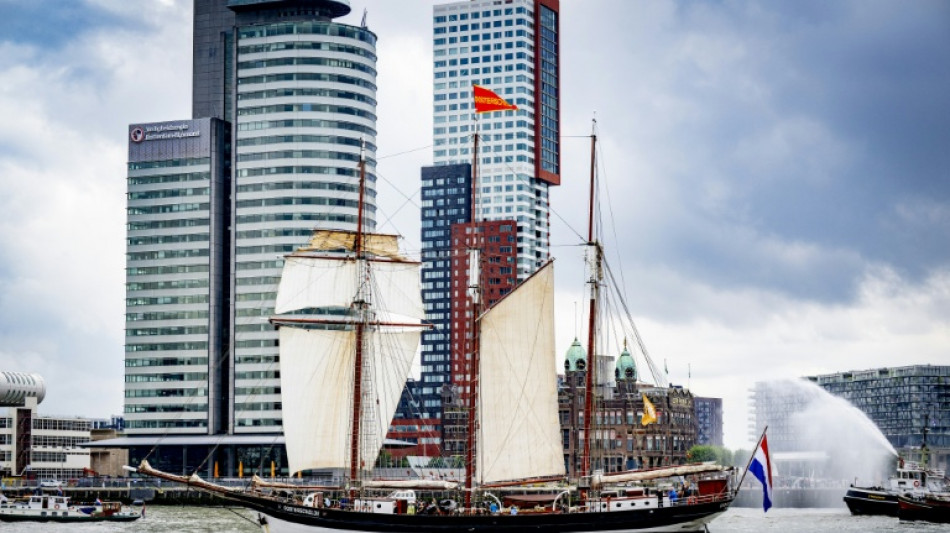
In Darwin's wake: Two-year global conservation voyage sparks hope / Photo: Robin Utrecht - ANP/AFP

 Forex Expo Dubai 2026 Breaks Guinness World Record Again With 23,816 Attendees

 Asian markets fall on US-China jitters as leaders meet

 As Moscow steps up attacks, Kyiv residents brace for harsh winter
 Markets mixed as China's Xi arrives for US talks

 Archaeological 'breakthrough' could confirm origins of Paris

 Australian PM says OpenAI hacked government health website

 Rio breaks record for rainiest September amid powerful El Nino

 Mandela Digital Extends Early Access Programme to 11 February 2027 Following Strong Response

 McDonald's to boost franchisees as inflation weighs on consumers

 Archaelogical 'breakthrough' could confirm origins of Paris

 Fendi brings disco bling, Italian style, to Milan Fashion Week
 アレックス・ボディ氏とシュテファン・ハウプト教授、ルーマニアの伝説的な美術コレクションをめぐり提携に合意
 Stocks dip, oil rises as traders eye chances of Iran deal

 Oil falls, stocks steady as Trump hails 'good' Iran talks

 Canada judge to decide prison term for suicide poison seller

 Meta leans into AI, smart glasses amid privacy pushback
 Oil prices fall after Trump hails 'good' talks with Iran

 AI political ads warp reality ahead of US midterms

 Oil prices retreat as markets welcome US-Iran talks
 French prosecutors probe secret filming of women with smart glasses

 Trump renames AI "super intelligence," rejects international oversight

 How is the EU approaching record fuel prices?

 11 hurt as teen opens fire outside school in western Turkey

 UN chief says 'Big Oil' treats atmosphere as open sewer
 Memoir by Diana's brother goes on sale after rocking UK monarchy

After a two-year around-the-world ocean voyage inspired by Charles Darwin, scientists and crew sailed home on a historic vessel into Rotterdam Thursday bearing a warning about climate change -- but also a message of hope.
The majestic three-masted Oosterschelde, the last remaining vessel from a fleet of Dutch schooners that criss-crossed the globe in the early 20th century, arrived to a welcome befitting a voyage of more than 40,000 nautical miles (74,000 kilometres, 46,000 miles).
Ceremonially escorted by more than a dozen vessels ranging from tall ships to steamships, all blaring horns, the Oosterschelde received a "water cannon salute" from fire service boats, as hundreds waved and cheered from the banks.
Like Darwin in 1831, the Oosterschelde departed the British port of Plymouth in August 2023 to embark on a voyage of discovery that took in the major stops explored during the British naturalist's world-changing mission aboard the HMS Beagle.
From the Falkland Islands to the southern tips of Africa, South America and Australia, the trip closely shadowed Darwin's voyage that inspired his groundbreaking theory of natural selection described in "On the Origin of Species".
Aboard the Oosterschelde at various points of the voyage were some of the world's best young conservationists, 100 scientists aged 18-25, selected to study a species also observed by Darwin, himself aged 22 at the time of his trip.
Giant tortoises, Chilean dolphins, and howler monkeys were just some of the weird and wonderful creatures the young "Darwin Leaders" investigated, tracking changes since their appearance in "Origin of Species" two centuries ago.
With "online classrooms" onboard and slick social media output, the mission also hoped to inspire a new generation around the message: "Conservation isn't about what we've lost, it's about protecting what we still have."
- 'Barely anything left' -
One of the Darwin Leaders, 23-year-old Lotta Baten, spent a week on the ship and conducted a study into the impact of tourism on forests in Tenerife, Spain.
She said only roughly four percent of the forest that Darwin would have seen from the Beagle is still alive today, with much torn down to support the tourism industry.
"There's barely anything left, mainly the strips around the coast," the Dutch-German scientist told AFP.
She said it was "quite something" to follow in the footsteps of Darwin, but noted that the botanist's legacy is divided, as a European in colonial times.
"He basically explored and discovered things that maybe had already been explored and discovered by people at the places themselves. And then he claimed he discovered them," said Baten.
Science co-ordinator Rolf Schreuder admitted that "it's not a rosy picture", with habitat loss and climate change all transforming the environment beyond what Darwin would have recognised.
"You see the natural world degrading in many places," the 55-year-old told AFP.
But Schreuder, like many on board, found the mission inspiring rather than depressing.
He ran more than 100 local projects during the trip with people seeking to preserve their landscapes.
"We met so many great people that are actually on the ground working on the survival of those species," he said.
He found himself inspired too by the young scientists, "full of ideas, full of commitment and determination to really make a difference."
- 'Do another tour' -
Crew member Daan van Roosmalen was a boy of 17 when he set sail on the Oosterschelde. He returned to his native Netherlands having just turned 19.
"I've just been to so many places. To the Galapagos Islands, French Polynesia. We went so far away and to then sail back up this river and see the skyline of Rotterdam again is just super special," he told AFP.
He said he hoped the round-the-world voyage completed by scientists and crew his age would send a message to his generation.
"I think it's very important that we keep inspiring young people to look after our world, because we are going to be the ones taking over," he said.
"So to see all these young conservationists putting so much effort in Mother Earth... I think that should inspire more people to also take care of our planet."
And what of Darwin, the inspiration behind the mission?
"I would say he would have been enthused by his fellow young people taking care of this natural world, which he described so nicely," said Schreuder.
"I think he would hop on this boat again and do another tour."
H.Meyer--CPN