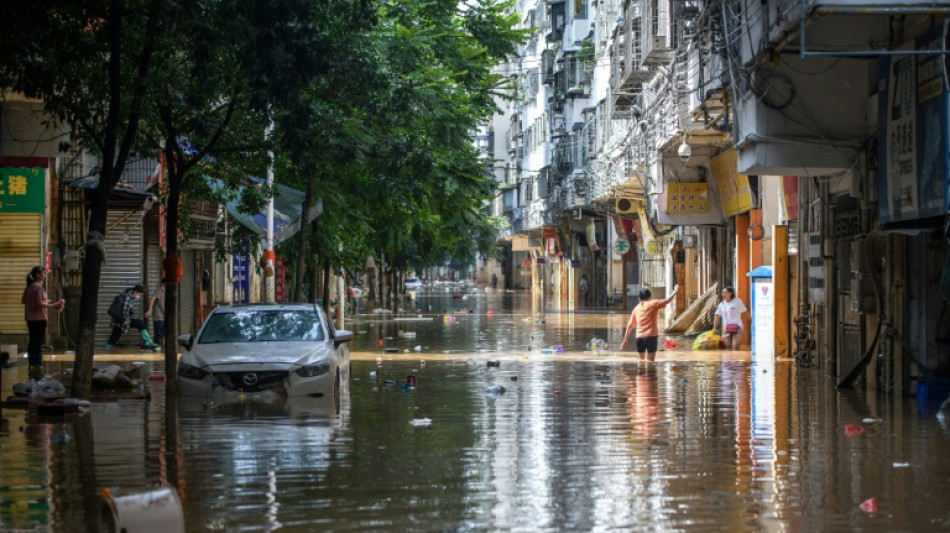
Record floods threaten southern China / Photo: STR - AFP/File

 Lights out in Laos as electricity exports surge

 Steven Strogatz weighs AI mathematics advances and their consequences for researchers

 Anthropic boss calls for AI slowdown, Altman and Musk agree

 French IT giant Capgemini sells subsidiary after row over ICE links

 Quebec Brokerage Qubit Insurance Announces New Data on Coverage Shortfalls as Rebuilding Costs Rise

 Lady Gaga welcomes first child with fiance: US media

 Bhutan business bets on hazelnuts for farming future

 'Widow's Bay' and 'The Pitt' are favorites for Emmys night

 Coastal erosion forces cancellation of California music festival

 Argentina's Dirty War rears its head in Venice film

 UK lawmakers throw out bill to legalise assisted dying

 US inflation steady in August, fueling Fed rate hike expectations

 New York marks 25th anniversary of 9/11 attacks

 Nepal flood reconstruction bill to be $4.78 bn: foreign ministry

 JUMO and Standard Bank launch Social Finance Framework to scale inclusive finance in Africa

 Doomsday tech: could AI really kill us all?

 French comedy show 'Call my agent' makes film comeback

 It's all coming back: Celine Dion fans gear up for Paris return

 Researchers eye AI revolution in natural disaster forecasts

 US braces for inflation report that may push Fed to hike rates

 Musk threatens legal action over documentary

 Latin America fact-check group asks Meta not to replace verification practice

 AI Risks to Enter 60–80% of Liability and Cyber Insurance Underwriting by 2028, ScienceSoft Predicts

 Tribal Launches Campfire, Letting Business and Technical Teams Build on Salesforce Together

 Stocks fall as fresh oil surge fans inflation fears

Record floods were expected in parts of southern China Thursday as heavy rains pushed water levels in the Pearl River delta to their highest in almost a century.
Hundreds of thousands of people have been evacuated from the worst-hit parts of the region, which includes Guangdong province, a manufacturing and logistics hub that is home to China's tech capital Shenzhen.
China's ministry of water resources on Wednesday placed its highest flood alert on the Pearl River basin, saying water levels at one location "surpassed historical records" and that the provincial capital Guangzhou would be impacted.
Images from the city of Shaoguan, north of Guangzhou, showed residents on Wednesday making their way through flooded main roads, as water in some areas reached the tops of cars.
The muddy floodwater inundated shops and buildings, and people were seen clearing away the debris.
The low-lying Pearl River delta is home to the economic powerhouses of Guangzhou and Shenzhen, as well as several smaller but densely populated cities with major manufacturing and other industries.
Provincial emergency management authorities said earlier this week that direct economic losses were estimated at 1.7 billion yuan ($253 million).
Under the highest alert level, at-risk areas in Guangdong have been ordered to take all necessary measures including suspending work at factories and closing schools to minimise damage.
Other regions in southern China, including coastal Fujian province and Guangxi, have also been affected by record rains this month, forcing hundreds of thousands to evacuate.
Summer floods are common in parts of China, but these have been getting more extreme in recent years as a result of climate change.
Chinese authorities so far have not directly linked this year's extreme floods to climate change.
Some local media have dubbed it a "once-in-a-century flood", reporting that water levels have surpassed the highest recorded in 1931 and are approaching the area's worst floods in 1915.
Ng.A.Adebayo--CPN