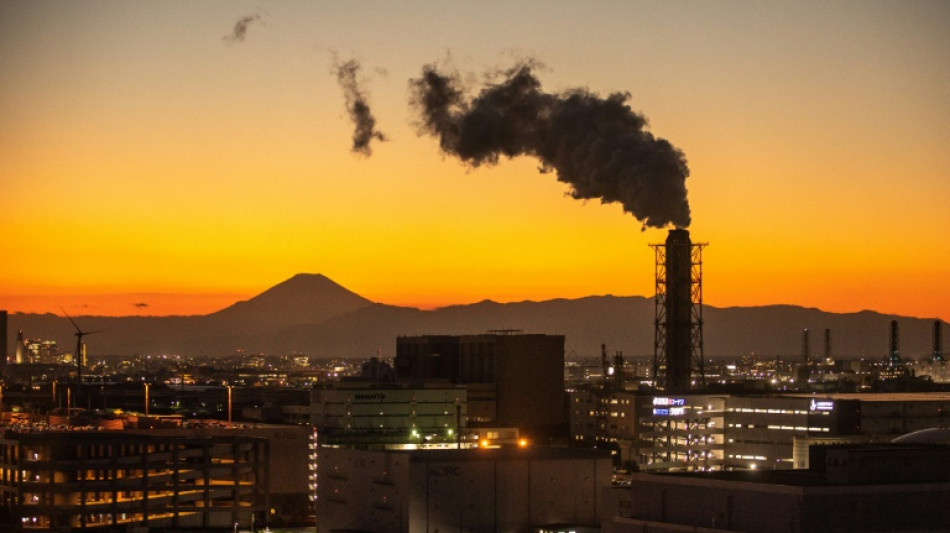
Japan targets 60% emissions cut by 2035 from 2013 levels / Photo: Philip FONG - AFP

 Kenya's economy faces climate change risks: World Bank

 Milei demands expulsion of foreigners expressing 'hate' against Argentina

 Italy's Po River valley on drought alert

 Prada profits pinched as growth hard to chase

 Stocks climb on earnings and rates, oil retreats

 US economic growth slows in second quarter, missing expectations

 Russia adds Telegram founder Durov to 'terrorist' blacklist

 Stocks diverge on earnings, as oil steadies

 Eurozone economy grows despite Middle East war

 Singapore group will develop 'most promising' Ebola vaccine

 Shell profit surges as Mideast war fuels oil prices

 Car maker Stellantis says back in profit in second quarter

 Samsung quarterly operating profit up 1,800% on AI boom

 South Korean stocks bounce after rout, oil holds gains on Mideast woes

 South Korea's women web sleuths fight AI deepfake porn

 Anything but programmable: New cost-efficient EC-power-supply-series for the DIN rail by CAMTEC PS

 Meta misses profit expectations, sticks to massive AI spending

 Campari - king of the spritz - hopes to conquer American heartland
 Air France-KLM and Lufthansa bid for Portugal's TAP airline

 Profits soar at Airbus as it delivers more planes

 Rheinmetall shares surge after armsmaker reports record profit

 FIFA hit by furious backlash over plans to sell stake in competitions

 MEXC Integrates World-Check to Fortify Institutional Grade Compliance Architecture
 Spain returns wildfire evacuees as France braces for worsening weather

 Russia seeks arrest of Telegram chief Durov

Japan set fresh climate targets on Tuesday, pledging to slash greenhouse gas emissions by 60 percent in the next decade from 2013 levels.
Under the Paris Agreement, each country is supposed to provide a steeper headline figure to the UN for cutting heat-trapping emissions by 2035, and a detailed blueprint for how to achieve this.
Japan's environment ministry said Tuesday it aims to slash emissions 60 percent by the 2035 fiscal year, which starts in April.
Tokyo also aims to cut emissions by 73 percent by the 2040 fiscal year, as part of its new Nationally Determined Contribution (NDC) -- a voluntary pledge to be submitted to the United Nations.
Nearly 200 nations had been required to deliver fresh climate plans by February 10 but just 10 did so on time, according to a UN database tracking submissions.
The environment ministry said on Tuesday that its "ambitious targets (are) aligned with the global 1.5 degree Celsius goal and on a straight pathway towards the achievement of net zero by 2050".
In 2016, Japan committed to a 26 percent reduction in emissions by 2030. But a renewed NDC issued in March 2020 had the same figure, sparking criticism from campaigners.
A more ambitious carbon cutting plan submitted in October 2021 set a goal of reducing emissions by 46 percent by 2030, compared to 2013 levels.
Global emissions have been rising, but need to almost halve by the end of the decade to limit global warming to safer levels agreed under the Paris deal.
Also on Tuesday, Japan approved its latest Strategic Energy Plan, which includes an intention to make renewables its top power source by 2040.
Nearly 14 years after the Fukushima disaster, Tokyo also sees a major role for nuclear power in helping Japan meet growing energy demand from artificial intelligence and microchip factories.
The world's fourth-largest economy has the dirtiest energy mix in the Group of Seven, campaigners say.
Nearly 70 percent of Japan's power needs in 2023 were met by power plants burning coal, gas and oil, a figure Tokyo wants to slash by 30 to 40 percent over the next 15 years.
Almost all must be imported, costing Japan about $500 million per day and representing a hurdle for the government's aim to reach carbon neutrality by 2050.
Under the new plans, renewables such as solar and wind are expected to account for 40 to 50 percent of electricity generation by 2040.
That marks a jump from last year's level of 23 percent and a previous target for 2030 of 38 percent.
A.Zimmermann--CPN