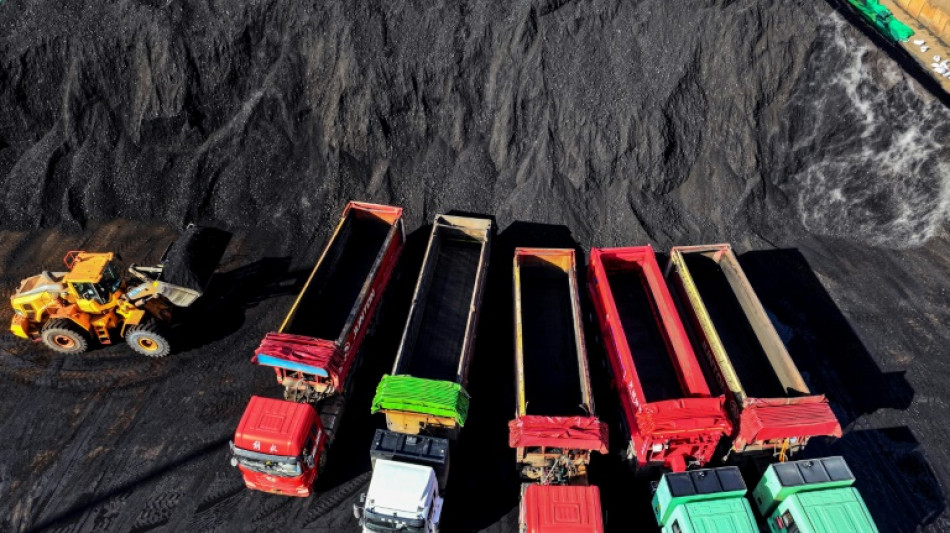
China's 2024 coal projects threaten climate goals: report / Photo: STR - AFP/File

 Kenya's economy faces climate change risks: World Bank

 Milei demands expulsion of foreigners expressing 'hate' against Argentina

 Italy's Po River valley on drought alert

 Prada profits pinched as growth hard to chase

 Stocks climb on earnings and rates, oil retreats

 US economic growth slows in second quarter, missing expectations

 Russia adds Telegram founder Durov to 'terrorist' blacklist

 Stocks diverge on earnings, as oil steadies

 Eurozone economy grows despite Middle East war

 Singapore group will develop 'most promising' Ebola vaccine

 Shell profit surges as Mideast war fuels oil prices

 Car maker Stellantis says back in profit in second quarter

 Samsung quarterly operating profit up 1,800% on AI boom

 South Korean stocks bounce after rout, oil holds gains on Mideast woes

 South Korea's women web sleuths fight AI deepfake porn

 Anything but programmable: New cost-efficient EC-power-supply-series for the DIN rail by CAMTEC PS

 Meta misses profit expectations, sticks to massive AI spending

 Campari - king of the spritz - hopes to conquer American heartland

 Air France-KLM and Lufthansa bid for Portugal's TAP airline

 Profits soar at Airbus as it delivers more planes

 Rheinmetall shares surge after armsmaker reports record profit

 FIFA hit by furious backlash over plans to sell stake in competitions

 MEXC Integrates World-Check to Fortify Institutional Grade Compliance Architecture

 Spain returns wildfire evacuees as France braces for worsening weather

 Russia seeks arrest of Telegram chief Durov

China last year began construction on projects with the greatest combined coal power capacity since 2015, jeopardising the country's goal to peak carbon emissions by 2030, according to a report published Thursday.
The world's second-largest economy is the biggest emitter of the greenhouse gases that drive climate change, but also a renewable energy powerhouse. It plans to reach net zero by 2060.
While coal has been a pivotal energy source in China for decades, explosive growth in wind and solar installations in recent years has raised hopes that the country can wean itself off the dirty fossil fuel.
But according to a report from the Finland-based Centre for Research on Energy and Clean Air (CREA) and Global Energy Monitor (GEM) in the United States, China began construction on 94.5 gigawatts of coal power projects in 2024 -- 93 percent of the global total.
Although the country also added a record 356 gigawatts of wind and solar capacity -- 4.5 times the European Union's additions -- the uptick in coal power risks solidifying its role in China's energy mix, the report said.
"China's rapid expansion of renewable energy has the potential to reshape its power system, but this opportunity is being undermined by the simultaneous large-scale expansion of coal power," said Qi Qin, lead author of the report and China analyst at CREA.
The rise comes despite a pledge by Chinese President Xi Jinping in 2021 to "strictly control" coal power projects and increases in coal consumption before "phasing it down" between 2026 and 2030.
Coal production has risen steadily in recent years, from 3.9 billion tons in 2020 to 4.8 billion tons in 2024.
"Without urgent policy shifts, China risks reinforcing a pattern of energy addition rather than transition, limiting the full potential of its clean energy boom," the report said.
- Coal prioritised -
New permits for coal power projects fell 83 percent in the first half of 2024, prompting optimism that China's clean energy transition was gathering pace.
In November, a survey of experts by CREA and the Australian think tank International Society for Energy Transition Studies (ISETS) found 52 percent thought China's coal consumption would peak in 2025.
But coal power surged in the latter months of 2024, despite the country adding enough power from clean energy sources to cover its growth in electricity demand.
That suggested coal power was being prioritised over renewable sources in some regions, the report said.
"Chinese coal power and mining companies are sponsoring and building new coal plants beyond what is needed," said Christine Shearer, research analyst at GEM.
"The continued pursuit of coal is crowding out the country's use of lower-cost clean energy."
China is due to announce details of its 15th Five-Year Plan -- for 2026 to 2030 -- in the coming months, likely including updated emissions and energy goals.
This month it was also due to submit new emissions targets, known as Nationally Determined Contributions (NDCs), under the 2015 Paris Agreement.
So far only a handful of countries have submitted new NDCs.
In October, CREA urged China to set a "strong but achievable" target of slashing emissions by at least 30 percent by 2035.
M.García--CPN