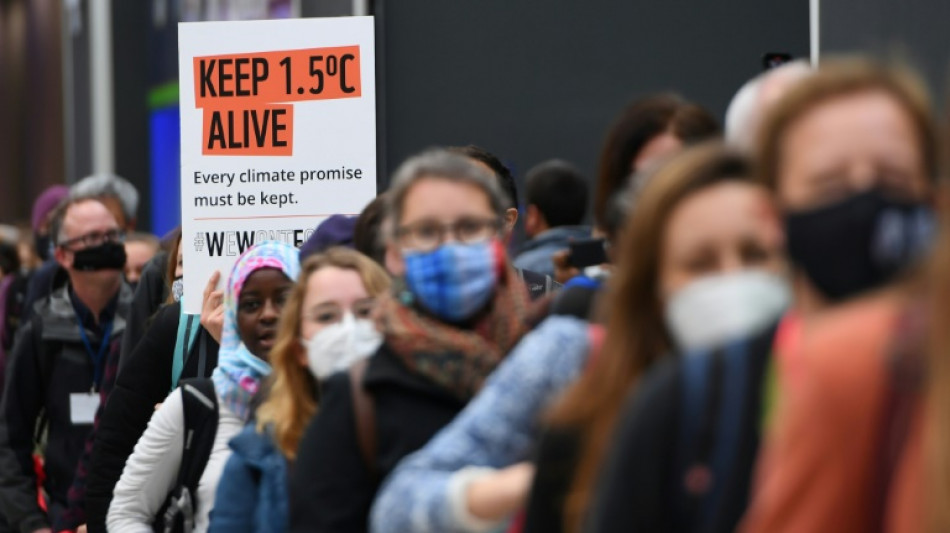
Top climate scientist declares 2C climate goal 'dead' / Photo: ANDY BUCHANAN - AFP/File

 Kenya's economy faces climate change risks: World Bank

 Milei demands expulsion of foreigners expressing 'hate' against Argentina

 Italy's Po River valley on drought alert

 Prada profits pinched as growth hard to chase

 Stocks climb on earnings and rates, oil retreats

 US economic growth slows in second quarter, missing expectations

 Russia adds Telegram founder Durov to 'terrorist' blacklist

 Stocks diverge on earnings, as oil steadies

 Eurozone economy grows despite Middle East war

 Singapore group will develop 'most promising' Ebola vaccine

 Shell profit surges as Mideast war fuels oil prices

 Car maker Stellantis says back in profit in second quarter

 Samsung quarterly operating profit up 1,800% on AI boom

 South Korean stocks bounce after rout, oil holds gains on Mideast woes

 South Korea's women web sleuths fight AI deepfake porn

 Anything but programmable: New cost-efficient EC-power-supply-series for the DIN rail by CAMTEC PS

 Meta misses profit expectations, sticks to massive AI spending

 Campari - king of the spritz - hopes to conquer American heartland

 Air France-KLM and Lufthansa bid for Portugal's TAP airline

 Profits soar at Airbus as it delivers more planes

 Rheinmetall shares surge after armsmaker reports record profit

 FIFA hit by furious backlash over plans to sell stake in competitions

 MEXC Integrates World-Check to Fortify Institutional Grade Compliance Architecture

 Spain returns wildfire evacuees as France braces for worsening weather

 Russia seeks arrest of Telegram chief Durov

Holding long-term global warming to two degrees Celsius -- the fallback target of the Paris climate accord -- is now "impossible," according to a stark new analysis published by leading scientists.
Led by renowned climatologist James Hansen, the paper appears in the journal "Environment: Science and Policy for Sustainable Development" and concludes that Earth's climate is more sensitive to rising greenhouse gas emissions than previously thought.
Compounding the crisis, Hansen and colleagues argued, is a recent decline in sunlight-blocking aerosol pollution from the shipping industry, which had been mitigating some of the warming.
An ambitious climate change scenario outlined by the UN's climate panel, which gives the planet a 50 percent chance of keeping warming under 2C by the year 2100, "is an implausible scenario," Hansen told a briefing Tuesday.
"That scenario is now impossible," said Hansen, formerly a top NASA climate scientist who famously announced to the US Congress in 1988 that global warming was underway.
"The two degree target is dead."
Instead, he and co-authors argued, the amount of greenhouse gases already pumped into the atmosphere by burning fossil fuels meant increased warming is now guaranteed.
Temperatures will stay at or above 1.5C in the coming years -- devastating coral reefs and fueling more intense storms -- before rising to around 2.0C by 2045, they forecast.
They estimated polar ice melt and freshwater injection into the North Atlantic will trigger the shutdown of the Atlantic Meridional Overturning Circulation (AMOC) within the next 20–30 years.
The current brings warmth to various parts of the globe and also carries nutrients necessary to sustain ocean life.
Its end "will lock in major problems including sea level rise of several meters -- thus, we describe AMOC shutdown as the 'point of no return,'" the paper argued.
The world's nations agreed during the landmark Paris climate accord of 2015 to try to hold end-of-century warming to 1.5C above pre-industrial levels.
Scientists identified the threshold as critical to preventing the breakdown of major ocean circulation systems, the abrupt thawing of boreal permafrost, and the collapse of tropical coral reefs.
The 1.5C target has already been breached over the past two years, according to data from the EU's climate monitoring system Copernicus, though the Paris Agreement referred to a long-term trend over decades.
At 2C, the impacts would be even greater, including irreversible loss to Earth's ice sheets, mountain glaciers and snow, sea ice and permafrost.
The authors acknowledged the findings appeared grim, but argued that honesty is a necessary ingredient for change.
"Failure to be realistic in climate assessment and failure to call out the fecklessness of current policies to stem global warming is not helpful to young people," they said.
"Today, with rising crises including global climate change, we have reached a point where we must address the problem of special interests," they added, stressing they were "optimistic" for the future.
T.Morelli--CPN