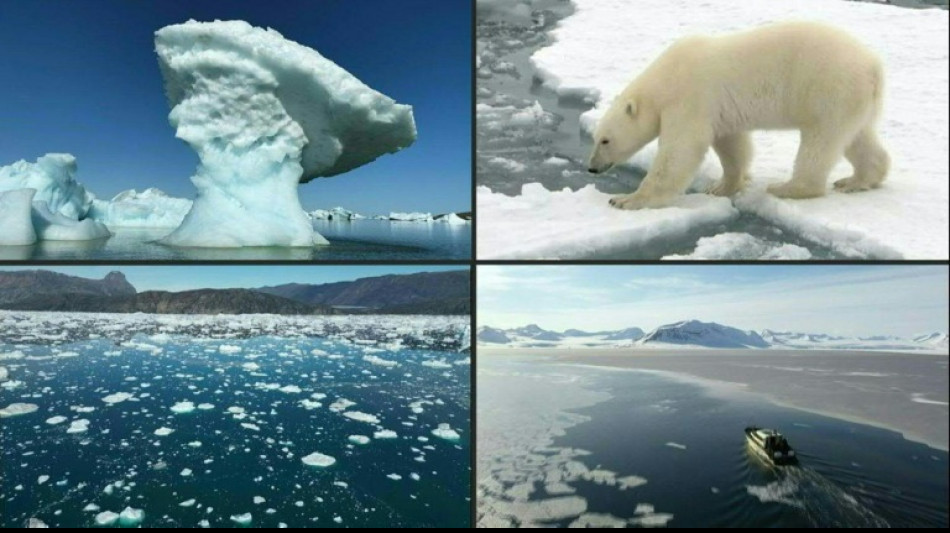
Arctic sea ice levels second lowest on record for January: US data / Photo: Viken KANTARCI, Ekaterina ANISIMOVA, Jonathan NACKSTRAND, Viken KANTARCI, Odd ANDERSEN, Madeleine PRADEL, Diane DESOBEAU - AFP

 Kenya's economy faces climate change risks: World Bank

 Milei demands expulsion of foreigners expressing 'hate' against Argentina

 Italy's Po River valley on drought alert

 Prada profits pinched as growth hard to chase

 Stocks climb on earnings and rates, oil retreats

 US economic growth slows in second quarter, missing expectations

 Russia adds Telegram founder Durov to 'terrorist' blacklist

 Stocks diverge on earnings, as oil steadies

 Eurozone economy grows despite Middle East war

 Singapore group will develop 'most promising' Ebola vaccine

 Shell profit surges as Mideast war fuels oil prices

 Car maker Stellantis says back in profit in second quarter

 Samsung quarterly operating profit up 1,800% on AI boom

 South Korean stocks bounce after rout, oil holds gains on Mideast woes

 South Korea's women web sleuths fight AI deepfake porn

 Anything but programmable: New cost-efficient EC-power-supply-series for the DIN rail by CAMTEC PS

 Meta misses profit expectations, sticks to massive AI spending

 Campari - king of the spritz - hopes to conquer American heartland

 Air France-KLM and Lufthansa bid for Portugal's TAP airline

 Profits soar at Airbus as it delivers more planes

 Rheinmetall shares surge after armsmaker reports record profit

 FIFA hit by furious backlash over plans to sell stake in competitions

 MEXC Integrates World-Check to Fortify Institutional Grade Compliance Architecture

 Spain returns wildfire evacuees as France braces for worsening weather

 Russia seeks arrest of Telegram chief Durov

Both the North and South Pole regions have warmed by some three degrees Celsius compared to late 19th-century levels, much faster than the global average.
The US National Snow and Ice Data Center (NSIDC) said the Arctic sea ice surface area was at a record low in December and continued near record lows in during January. It said the surface in January averaged 13.13 million square kilometers (5.07 million square miles).
"In contrast to the cold conditions dominating the contiguous United States, much of the Arctic experienced above-average January temperatures," the NSIDC said.
This was particularly marked north of Greenland and over central Alaska, the report said, with temperatures as much as eight degrees Celsius (14 degrees Fahrenheit) above average for the month.
Greenland is located between the United States and Europe in a region of increasing strategic value as the melting of Arctic sea ice opens up new shipping routes.
President Donald Trump has signalled that he wants the Arctic island -- which is believed to hold large untapped mineral and oil reserves -- to become part of the United States.
Last year annual surface air temperatures in the Arctic were the second-warmest on record, according to the US National Oceanic and Atmospheric Administration.
Rising temperatures melt sea ice which in turn contributes to accelerated warming in the region, as dark sea water absorbs more solar radiation and thus helps to heat up the atmosphere, which then further accelerates the melting of the ice.
In a 2023 study, researchers found that the Arctic Ocean's ice cap would likely disappear in summer as soon as the 2030s and a decade earlier than thought, no matter how aggressively humanity draws down the carbon pollution that drives global warming.
The retreating ice also has a major impact on polar bears, which need sea ice to hunt.
A study published in the journal Science last week found that around half of the decline in Canada's Hudson Bay polar bears from 1979 to 2021 was due to climate-driven sea ice loss.
M.P.Jacobs--CPN