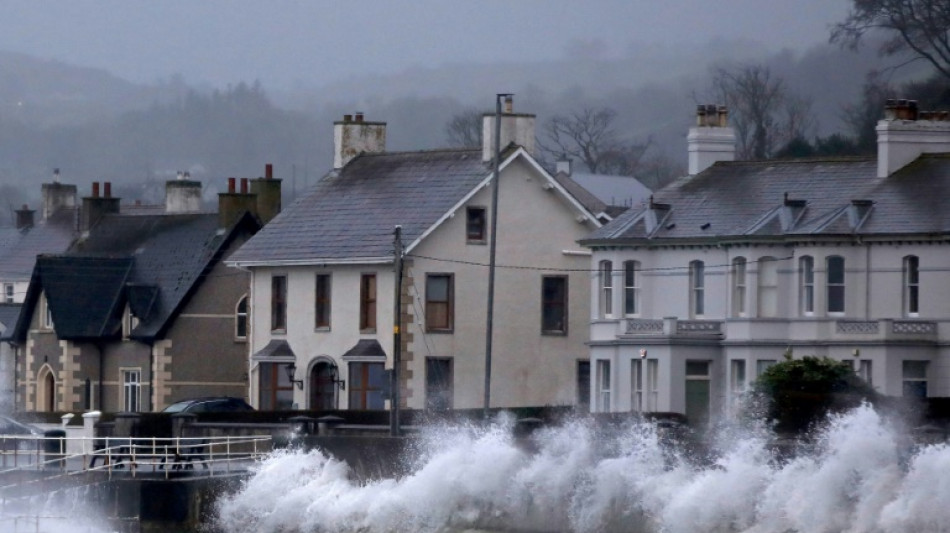
Power cuts and transport chaos as Storm Eowyn hits Ireland and UK / Photo: PAUL FAITH - AFP

 Kenya's economy faces climate change risks: World Bank

 Milei demands expulsion of foreigners expressing 'hate' against Argentina

 Italy's Po River valley on drought alert

 Prada profits pinched as growth hard to chase

 Stocks climb on earnings and rates, oil retreats

 US economic growth slows in second quarter, missing expectations

 Russia adds Telegram founder Durov to 'terrorist' blacklist

 Stocks diverge on earnings, as oil steadies

 Eurozone economy grows despite Middle East war

 Singapore group will develop 'most promising' Ebola vaccine

 Shell profit surges as Mideast war fuels oil prices

 Car maker Stellantis says back in profit in second quarter

 Samsung quarterly operating profit up 1,800% on AI boom

 South Korean stocks bounce after rout, oil holds gains on Mideast woes

 South Korea's women web sleuths fight AI deepfake porn

 Anything but programmable: New cost-efficient EC-power-supply-series for the DIN rail by CAMTEC PS

 Meta misses profit expectations, sticks to massive AI spending

 Campari - king of the spritz - hopes to conquer American heartland
 Air France-KLM and Lufthansa bid for Portugal's TAP airline

 Profits soar at Airbus as it delivers more planes

 Rheinmetall shares surge after armsmaker reports record profit

 FIFA hit by furious backlash over plans to sell stake in competitions

 MEXC Integrates World-Check to Fortify Institutional Grade Compliance Architecture

 Spain returns wildfire evacuees as France braces for worsening weather

 Russia seeks arrest of Telegram chief Durov

Storm Eowyn caused havoc Friday as it battered Ireland, Northern Ireland and Scotland, killing one person and leaving hundreds of thousands of homes without power, flights grounded and schools shut, officials said.
Millions of people across the three nations were urged to shelter at home from the "destructive" storm as Ireland recorded its strongest-ever wind gusts. One man died in Ireland when a tree fell on his car, police said.
Gusts of 183 kilometres (114 miles) per hour -- breaking an 80-year-old record -- brought down power lines, felled trees, blocked roads and destroyed two Irish sports facilities.
By evening, the highest-level red warning had been lifted in Ireland and Scotland, but authorities still called for vigilance.
"It is so important that people follow... advice not to travel because if people stay at home and don't travel then it means they don't invite that risk to themselves," Scotland's deputy first minister Kate Forbes told BBC radio.
Scotland, Ireland and Northern Ireland closed schools and cancelled trains, flights and ferries.
After winds eased, Dublin Airport -- which had earlier announced that airlines had cancelled more than 120 scheduled departures and 110 arrivals -- said its first flight took off at around 0930 GMT.
Flights were also cancelled at other airports including Belfast in Northern Ireland and Aberdeen, Edinburgh and Glasgow in Scotland.
Damage in Ireland included the destruction of an ice-skating rink near Dublin and a multi-million-pound indoor games facility in western County Mayo after winds ripped through them.
Cathriona Heffernan, 25, from Galway city in Ireland, described the winds as "crazy" even in the early stages of the storm, adding that five 60-year-old trees had been uprooted.
"One of them split right in half, so it's scary to think just how strong the wind was to be able to do that," she said.
Satellite imagery suggested a dangerous weather phenomenon known as a sting jet had developed over Ireland on Friday morning, the Met Office said.
A sting jet is a small area of very intense winds, which can be as strong as 160 kilometres per hour or more, it said.
The same type of extreme weather event was the cause of England's "Great Storm" in October 1987, which claimed 18 lives.
- 'Dangerous and destructive' -
In Ireland, 715,000 homes and businesses were without power while in Northern Ireland, over 93,000 were hit by outages, electricity suppliers said.
The highest wind speed recorded in Britain on Friday was 149 kilometres per hour at Brizlee Wood in Northumberland in northeast England, according to the Met Office.
The strongest gust ever recorded in the UK is 228 kilometres per hour at Fraserburgh in eastern Scotland, on February 13, 1989.
Irish forecaster Met Eireann said on X the previous record in Ireland was 182 kilometres per hour, recorded in 1945.
Northern Ireland Electricity Networks said Storm Eowyn was causing "widespread damage" to the electricity network.
"We anticipate we will begin assessing the damage to the network after 2:00 pm once the red weather warning has been lifted," it said in a statement.
In Scotland over 22,000 homes were without electricity, suppliers said, fallen trees and debris having damaged power lines.
Britain's environment agency warned of flooding in southern and central England over the coming days.
Ahead of the storm, some 4.5 million people on Thursday received emergency alerts on their phones, the "largest real-life use of the tool to date" on Thursday, the UK government said.
Storms, however, are natural phenomena and to date no specific scientific attribution to climate change has been made for this storm.
P.Schmidt--CPN