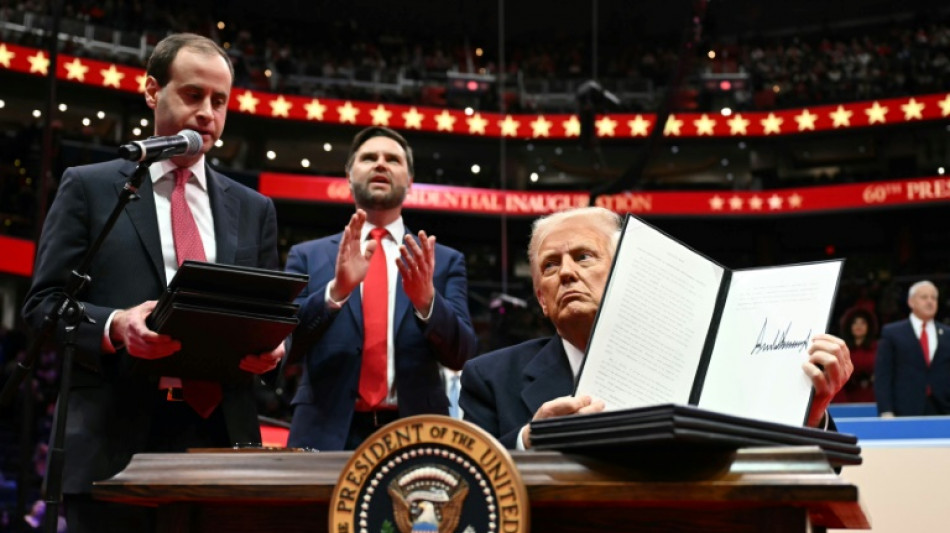
Trump leaves Paris climate agreement, doubles down on fossil fuels / Photo: Jim WATSON - AFP

 Three killed by storm in southern India

 Two hundred 'Cruise for life' passengers stranded in Cambodia

 Billionaire Ambani's Jio jumps 21% in market debut after record India IPO

 Sri Lanka's Tamil farmers fight to reclaim land after civil war

 'They don't care about us': Trump food aid cuts leave Americans struggling and angry
 Palestinian activist Khalil returns to Columbia after US detention

 Youths testify about 'despair' in unprecedented Canadian climate trial

 Storied Paris department store seeks bankruptcy protection
 Boeing shares tumble after it releases cautious growth forecast
 Boeing reports smaller loss as it aims for stable output growth

 Dangote, Nigeria's oil tycoon rewriting Africa's story

 Kane says Ballon d'Or win 'feels like a dream' as tributes pour in

 Mercedes-Benz cuts 2026 profit outlook on tough China market
President Donald Trump on Monday announced the United States' withdrawal from the Paris climate accord for a second time, a defiant rejection of global efforts to combat planetary warming as catastrophic weather events intensify worldwide.
The Republican leader also declared a "national energy emergency" to expand drilling in the world's top oil and gas producer, said he would scrap vehicle emissions standards that amount to an "electric vehicle mandate," and vowed to halt offshore wind farms, a frequent target of his scorn.
"I'm immediately withdrawing from the unfair, one-sided Paris Climate Accord rip-off," he said to cheering supporters at a Washington sports arena after being sworn in. "The United States will not sabotage our own industries while China pollutes with impunity."
He also signed an order instructing federal agencies to reject international climate finance commitments made under the previous administration, and issued a formal letter to the United Nations notifying it of Washington's intent to leave the agreement.
Under the accord's rules, the United States will formally exit in one year.
Critics warn the move undermines global cooperation on reducing fossil fuel use and could embolden major polluters like China and India to weaken their commitments, while Argentina, under libertarian President Javier Milei has also said it is "re-evaluating" its participation.
"Withdrawing the United States from the Paris Agreement is a travesty," said Rachel Cleetus, of the Union of Concerned Scientists, adding the move "shows an administration cruelly indifferent to the harsh climate change impacts that people in the United States and around the world are experiencing."
- Agreement to endure without US -
The move comes as global average temperatures over the past two years surpassed a critical 1.5 degrees Celsius warming threshold for the first time, underscoring the urgency of climate action.
Trump previously withdrew the United States from the Paris Accord during his first term. Despite this, the agreement -- adopted in 2015 by 195 parties to curb greenhouse gas emissions driving climate change -- appears poised to endure.
"The US withdrawing from the Paris Agreement is unfortunate, but multilateral climate action has proven resilient and is stronger than any single country's politics and policies," said Laurence Tubiana, a key architect of the accord. UN climate chief Simon Stiell added the "door remains open" for Washington.
Trump also on Monday signed a flurry of sweeping energy-related federal orders aimed at undoing former president Joe Biden's climate legacy.
"The inflation crisis was caused by massive overspending and escalating energy prices, and that is why today I will also declare a national energy emergency. We will 'Drill, baby, drill!'" Trump said.
He also attacked "big, ugly windmills" and said he'd take on Biden's Inflation Reduction Act, which channels billions of dollars into clean energy tax credits.
Trump additionally plans to reverse offshore drilling bans enacted by Biden, though such moves are likely to face legal challenges.
Environmentalists note that Biden's climate record is also clouded by the aggressive expansion of fossil fuel leasing under his administration, with US emissions remaining nearly unchanged last year.
- Praise and scorn -
Trump's actions drew praise from energy industry leaders, who view the new administration's policies as a return to "American energy dominance."
"The US oil and natural gas industry stands ready to work with the new administration to deliver the common sense energy solutions Americans voted for," said Mike Sommers, of the American Petroleum Institute.
But they sparked immediate outrage from environmental advocates.
"There is no energy emergency. There is a climate emergency," said Manish Bapna, president of the Natural Resources Defense Council.
"The United States is producing more oil and gas than any country in history," Bapnda said, accusing the Trump administration of "further enriching billionaire oil and gas donors at the people's expense."
Analyses by the Rhodium Group and Carbon Brief predict that Trump's policies will significantly slow the pace of greenhouse gas emissions reductions. Still, experts remain optimistic that emissions will continue trending downward over the long term.
Trump's actions come despite overwhelming scientific consensus linking fossil fuel combustion to rising global temperatures and increasingly severe climate disasters.
Last year, the United States endured a barrage of catastrophic hurricanes, including Hurricane Helene, the second-deadliest storm to strike the mainland in the past 50 years. Wildfires exacerbated by climate change are currently devastating Los Angeles, leaving widespread destruction in their wake.
A.Levy--CPN