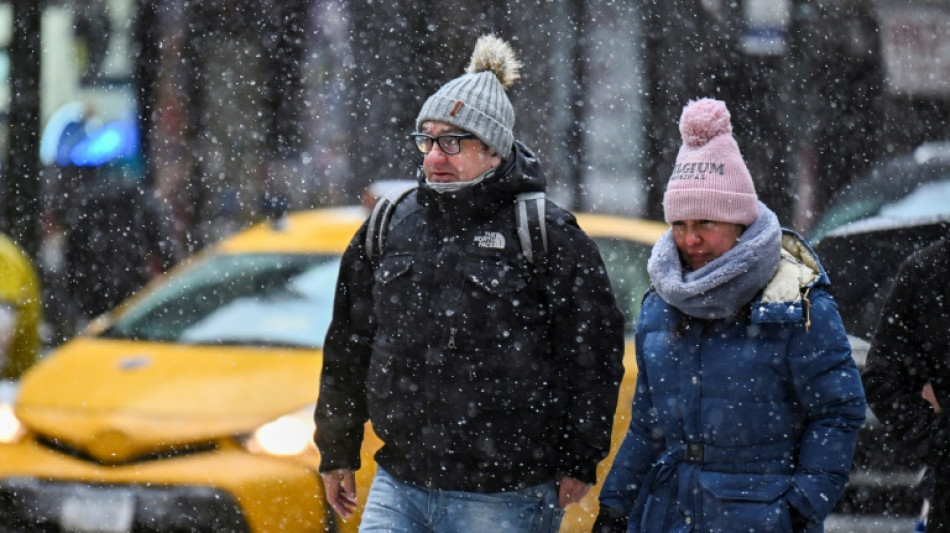
US braces for freezing weather fueled by polar vortex / Photo: ANGELA WEISS - AFP/File

 Kenya's economy faces climate change risks: World Bank

 Milei demands expulsion of foreigners expressing 'hate' against Argentina

 Italy's Po River valley on drought alert

 Prada profits pinched as growth hard to chase

 Stocks climb on earnings and rates, oil retreats

 US economic growth slows in second quarter, missing expectations

 Russia adds Telegram founder Durov to 'terrorist' blacklist

 Stocks diverge on earnings, as oil steadies

 Eurozone economy grows despite Middle East war

 Singapore group will develop 'most promising' Ebola vaccine

 Shell profit surges as Mideast war fuels oil prices

 Car maker Stellantis says back in profit in second quarter

 Samsung quarterly operating profit up 1,800% on AI boom

 South Korean stocks bounce after rout, oil holds gains on Mideast woes

 South Korea's women web sleuths fight AI deepfake porn

 Anything but programmable: New cost-efficient EC-power-supply-series for the DIN rail by CAMTEC PS

 Meta misses profit expectations, sticks to massive AI spending

 Campari - king of the spritz - hopes to conquer American heartland

 Air France-KLM and Lufthansa bid for Portugal's TAP airline

 Profits soar at Airbus as it delivers more planes

 Rheinmetall shares surge after armsmaker reports record profit
 FIFA hit by furious backlash over plans to sell stake in competitions

 MEXC Integrates World-Check to Fortify Institutional Grade Compliance Architecture
 Spain returns wildfire evacuees as France braces for worsening weather

 Russia seeks arrest of Telegram chief Durov

Americans were bracing Thursday for frigid temperatures that forecasters said could produce life-threatening conditions, with Donald Trump's inauguration expected to be the coldest in 40 years.
The bitter weather -- tied to an Arctic "polar vortex" blast -- is expected to bring nighttime lows as cold as minus 23 degrees Fahrenheit (minus 31 degrees Celsius) over the weekend for some of the northernmost parts of the United States.
President-elect Trump, who takes office Monday, will see his swearing-in ceremony in Washington hit by freezing temperatures and winds of up to 30 miles per hour.
"It's going to be pretty gusty," said Marc Chenard, a meteorologist at the National Weather Service (NWS).
He told AFP that a "few inches" of snow is forecast on Sunday in the US capital, which is still blanketed in ice from a winter storm earlier this month.
Trump's inauguration -- set to draw more than 200,000 visitors to Washington -- will go ahead under chilly conditions of no more than 21 degrees Fahrenheit (minus six degrees Celsius), according to the NWS.
If the forecast is correct, US media reported it will be the coldest inauguration since Ronald Reagan's in 1985, when the temperature was seven degrees Fahrenheit.
Chenard said central and eastern parts of the United States would face the most below average temperatures in the coming days, cooled by winds pushed south by a weakening of the polar vortex.
The polar vortex is an air mass above the North Pole, located high in the stratosphere. Humans dwell in the troposphere, and the stratosphere is just above it.
Chenard added that temperatures "could certainly be life-threatening" for some people who find themselves outdoors during the cold snap due to the risk of hypothermia.
While the link between global warming and heat waves is very direct, the behavior of winter storms is governed by complex atmospheric dynamics that are more difficult to study.
In December 2022, a fierce winter storm left at least 61 people dead in the United States, with some victims found outside and others in their homes or cars.
The latest temperature drop comes two weeks after parts of the country were blanketed by a large swath of snow and ice, contributing to at least five deaths and disrupting travel for millions.
Extreme weather has also struck the western United States, with Los Angeles ravaged by wildfires this month that left two dozen people dead and large areas of the city in ruins.
Conditions have since eased and firefighters have begun making progress to contain the blazes.
C.Smith--CPN