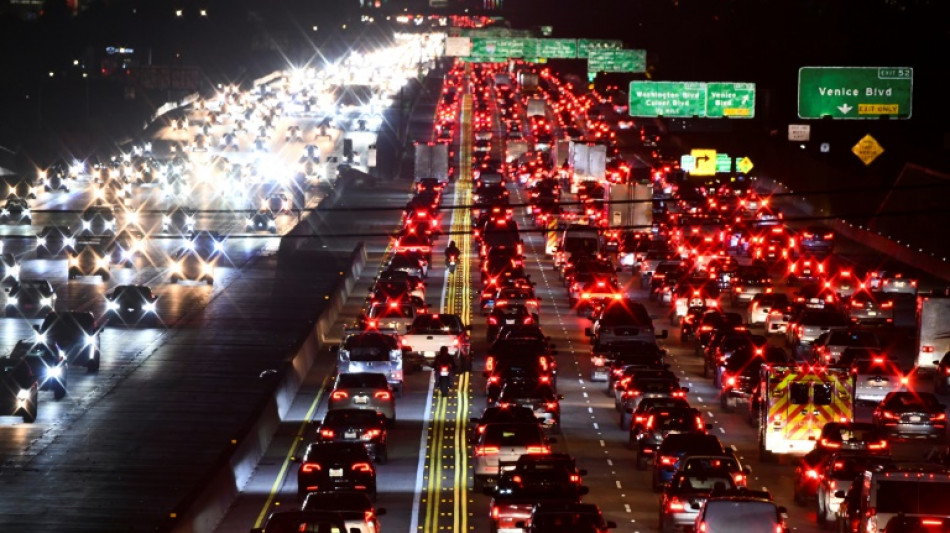
Global road transport emissions to peak in 2025: study / Photo: Patrick T. FALLON - AFP/File

 Kenya's economy faces climate change risks: World Bank

 Milei demands expulsion of foreigners expressing 'hate' against Argentina

 Italy's Po River valley on drought alert

 Prada profits pinched as growth hard to chase

 Stocks climb on earnings and rates, oil retreats

 US economic growth slows in second quarter, missing expectations

 Russia adds Telegram founder Durov to 'terrorist' blacklist

 Stocks diverge on earnings, as oil steadies

 Eurozone economy grows despite Middle East war

 Singapore group will develop 'most promising' Ebola vaccine

 Shell profit surges as Mideast war fuels oil prices

 Car maker Stellantis says back in profit in second quarter

 Samsung quarterly operating profit up 1,800% on AI boom

 South Korean stocks bounce after rout, oil holds gains on Mideast woes

 South Korea's women web sleuths fight AI deepfake porn

 Anything but programmable: New cost-efficient EC-power-supply-series for the DIN rail by CAMTEC PS

 Meta misses profit expectations, sticks to massive AI spending

 Campari - king of the spritz - hopes to conquer American heartland

 Air France-KLM and Lufthansa bid for Portugal's TAP airline

 Profits soar at Airbus as it delivers more planes

 Rheinmetall shares surge after armsmaker reports record profit

 FIFA hit by furious backlash over plans to sell stake in competitions

 MEXC Integrates World-Check to Fortify Institutional Grade Compliance Architecture

 Spain returns wildfire evacuees as France braces for worsening weather

 Russia seeks arrest of Telegram chief Durov

CO2 emissions from road transport could peak worldwide this year thanks to rapid growth in electric vehicles and stricter new regulations, a German think tank said Tuesday.
The International Council on Clean Transportation (ICCT) estimated that vehicle emissions would top out at around nine gigatonnes in 2025, a quarter-century earlier than previously predicted.
The volume of emissions would then decline to 7.1 gigatonnes in 2050, the ICCT calculated in a scenario based on environmental rules as of August 2024.
The organisation's previous forecast, which used regulatory conditions in 2021, predicted a peak in road transport emissions in 2050.
The quicker turnaround was due to changing regulations in major markets that required a higher share of zero-emissions vehicles (ZEVs), including battery-powered cars, in new sales, the ICCT said.
Progress in the number of cleaner vehicles already on the roads was "underpinned by the falling costs of ZEVs", the ICCT said.
The think tank, however, warned that a weakening of current environmental standards for road transport could lead to the peak being delayed.
The European Union for example has agreed to ban the sale of new petrol and diesel cars from 2035 but criticism of the plan has grown.
The target is increasingly under fire from Europe's struggling automotive industry and has become a bugbear of many far-right political parties in the bloc.
An increase in global vehicle activity or a slowdown in the sale of ZEVs could also delay the peak, the ICCT said.
While the difference between the two scenarios modelled by the think tank was already significant, yearly emissions would have to fall to 2.3 gigatonnes by 2050 to align with the Paris climate accords.
The climate deal set a target to limit global warming to well below 2 degrees Celsius above pre-industrial levels -- and to 1.5C if possible.
The ICCT included all emissions linked to road transport in its modelling, including vehicle production and fuel use.
D.Avraham--CPN