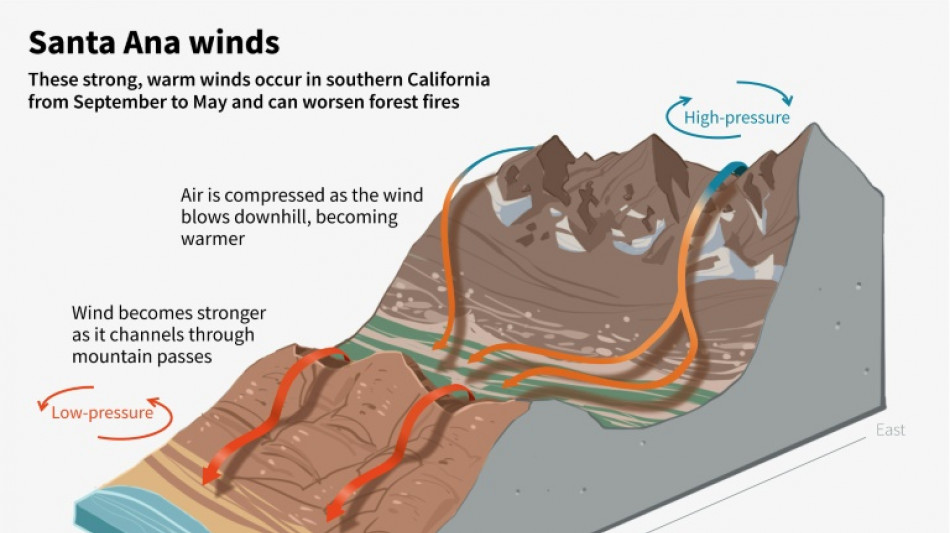
Fueling the Los Angeles fires: the Santa Ana winds / Photo: Jonathan WALTER, David LORY - AFP

 Kenya's economy faces climate change risks: World Bank

 Milei demands expulsion of foreigners expressing 'hate' against Argentina

 Italy's Po River valley on drought alert

 Prada profits pinched as growth hard to chase

 Stocks climb on earnings and rates, oil retreats

 US economic growth slows in second quarter, missing expectations

 Russia adds Telegram founder Durov to 'terrorist' blacklist

 Stocks diverge on earnings, as oil steadies

 Eurozone economy grows despite Middle East war
 Singapore group will develop 'most promising' Ebola vaccine
 Shell profit surges as Mideast war fuels oil prices

 Car maker Stellantis says back in profit in second quarter

 Samsung quarterly operating profit up 1,800% on AI boom
 South Korean stocks bounce after rout, oil holds gains on Mideast woes

 South Korea's women web sleuths fight AI deepfake porn

 Anything but programmable: New cost-efficient EC-power-supply-series for the DIN rail by CAMTEC PS

 Meta misses profit expectations, sticks to massive AI spending

 Campari - king of the spritz - hopes to conquer American heartland
 Air France-KLM and Lufthansa bid for Portugal's TAP airline

 Profits soar at Airbus as it delivers more planes

 Rheinmetall shares surge after armsmaker reports record profit
 FIFA hit by furious backlash over plans to sell stake in competitions

 MEXC Integrates World-Check to Fortify Institutional Grade Compliance Architecture
 Spain returns wildfire evacuees as France braces for worsening weather

 Russia seeks arrest of Telegram chief Durov

Helping drive the wildfires in the US city of Los Angeles are the so-called Santa Ana winds, a weather phenomenon known to dry out "the hills and the nerves to flash point."
The windstorms occur when cold air gathers in the neighboring states of Nevada and Utah. As it moves west and then rushes down California's mountains, it heats up -- and dries out.
- Creating fuel, spreading fires -
The Santa Anas can both create the conditions for deadly wildfires and fuel them once they are underway -- drying out vegetation when they blow through, and then fanning blazes once they spark.
As the 23,700-acre (9,500-hectare) Palisades Fire and 14,000-acre Eaton Fire have raged around Los Angeles, fast-moving winds have exacerbated the situation, throwing hot embers into new patches of dried brush.
While firefighters sought to take advantage of a brief lull on Friday and Saturday, heavy winds were back with gusts up to 70 miles per hour (110 kilometers per hour) by Sunday, with harsh conditions forecast to continue this week.
- Cold air, hot winds -
Santa Ana winds usually occur between September and May, typically for a few days at a time.
When a high-pressure system forms over the deserts to California's east, it pushes air toward the Pacific coast.
As they move down the Santa Ana and Sierra Nevada mountains and shoot through valleys, the winds compress -- creating a rise in their temperature and a drop in their relative humidity.
With hot, dry gusts that can knock down trees or kick up dust and particulate matter, the winds have long caused problems in southern California.
The 2017 Thomas Fire, which destroyed more than 1,000 structures, was fueled in part by back-to-back Santa Ana winds.
- Frayed nerves -
The Washington Post likened the weather pattern to "a giant hair dryer," and writers have long noted the effect the winds seem to have on residents psychologically.
American author Raymond Chandler once described them as so hot they "curl your hair and make your nerves jump and your skin itch."
For Joan Didion, they blew "sandstorms out along Route 66, drying the hills and nerves to flash point."
M.García--CPN