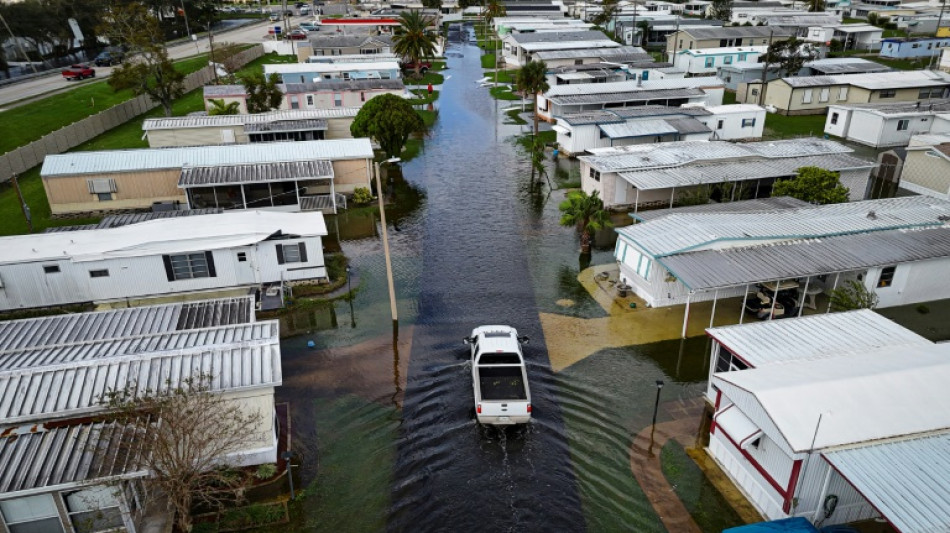
2024 warmest year on record for mainland US: agency / Photo: Miguel J. Rodriguez CARRILLO - AFP/File

 Three killed by storm in southern India

 Two hundred 'Cruise for life' passengers stranded in Cambodia

 Billionaire Ambani's Jio jumps 21% in market debut after record India IPO

 Sri Lanka's Tamil farmers fight to reclaim land after civil war

 'They don't care about us': Trump food aid cuts leave Americans struggling and angry

 Palestinian activist Khalil returns to Columbia after US detention

 Youths testify about 'despair' in unprecedented Canadian climate trial

 Storied Paris department store seeks bankruptcy protection

 Boeing shares tumble after it releases cautious growth forecast

 Boeing reports smaller loss as it aims for stable output growth

 Dangote, Nigeria's oil tycoon rewriting Africa's story

 Kane says Ballon d'Or win 'feels like a dream' as tributes pour in

 Mercedes-Benz cuts 2026 profit outlook on tough China market

Last year set a record for high temperatures across the mainland United States, with the nation also pummeled by a barrage of tornadoes and destructive hurricanes, the National Oceanic and Atmospheric Administration said in a report Friday.
The announcement came as Europe's climate monitor confirmed 2024 was the hottest year globally, with temperatures so extreme that the planet breached a critical climate threshold for the first time ever.
President-elect Donald Trump, a vocal climate skeptic, is just days away from taking office and has pledged to expand fossil fuel production -- the main driver of human-caused warming -- while rolling back the green policies of his predecessor, Joe Biden.
According to NOAA, the average annual temperature across the lower 48 states and Washington was 55.5 degrees Fahrenheit (13.1 degrees Celsius) -- 3.5F above average and the highest in the agency's 130-year records.
It was also the third-wettest year since 1895 and saw the second-highest number of tornadoes on record, trailing only 2004.
Annual precipitation totaled 31.6 inches (802.1 millimeters) -- 1.7 inches above average -- while 1,735 tornadoes struck amid a punishing Atlantic hurricane season that included Hurricane Helene, the second deadliest hurricane to hit the US mainland in more than half-a-century.
Wildfires scorched 8.8 million acres, 26 percent above the 20-year average. These included the devastating Park Fire in California, the state's fourth-largest on record, which consumed nearly 430,000 acres and destroyed over 600 structures.
In total, the United States experienced 27 billion-dollar weather and climate disasters, second only to the 28 recorded in 2023.
Weather extremes battered the country from all sides, with heavy rainfall mid-year and drought conditions covering 54 percent of the nation by October 29.
The last two years exceeded on average a critical warming limit for the first time as global temperatures soar "beyond what modern humans have ever experienced," the European Commission's Copernicus Climate Change Service confirmed Friday.
This does not mean the internationally-agreed target of holding warming to 1.5C above pre-industrial levels has been permanently breached, but it is drawing dangerously near.
Copernicus also confirmed that 2024 was the hottest year on record, surpassing 2023 and extending a streak of extraordinary heat that fuelled climate extremes on all continents.
A repeat in 2025 is considered less likely, with the onset of a La Nina weather system expected to offer slight relief.
China remains the world's largest current emitter, but the United States is historically the biggest polluter, underscoring its responsibility to confront the climate crisis, according to environmental advocates.
But progress remains tepid, with US greenhouse gas emissions dipping just 0.2 percent last year, according to a study by the Rhodium Group -- leaving the country dangerously off track to meet its climate goals under the Paris agreement.
Y.Ponomarenko--CPN