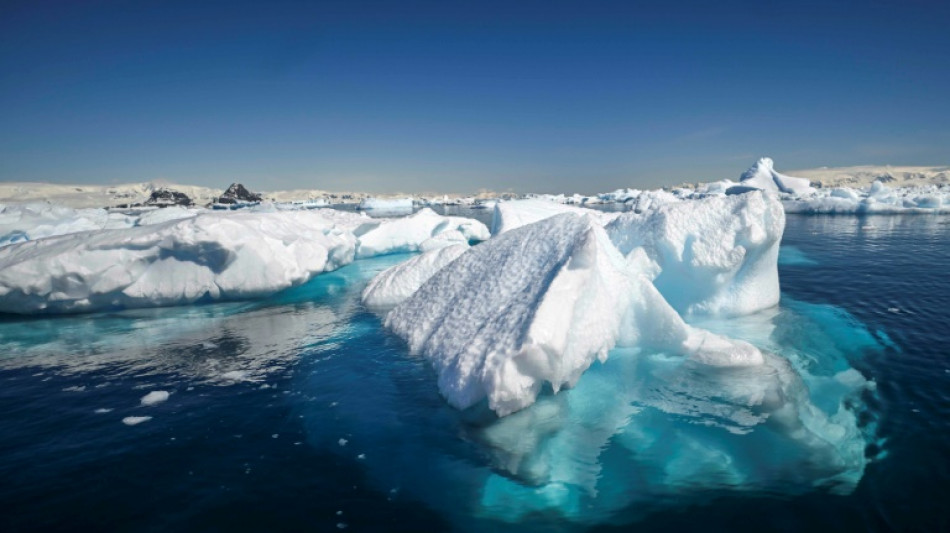
Antarctic sea ice rebounds from record lows: US scientists / Photo: Juan BARRETO - AFP

 Kenya's economy faces climate change risks: World Bank

 Milei demands expulsion of foreigners expressing 'hate' against Argentina

 Italy's Po River valley on drought alert

 Prada profits pinched as growth hard to chase

 Stocks climb on earnings and rates, oil retreats

 US economic growth slows in second quarter, missing expectations

 Russia adds Telegram founder Durov to 'terrorist' blacklist

 Stocks diverge on earnings, as oil steadies

 Eurozone economy grows despite Middle East war

 Singapore group will develop 'most promising' Ebola vaccine

 Shell profit surges as Mideast war fuels oil prices

 Car maker Stellantis says back in profit in second quarter

 Samsung quarterly operating profit up 1,800% on AI boom

 South Korean stocks bounce after rout, oil holds gains on Mideast woes

 South Korea's women web sleuths fight AI deepfake porn

 Anything but programmable: New cost-efficient EC-power-supply-series for the DIN rail by CAMTEC PS

 Meta misses profit expectations, sticks to massive AI spending

 Campari - king of the spritz - hopes to conquer American heartland

 Air France-KLM and Lufthansa bid for Portugal's TAP airline

 Profits soar at Airbus as it delivers more planes

 Rheinmetall shares surge after armsmaker reports record profit

 FIFA hit by furious backlash over plans to sell stake in competitions

 MEXC Integrates World-Check to Fortify Institutional Grade Compliance Architecture

 Spain returns wildfire evacuees as France braces for worsening weather

 Russia seeks arrest of Telegram chief Durov

Antarctic sea ice rebounded in December after a long period of record lows, US scientists said, giving pause to speculation that Earth's frozen continent could be undergoing a permanent change.
The rate of sea ice loss during the warmer spring months of November and December slowed to well below average, the US National Snow and Ice Data Center (NSIDC) said in a statement on Tuesday.
This followed a "prolonged period of record to near-record daily lows" in 2023 and 2024 -- the hottest years in the history books for global temperature rises driven by climate change.
By the end of 2024, Antarctic sea ice extent had recovered to 7.3 million square kilometres (2.8 million square miles) -- very close to the 1981 to 2010 average, NSIDC said.
This erased the record and near-record low extents of October and November, it added.
"This provides a sharp illustration of the high variability of Antarctic sea ice extent," NSIDC said.
Ocean temperature records -- both at the surface and deep below -- have tumbled since 2023, driven partly by an El Nino phenomenon that elevated heat around the globe.
Scientists have been concerned since mid-2016 that global warming could be setting in motion more lasting changes in how much sea ice forms around the world's coldest continent.
NSIDC said this "regime-shift idea" took hold particularly after a persistent stretch of below-average sea ice and "dramatic" records or near-records in 2017, 2023 and 2024.
"The recent slowdown in extent loss during December gives some pause to this idea", it said, though cautioned that a one-month rebound was not enough to contradict the theory outright.
Overall, sea ice concentrations in Antarctica remain "generally low over large areas of the pack", it added.
"This, combined with indications of a warm spring with high surface melting on the continent itself, will make for an interesting upcoming summer."
Y.Tengku--CPN