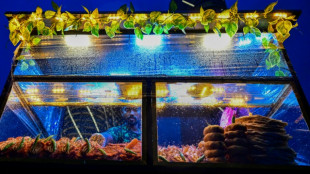
Brazil gears up for first climate conference in Amazon / Photo: Pablo PORCIUNCULA - AFP

 Three killed by storm in southern India

 Two hundred 'Cruise for life' passengers stranded in Cambodia

 Billionaire Ambani's Jio jumps 21% in market debut after record India IPO

 Sri Lanka's Tamil farmers fight to reclaim land after civil war

 'They don't care about us': Trump food aid cuts leave Americans struggling and angry

 Palestinian activist Khalil returns to Columbia after US detention

 Youths testify about 'despair' in unprecedented Canadian climate trial

 Storied Paris department store seeks bankruptcy protection

 Boeing shares tumble after it releases cautious growth forecast

 Boeing reports smaller loss as it aims for stable output growth

 Dangote, Nigeria's oil tycoon rewriting Africa's story

 Kane says Ballon d'Or win 'feels like a dream' as tributes pour in

 Mercedes-Benz cuts 2026 profit outlook on tough China market
After serving a customer a bowl of acai with fried fish in Belem's market, Sandra da Costa wipes her hands excitedly.
"Finally, the long-awaited renovation is going to happen," she says.
With 200 workers laboring seven days a week, the largest open-air market in Latin America reflects the transformation underway in the Brazilian city, which is preparing to host in November the first UN climate conference in the Amazon, a meeting called COP30.
But the challenge is immense for this northern metropolis of 1.3 million people, crisscrossed by canals.
It faces severe social inequality and lacks sufficient infrastructure, including accommodations for the 60,000 delegates expected to attend.
Record public investment is restoring monuments, transforming the abandoned port warehouses into leisure zones, and dredging the river bay to anchor two cruise ships, which will expand lodging options alongside two new hotels.
- Turning point -
"The COP30 will be a turning point for the city and the Amazon," says Igor Normando, the 37-year-old mayor, to AFP.
"The world will learn the challenges of the Amazonian people, and see that there is nothing fairer than helping us," says Normando atop the historic Forte do Presepio, overlooking an acai market where tons of the Amazonian fruit arrive every dawn.
The world's largest tropical rainforest is critical in the fight against climate change, but increasingly suffers its effects, with fires and droughts growing more severe each year.
Experts view the UN conference, set for November 10-21, as a crucial chance for humanity to reverse the warming trend with firm commitments to reduce global emissions and preserve the forest.
- 'Canopy of a tree' -
At the new Parque da Cidade, a former airfield where COP30 events will take place alongside the convention center for official negotiations, references to nature and Indigenous cultures abound.
Among the metal structures set to host culinary and craft hubs, native flora like rubber trees are being planted. Excavators are also working to prepare the site for a lake.
Replacing asphalt with green spaces in one of Brazil's least forested cities — despite it being in the Amazon — is another goal for local authorities.
The initiative gained momentum after President Luiz Inacio Lula da Silva declared in 2023 that COP30 meetings might even take place "under the canopy of a tree."
- 'Invisible City' -
Belem is "two cities: the one everyone will see, including heads of state; and another that is invisible," says historian Michel Pinho.
Max Moraes, a 56-year-old boatman from Vila da Barca, a stilt neighborhood struggling without basic sanitation while luxury apartment towers loom nearby, expresses outrage.
"Where is the money for the COP30 going? To help the population?" he asks skeptically while sitting on a wooden walkway above garbage floating in yellowish water.
Yet, in Vila da Barca, founded a century ago by fishermen and now coveted by real estate speculators, resistance is key, according to community leaders.
- 'Urban Amazon' -
"Our daily struggle is real," says Inez Medeiros, a 37-year-old teacher and social leader from the neighborhood. "We want the COP30 to consider us because we also live in the Amazon, even if it's an urban Amazon."
After more than two decades of delays, the city recently delivered 100 social housing units, finally providing some families with decent homes.
Each victory brings motivation, Medeiros says.
Her next challenge: launching a small floating hotel to host COP participants, offering them a firsthand view of Belem, "beyond the spotlight."
Y.Ibrahim--CPN