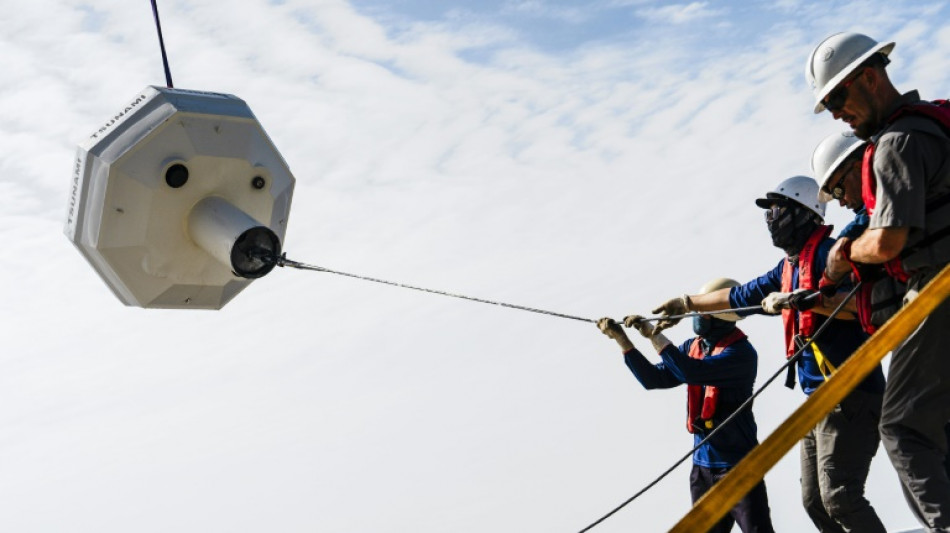
The tsunami detection buoys safeguarding lives in Thailand / Photo: Chanakarn Laosarakham - AFP

 Kenya's economy faces climate change risks: World Bank

 Apple tops estimates in CEO Cook's final quarter, but shares fall

 Milei demands expulsion of foreigners expressing 'hate' against Argentina

 Italy's Po River valley on drought alert

 Prada profits pinched as growth hard to chase

 Stocks climb on earnings and rates, oil retreats

 US economic growth slows in second quarter, missing expectations

 Russia adds Telegram founder Durov to 'terrorist' blacklist

 Stocks diverge on earnings, as oil steadies

 Eurozone economy grows despite Middle East war

 Singapore group will develop 'most promising' Ebola vaccine

 Shell profit surges as Mideast war fuels oil prices

 Car maker Stellantis says back in profit in second quarter

 Samsung quarterly operating profit up 1,800% on AI boom

 South Korean stocks bounce after rout, oil holds gains on Mideast woes

 South Korea's women web sleuths fight AI deepfake porn

 Anything but programmable: New cost-efficient EC-power-supply-series for the DIN rail by CAMTEC PS

 Meta misses profit expectations, sticks to massive AI spending

 Campari - king of the spritz - hopes to conquer American heartland

 Air France-KLM and Lufthansa bid for Portugal's TAP airline

 Profits soar at Airbus as it delivers more planes

 Rheinmetall shares surge after armsmaker reports record profit

 FIFA hit by furious backlash over plans to sell stake in competitions

 MEXC Integrates World-Check to Fortify Institutional Grade Compliance Architecture

 Spain returns wildfire evacuees as France braces for worsening weather

Almost 1,000 kilometres off the Thai coast devastated by a tsunami 20 years ago, engineers lower a detection buoy into the waves -- a key link in a warning system intended to ensure no disaster is as deadly again.
On December 26, 2004, a magnitude 9.1 earthquake under the Indian Ocean triggered a huge tsunami with waves up to 30 metres (100 feet) high.
Only a rudimentary warning system was in place at the time, with no way to alert the millions of people living around the Indian Ocean in advance. More than 225,000 people were killed in a dozen countries.
In the years following the disaster, multiple governments developed a global tsunami information system, building on the US National Oceanic and Atmospheric Administration's (NOAA) network of six detection buoys in the Pacific.
Known as Deep-Ocean Assessment and Reporting of Tsunamis (DART), the system now has 74 buoys around the world.
Each floats on the surface while tethered to the seabed, monitoring signals from a seismic sensor on the ocean floor and changes in the water level.
Installed in some of the toughest working environments anywhere on the planet, the battery-powered buoys must be replaced every two years. Only 50 of the devices are currently operational but the network has been designed to provide coverage regardless.
The Thai research vessel M.V. SEAFDEC crew gently lowered a replacement buoy -- a yellow cylinder about two metres in diameter -- this month into the Indian Ocean 965 kilometres (600 miles) offshore.
- Five-minute warning -
The same team also sought to replace a closer buoy in the Andaman Sea, 340 kilometres from the coast, but were unsuccessful and will mount a new mission in the coming weeks.
Shawn Stoeckley, a mechanical engineer from buoy manufacturers Science Applications International Corporation (SAIC), calibrates the system from his laptop on board before it is deployed.
"I feel that it has a lot of purpose, that it can save coastal lives," he told AFP.
The 2004 tsunami killed more than 5,000 people in Thailand, according to official figures, with 3,000 missing.
Now the country's two DART buoys are linked by satellite to a nationwide network of 130 alarm towers equipped with sirens and loudspeakers that can broadcast in five languages in coastal provinces.
Residents in disaster-prone areas also receive an SMS alert of an imminent tsunami, warning them to evacuate quickly.
Before 2004, it would take anywhere from 15 to 50 minutes before an alarm could be issued, says Laura Kong, director of UNESCO's International Tsunami Information Center.
"Today it's typical we would get something within five to seven minutes," she said.
One day, say UN experts, the system will prove essential.
There is a "100 percent chance" of another tsunami on the scale of 2004 at some point, Bernardo Aliaga, UNESCO's head of Tsunami Resilience Section, told an anniversary conference, adding it "could be tomorrow or in 50 years or 100 years".
- False alarms -
Mobile phones have become ubiquitous and disaster apps widely available in the years since the tsunami, but locals say the towers are still vital.
Songsil Nodharith, 51, head of Khuek Khak village, helped residents to evacuate "without even grabbing their belongings" during a night-time false alarm last year and urged authorities to ensure that the towers were well maintained.
In Sri Lanka -- where 31,000 were killed in 2004, making it the second-worst-hit country -- more than three-quarters of the 77 tsunami warning towers the government subsequently installed are not operating because the communications equipment has become obsolete, the island's Disaster Management Centre chief Udaya Herath told AFP.
Mobile phone companies have instead identified some 70,000 "key contacts" in coastal areas, including resort managers, to receive warnings and evacuation orders in the event of impending danger.
Warnings have occasionally set off panic in Thailand, with locals and tourists rushing for higher ground, but residents have faith in the system.
The fishing village of Ban Nam Khem saw Thailand's worst destruction in 2004, with trawlers swept onto houses and 800 residents killed.
Manasak Yuankaew, 48, now head of the village, lost four members of his family that day.
"We have a saying here," he told AFP. "Fleeing 100 times is better than not fleeing that one crucial time."
D.Avraham--CPN