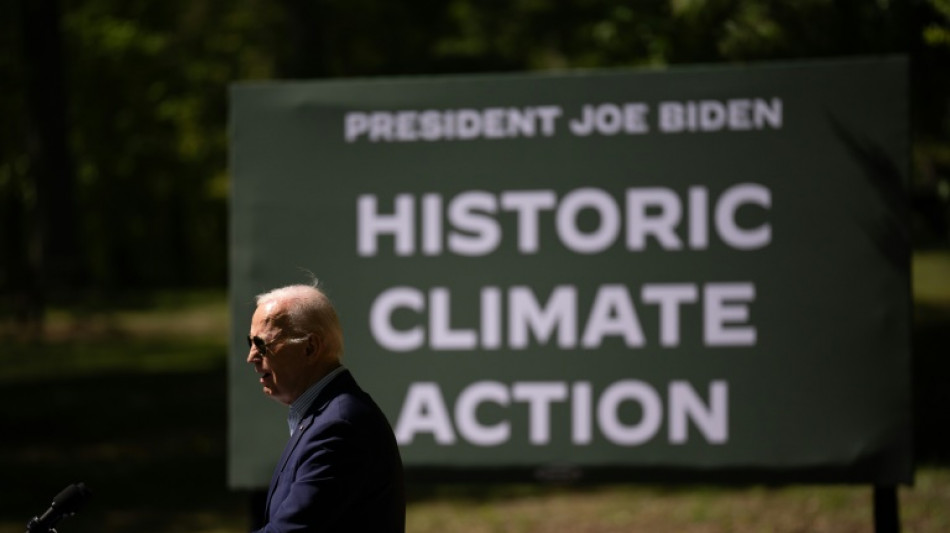
White House unveils new climate goals weeks before Trump's return / Photo: Andrew Harnik - GETTY IMAGES NORTH AMERICA/AFP/File

 Kenya's economy faces climate change risks: World Bank

 Apple tops estimates in CEO Cook's final quarter, but shares fall

 Milei demands expulsion of foreigners expressing 'hate' against Argentina

 Italy's Po River valley on drought alert

 Prada profits pinched as growth hard to chase

 Stocks climb on earnings and rates, oil retreats

 US economic growth slows in second quarter, missing expectations

 Russia adds Telegram founder Durov to 'terrorist' blacklist

 Stocks diverge on earnings, as oil steadies

 Eurozone economy grows despite Middle East war

 Singapore group will develop 'most promising' Ebola vaccine

 Shell profit surges as Mideast war fuels oil prices

 Car maker Stellantis says back in profit in second quarter

 Samsung quarterly operating profit up 1,800% on AI boom

 South Korean stocks bounce after rout, oil holds gains on Mideast woes

 South Korea's women web sleuths fight AI deepfake porn

 Anything but programmable: New cost-efficient EC-power-supply-series for the DIN rail by CAMTEC PS

 Meta misses profit expectations, sticks to massive AI spending

 Campari - king of the spritz - hopes to conquer American heartland

 Air France-KLM and Lufthansa bid for Portugal's TAP airline

 Profits soar at Airbus as it delivers more planes

 Rheinmetall shares surge after armsmaker reports record profit

 FIFA hit by furious backlash over plans to sell stake in competitions

 MEXC Integrates World-Check to Fortify Institutional Grade Compliance Architecture

 Spain returns wildfire evacuees as France braces for worsening weather

President Joe Biden's administration on Thursday unveiled a new climate target under the landmark Paris accord, just weeks before Donald Trump's return to the White House threatens to upend US efforts to combat global warming.
According to a White House Statement, the United States commits to reducing economy-wide greenhouse gas emissions by 61-66 percent below 2005 levels by 2035, reflecting the world's second-largest polluter's goal of limiting long-term heating to 1.5 degrees Celsius.
"I'm proud that my administration is carrying out the boldest climate agenda in American history," Biden said in a video statement hailing the new measures, aimed at keeping the United States on the path to net zero emissions by 2050.
"We will turn this existential threat into a once-in-a-generation opportunity to transform our nation for generations to come."
But his climate legacy hangs in the balance, with Trump's second term expected to bring sweeping rollbacks of environmental protections and a retreat from international commitments, including the Paris agreement, mirroring his first term.
"In his first term, President Trump advanced conservation and environmental stewardship while promoting economic growth for families," Trump-Vance transition spokeswoman Karoline Leavitt said in a statement to AFP.
She added Trump's policies "produced affordable, reliable energy for consumers along with stable, high-paying jobs" and vowed that his second term "will once again deliver clean air and water for American families while Making America Wealthy Again."
- States and businesses to the rescue?
In a call with reporters, Biden's global climate envoy John Podesta acknowledged that while Trump "may put climate action on the back burner," he remained confident in the private sector and state and local governments to drive progress.
"That's not wishful thinking -- it's happened before," he stressed.
Environmental groups broadly welcomed the new targets, which were due before a deadline in February and include a commitment to reduce emissions of super polluting methane by 35 percent by 2035.
"This provides an important rallying point and benchmark for forward-looking states, cities, and businesses that understand addressing climate change is good for the economy," Rachel Cleetus of the Union of Concerned Scientists told AFP.
"Even though the Trump administration may not lift a finger to deliver on this plan, it sets a north star for what the US should be aiming for," added Debbie Weyl of the World Resources Institute.
- Bold record, with caveats -
Biden's administration arguably pursued the most ambitious climate agendas in US history, marked by rejoining the Paris agreement, passing the Inflation Reduction Act with record clean energy investments, and committing to protecting 30 percent of land and water by 2030.
Yet critics point to the contradiction of the US maintaining its status as the world's largest fossil fuel producer, complicating efforts to lead on global climate action.
While China is the world's largest emitter, the United States remains the largest historic polluter, amplifying its responsibility to address the climate crisis, environmentalists argue.
Despite progress, the US remains off-track to meet its current 2030 target of reducing emissions by 50-52 percent below 2005 levels.
A recent report by the independent Rhodium Group said the United States was on track to achieve only a 32-43 percent reduction by 2030, though a senior Biden administration official said their own estimate "now reaches up to 45-46 percent."
Meanwhile, the European Union -- the world's fourth largest emitter -- is debating a 90 percent reduction by 2040 over 1990 levels, but will likely miss a February UN deadline to file its revised climate roadmap.
Neil Makaroff, an analyst at the Strategic Perspectives think tank specializing in climate transition, said the European Union is "behind schedule" in presenting its Nationally Determined Contribution (NDC) and is "unlikely to fit into the UN timetable".
Market trends and falling renewable energy costs may limit backsliding under Trump, but Cleetus cautioned against complacency, highlighting concerns about fossil fuel expansion.
"Regardless of the politics, the science and what's happening in the world are very clear," she said, noting that 2024 is on track to be the hottest year on record as climate catastrophes mount.
Even if Trump withdraws the United States from the Paris Agreement on his first day back, the process takes a year.
In the meantime, his administration could revise or simply ignore the US NDC -- the voluntary pledge underpinning Washington's climate commitments to the United Nations.
H.Müller--CPN