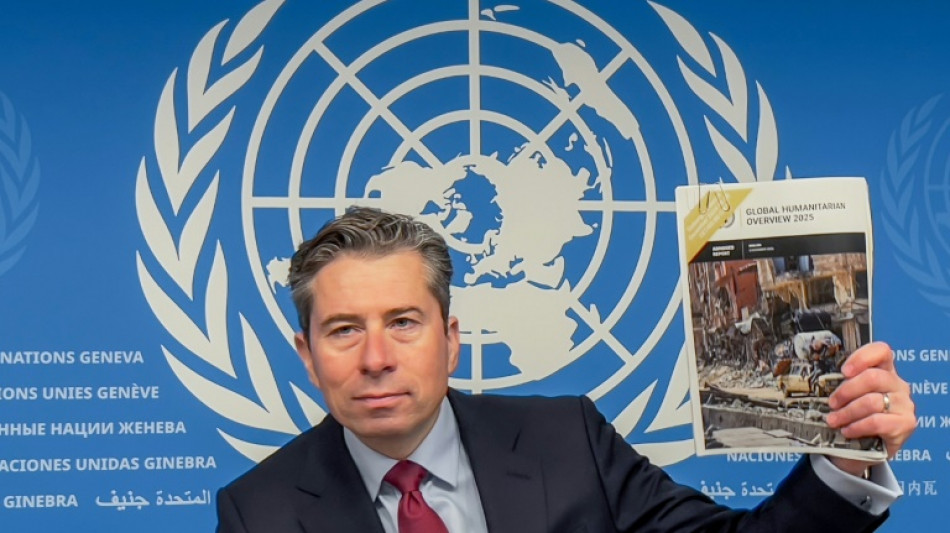
'World on fire': UN seeks $47 bn for aid in 2025 / Photo: Elodie LE MAOU - AFP

 Kenya's economy faces climate change risks: World Bank

 Apple tops estimates in CEO Cook's final quarter, but shares fall

 Milei demands expulsion of foreigners expressing 'hate' against Argentina

 Italy's Po River valley on drought alert

 Prada profits pinched as growth hard to chase

 Stocks climb on earnings and rates, oil retreats

 US economic growth slows in second quarter, missing expectations

 Russia adds Telegram founder Durov to 'terrorist' blacklist

 Stocks diverge on earnings, as oil steadies

 Eurozone economy grows despite Middle East war

 Singapore group will develop 'most promising' Ebola vaccine

 Shell profit surges as Mideast war fuels oil prices

 Car maker Stellantis says back in profit in second quarter

 Samsung quarterly operating profit up 1,800% on AI boom

 South Korean stocks bounce after rout, oil holds gains on Mideast woes

 South Korea's women web sleuths fight AI deepfake porn

 Anything but programmable: New cost-efficient EC-power-supply-series for the DIN rail by CAMTEC PS

 Meta misses profit expectations, sticks to massive AI spending

 Campari - king of the spritz - hopes to conquer American heartland

 Air France-KLM and Lufthansa bid for Portugal's TAP airline

 Profits soar at Airbus as it delivers more planes

 Rheinmetall shares surge after armsmaker reports record profit

 FIFA hit by furious backlash over plans to sell stake in competitions

 MEXC Integrates World-Check to Fortify Institutional Grade Compliance Architecture

 Spain returns wildfire evacuees as France braces for worsening weather

The UN on Wednesday appealed for more than $47 billion to deliver vital aid next year in a world ravaged by surging conflicts and the climate crisis, but warned many in need would not be reached.
"The world is on fire," the United Nations' new humanitarian chief Tom Fletcher told reporters in Geneva, acknowledging he was looking ahead to 2025 with "dread".
With brutal conflicts spiralling in places like Gaza, Sudan and Ukraine, and as climate change and extreme weather take an ever-heavier toll, the UN estimated that 305 million people globally will need some form of emergency assistance next year.
"We are dealing with a poly-crisis right now globally, and it is the most vulnerable people in the world who are paying the price," Fletcher said, warning that swelling inequality combined with the convergence of conflict and climate change had created a "perfect storm" of needs.
Launching the Global Humanitarian Overview, Fletcher acknowledged that the UN and its partners would not be able to reach all of those in need.
The annual appeal by UN agencies and partner humanitarian organisations is seeking $47.4 billion for 2025 -- slightly less than the appeal for this year -- which it said was enough to provide assistance to the 189.5 million most vulnerable people.
"There's 115 million that we won't be able to reach" with this plan, Fletcher acknowledged.
- 'Ruthless' -
Pointing to significant "donor fatigue" hitting humanitarian operations, he stressed the need for a "realistic" plan, which required prioritisation and making "really tough, tough choices".
"We've got to be absolutely focused on reaching those in the most dire need, and really ruthless."
As of last month, only 43 percent of the $50 billion appeal for this year had been met.
Underfunding this year has seen an 80-percent reduction in food assistance in Syria, cuts to protection services in Myanmar, and diminished water and sanitation aid in cholera-prone Yemen, the UN said.
Camilla Waszink of the Norwegian Refugee Council described the appeal's acknowledgement that millions would not be reached as "devastating".
"When the richest people on Earth can go to space as a tourist and trillions of US dollars are used annually on global military expenditure, it is incomprehensible that we as an international community are unable to find the necessary funding to provide displaced families with shelter and prevent children from dying of hunger," she said.
- 'Under attack' -
Even more than funding woes, Fletcher said the biggest barrier to assisting and protecting people in armed conflict was the widespread violation of international law.
This year has already been the deadliest for humanitarian workers, surpassing the 2023 toll of 280 killed.
The global humanitarian system "is overstretched, it's underfunded and it's literally under attack", he said.
Meanwhille, fears abound that Donald Trump's looming return to the presidency in the United States -- the world's largest humanitarian donor -- could see aid agency budgets cut further.
Fletcher said he planned to spend "a lot of time in Washington" in the coming months to engage with the new administration.
But the "much tougher global climate (is) not just about America", Fletcher said.
- 'Unconscionable' -
A record 123 million people were living displaced from their homes due to conflict by mid-2024, while one in every five children globally is currently living in or fleeing conflict zones, according to UN figures.
"The suffering behind the numbers is all the more unconscionable for being man-made," Fletcher said.
"Wars in Gaza, Sudan and Ukraine are marked by the ferocity and intensity of the killing, the complete disregard for international law, and the deliberate obstruction of our humanitarian movement's effort to save lives."
Numerous old crises remain unresolved, with average humanitarian operations now spanning a decade, the UN said.
"The longer they last, the bleaker the prospects," Fletcher warned.
Even more worryingly, he said, was how conflicts were increasingly converging with the climate-induced disasters that are ravaging communities, devastating food systems and driving mass displacement.
T.Morelli--CPN