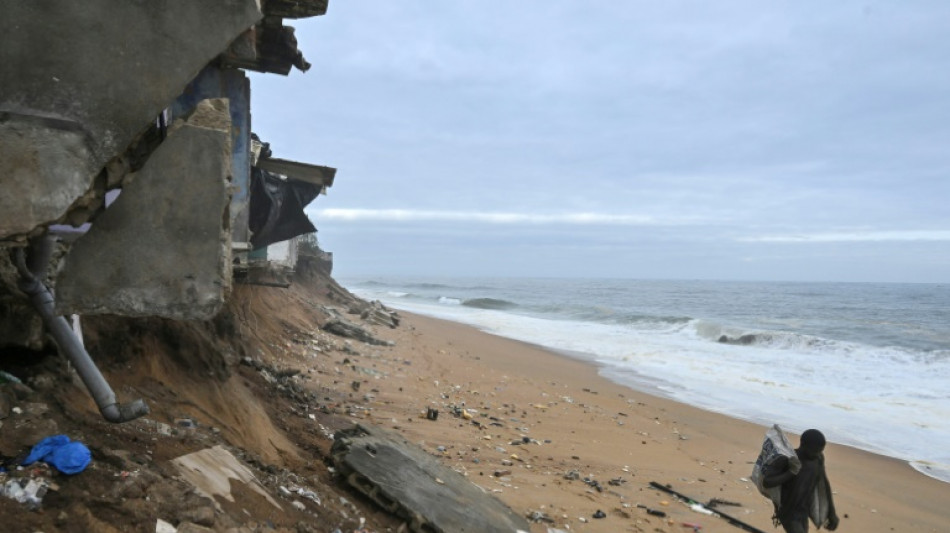
Landmark climate case to open at top UN court / Photo: Issouf SANOGO - AFP

 Kenya's economy faces climate change risks: World Bank

 Apple tops estimates in CEO Cook's final quarter, but shares fall

 Milei demands expulsion of foreigners expressing 'hate' against Argentina

 Italy's Po River valley on drought alert

 Prada profits pinched as growth hard to chase

 Stocks climb on earnings and rates, oil retreats

 US economic growth slows in second quarter, missing expectations

 Russia adds Telegram founder Durov to 'terrorist' blacklist

 Stocks diverge on earnings, as oil steadies

 Eurozone economy grows despite Middle East war
 Singapore group will develop 'most promising' Ebola vaccine

 Shell profit surges as Mideast war fuels oil prices
 Car maker Stellantis says back in profit in second quarter

 Samsung quarterly operating profit up 1,800% on AI boom

 South Korean stocks bounce after rout, oil holds gains on Mideast woes

 South Korea's women web sleuths fight AI deepfake porn

 Anything but programmable: New cost-efficient EC-power-supply-series for the DIN rail by CAMTEC PS

 Meta misses profit expectations, sticks to massive AI spending

 Campari - king of the spritz - hopes to conquer American heartland
 Air France-KLM and Lufthansa bid for Portugal's TAP airline

 Profits soar at Airbus as it delivers more planes

 Rheinmetall shares surge after armsmaker reports record profit
 FIFA hit by furious backlash over plans to sell stake in competitions

 MEXC Integrates World-Check to Fortify Institutional Grade Compliance Architecture

 Spain returns wildfire evacuees as France braces for worsening weather

The United Nations' top court will start unprecedented hearings on Monday aimed at setting legal guidelines for how countries should protect the planet against climate change and help vulnerable nations combat its devastating impact.
Representatives from Vanuatu and other low-lying at-risk islands in the Pacific Ocean will open marathon proceedings at the International Court of Justice at 10:00 am (0900 GMT) before a 15-judge panel.
Over the course of the next two weeks, more than 100 countries and organisations will make submissions on the topic, the highest number ever before the Hague-based court.
Activists hope that the opinion from the ICJ's judges will have far-reaching legal consequences in the fight against climate change.
Others fear the UN-backed request for a non-binding advisory opinion will have limited impact -- and it could take the UN's highest court months, or even years, to deliver.
The hearings at the scenic Peace Palace come days after a bitterly negotiated climate deal at the COP29 summit in Azerbaijan.
Wealthy polluting countries ultimately agreed to find at least $300 billion a year by 2035 to help poorer nations transition to cleaner energy sources and prepare for increasing climate impacts such as extreme weather.
Developing countries condemned the pledge as too little, too late, and the summit's final deal failed to include a global pledge to move away from burning planet-heating fossil fuels.
- 'Pivotal moment' -
"We are on the frontline of climate change impact," said Ralph Regenvanu, special envoy for Vanuatu, which has been driving the ICJ initiative along with neighbouring island states.
"Our call for an advisory opinion from the ICJ on climate change is at a pivotal moment... one that sets clear the international legal obligations for climate action," he told journalists ahead of the hearings.
The UN General Assembly adopted a resolution last year that referred two key climate questions to the international judges.
Firstly, it asked, what obligations do states have under international law to protect the Earth's climate system from pollutant greenhouse gas emissions?
Secondly, what are the legal consequences of these obligations in cases where states, "by their acts and omissions, have caused significant harm to the climate system and other parts of the environment"?
The second question also was linked to the legal responsibilities states have for harm caused by climate change to small, more vulnerable countries and their populations.
This applies especially to countries under threat from rising sea levels and harsh weather patterns in places like the Pacific Ocean.
- Record high emissions -
Joie Chowdhury, a senior lawyer at the US- and Swiss-based Center for International Environmental Law, said climate advocates did not expect the ICJ's opinion "to provide very specific answers".
Instead, she predicted the court would provide "a legal blueprint... on which more specific questions can be decided".
The judges' opinion, which she expected some time next year, "will inform climate litigation on domestic, national and international levels".
Some of the world's largest carbon polluters -- including the world's top three greenhouse gas emitters, China, the United States and India -- will be among the 98 countries and 12 organisations expected to make submissions to the court.
The world agreed in 2015 to try and limit global heating to 1.5 degrees Celsius above pre-industrial levels.
But it did not prescribe how to achieve that and it is nowhere near on track.
Preliminary scientific data from the Global Carbon Project, published during the COP29 negotiations, showed emissions of carbon dioxide (CO2) caused by burning fossil fuels like coal, oil and gas rose this year to a new record high.
Y.Tengku--CPN