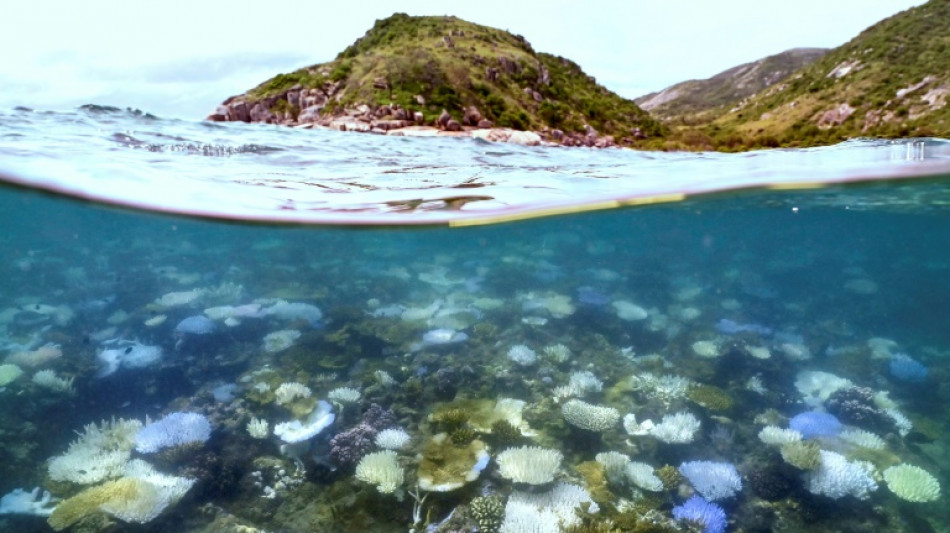
COP16 biodiversity talks to restart in February: UN / Photo: DAVID GRAY - AFP/File

 Kenya's economy faces climate change risks: World Bank

 Apple tops estimates in CEO Cook's final quarter, but shares fall

 Milei demands expulsion of foreigners expressing 'hate' against Argentina

 Italy's Po River valley on drought alert

 Prada profits pinched as growth hard to chase

 Stocks climb on earnings and rates, oil retreats

 US economic growth slows in second quarter, missing expectations

 Russia adds Telegram founder Durov to 'terrorist' blacklist

 Stocks diverge on earnings, as oil steadies

 Eurozone economy grows despite Middle East war

 Singapore group will develop 'most promising' Ebola vaccine

 Shell profit surges as Mideast war fuels oil prices

 Car maker Stellantis says back in profit in second quarter

 Samsung quarterly operating profit up 1,800% on AI boom

 South Korean stocks bounce after rout, oil holds gains on Mideast woes

 South Korea's women web sleuths fight AI deepfake porn

 Anything but programmable: New cost-efficient EC-power-supply-series for the DIN rail by CAMTEC PS

 Meta misses profit expectations, sticks to massive AI spending

 Campari - king of the spritz - hopes to conquer American heartland
 Air France-KLM and Lufthansa bid for Portugal's TAP airline

 Profits soar at Airbus as it delivers more planes

 Rheinmetall shares surge after armsmaker reports record profit

 FIFA hit by furious backlash over plans to sell stake in competitions

 MEXC Integrates World-Check to Fortify Institutional Grade Compliance Architecture
 Spain returns wildfire evacuees as France braces for worsening weather

Crunch United Nations talks to find funding to curb the destruction of nature will resume in Rome in February, the UN said on Thursday, after negotiations this month in Colombia ended without a deal.
The largest summit yet on biodiversity -- the so-called COP16 talks in Cali, Colombia -- were aimed at boosting efforts to protect nature from deforestation, overexploitation, climate change and pollution.
But the meeting, which stretched hours into extra time, ended on November 2 with no agreement on a roadmap to ramp up funding for species protection. Many delegates had already left for home by then, meaning the Colombian presidency was unable to establish a quorum.
The new round of talks will be held at the headquarters of the UN's Food and Agriculture Organization from February 25 to 27 to tackle issues "left unresolved following the suspension of the meeting", the UN said in a statement.
"In the weeks to come, and during our meeting in Rome this February, I will work alongside parties to build the trust and consensus needed to achieve Peace with Nature," said Colombia's Environment Minister Susana Muhamad, the COP16 president.
She added that securing a key financial accord "will be central to our efforts".
Money has been a particularly thorny subject at recent UN environment negotiations, as nations face global political and economic uncertainties.
Negotiators at fractious UN climate talks were able to approve a deal in the early hours of Sunday morning after two weeks of chaotic and bitter wrangling, but the $300 billion a year pledge from wealthy historic polluters was immediately dismissed as insultingly low by many poorer nations.
- Deadlocked -
The Cali summit, which drew an unprecedented 23,000 participants, was tasked with assessing, and ramping up, progress toward reaching a range of targets set in Canada two years ago to halt humankind's rapacious destruction of the natural world by 2030.
They include placing 30 percent of land and sea areas under protection, reducing pollution, and phasing out agricultural and other subsidies harmful to nature.
For this purpose, it was agreed in 2022 that $200 billion per year be made available to protect biodiversity by 2030, including the transfer of $30 billion per year from rich to poor nations.
The Cali meeting did make advances on Indigenous representation and gene profit sharing.
But negotiators, largely split between poor and rich country blocs, were deadlocked over the biggest ask -- to lay out a detailed funding plan.
That was despite new research showing that more than a quarter of assessed plants and animals are now at risk of extinction.
Only 17.6 percent of land and inland waters, and 8.4 percent of the ocean and coastal areas, are estimated to be protected and conserved.
Ng.A.Adebayo--CPN