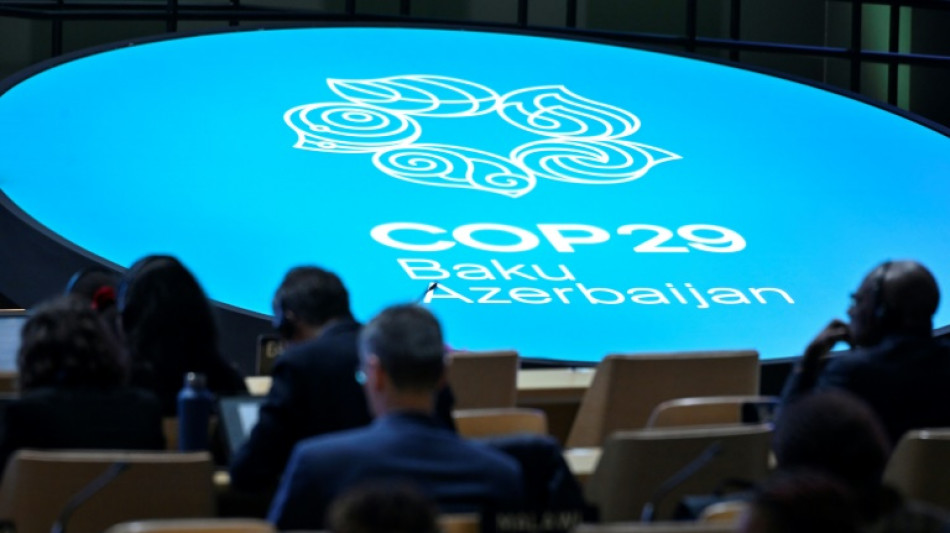
Nations race to land climate deal as COP29 draft rejected / Photo: Alexander NEMENOV - AFP

 Kenya's economy faces climate change risks: World Bank

 Apple tops estimates in CEO Cook's final quarter, but shares fall

 Milei demands expulsion of foreigners expressing 'hate' against Argentina

 Italy's Po River valley on drought alert

 Prada profits pinched as growth hard to chase

 Stocks climb on earnings and rates, oil retreats

 US economic growth slows in second quarter, missing expectations

 Russia adds Telegram founder Durov to 'terrorist' blacklist

 Stocks diverge on earnings, as oil steadies

 Eurozone economy grows despite Middle East war

 Singapore group will develop 'most promising' Ebola vaccine

 Shell profit surges as Mideast war fuels oil prices

 Car maker Stellantis says back in profit in second quarter

 Samsung quarterly operating profit up 1,800% on AI boom

 South Korean stocks bounce after rout, oil holds gains on Mideast woes

 South Korea's women web sleuths fight AI deepfake porn

 Anything but programmable: New cost-efficient EC-power-supply-series for the DIN rail by CAMTEC PS

 Meta misses profit expectations, sticks to massive AI spending

 Campari - king of the spritz - hopes to conquer American heartland

 Air France-KLM and Lufthansa bid for Portugal's TAP airline

 Profits soar at Airbus as it delivers more planes

 Rheinmetall shares surge after armsmaker reports record profit
 FIFA hit by furious backlash over plans to sell stake in competitions

 MEXC Integrates World-Check to Fortify Institutional Grade Compliance Architecture
 Spain returns wildfire evacuees as France braces for worsening weather
A fresh draft of a climate pact unveiled Thursday at COP29 failed to break an impasse between nations, with negotiators racing against the clock to broker a trillion-dollar finance agreement.
The UN climate summit is scheduled to conclude on Friday but the latest draft deal released by hosts Azerbaijan was spurned by rich and poor countries alike.
The main priority at COP29 is agreeing a new target to replace the $100 billion a year that rich nations pledged for poorer ones to fight climate change.
Developing countries plus China, an influential negotiating bloc, are pushing for $1.3 trillion by 2030 and want at least $500 billion of that from developed nations.
Major contributors like the European Union have baulked at such demands, and insist private sector money would be needed to meet a larger goal.
The latest draft recognises that developing countries need a commitment of at least "USD [X] trillion" per year, but omits the concrete figure sought in Baku.
"There is a critical piece of this puzzle missing: the overall number," said Cedric Schuster, the Samoan chairman of the Alliance of Small Island States (AOSIS), a group of nations at threat from rising seas.
"The time for political games is over."
Ali Mohamed, the chair of the African Group of Negotiators, another important bloc, said the "elephant in the room" was the figure.
"This is the reason we are here... but we are no closer and we need the developed countries to urgently engage on this matter," said Mohamed, who is also Kenya's climate envoy.
COP29 hosts Azerbaijan said a "shorter" draft would be unveiled Thursday evening and would "contain numbers".
- 'Unacceptable' -
Other major sticking points -- including who contributes and how the money is raised and delivered -- were also left unresolved in the slimmed-down 10-page document.
Many nations also said the text failed to reflect the need to phase out coal, oil and gas -- the main drivers of global warming.
Australian climate minister Chris Bowen said countries had "hidden, pared back or minimised" explicit references to fossil fuels.
"This is a big step back, and is not acceptable at this current moment of crisis," he said.
As the clock ticks down, frustration boiled over at the COP29 hosts.
"Could I please -- could I please -- urge you to step up the leadership?" EU climate commissioner Wopke Hoekstra said in pointed remarks.
"I'm not going to sugarcoat it. I'm really sorry to say, but the text we now have in front of us -- in our view -- is imbalanced, unworkable and unacceptable."
COP29 lead negotiator Yalchin Rafiyev appealed for "compromise and solidarity".
"This is a moment where you need to put all your cards on the table," he told delegates, stressing there was "a long way to go".
Ireland's climate minister Eamon Ryan insisted negotiations were "advancing" behind the scenes.
"This text is not the final text, that is clear. It will be quite radically different. But I think there is room for further agreement," he told AFP.
Norway's climate minister also offered a rosier view: "The deadline isn't here yet," he told AFP.
- 'Blank paper' -
Landing a deal on finance for poorer countries was meant to be the centrepiece of COP29.
But the draft entrenches the broad and opposing positions of developed and developing countries that have largely persisted since COP29 opened over a week ago.
Developed countries want all sources of finance, including public money and private investment, counted toward the goal, and for wealthy countries not obligated to pay, like China, to chip in.
Developing countries want the money to mostly come from government budgets of richer nations in the form of grants or money without strings attached, not loans that add to national debt.
The EU and the United States, two of the biggest providers of climate finance, have refused to put forward a figure without the finer points of the pact.
That was an "insult" for the millions of people imperilled by climate disaster, said Greenpeace's Jasper Inventor.
Mohamed Adow, a Kenyan climate activist, said developing countries "need a cheque but all we have right now is a blank piece of paper".
S.F.Lacroix--CPN