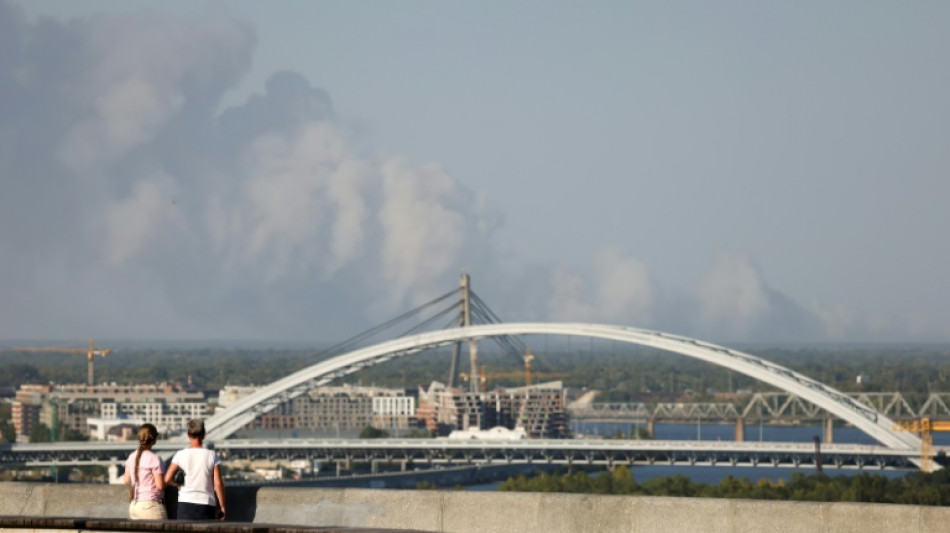
Russian invasion toll on environment $71 billion, Ukraine says / Photo: Anatolii STEPANOV - AFP/File

 Kenya's economy faces climate change risks: World Bank

 Apple tops estimates in CEO Cook's final quarter, but shares fall

 Milei demands expulsion of foreigners expressing 'hate' against Argentina

 Italy's Po River valley on drought alert

 Prada profits pinched as growth hard to chase

 Stocks climb on earnings and rates, oil retreats

 US economic growth slows in second quarter, missing expectations

 Russia adds Telegram founder Durov to 'terrorist' blacklist

 Stocks diverge on earnings, as oil steadies

 Eurozone economy grows despite Middle East war

 Singapore group will develop 'most promising' Ebola vaccine

 Shell profit surges as Mideast war fuels oil prices

 Car maker Stellantis says back in profit in second quarter

 Samsung quarterly operating profit up 1,800% on AI boom

 South Korean stocks bounce after rout, oil holds gains on Mideast woes

 South Korea's women web sleuths fight AI deepfake porn

 Anything but programmable: New cost-efficient EC-power-supply-series for the DIN rail by CAMTEC PS

 Meta misses profit expectations, sticks to massive AI spending

 Campari - king of the spritz - hopes to conquer American heartland

 Air France-KLM and Lufthansa bid for Portugal's TAP airline

 Profits soar at Airbus as it delivers more planes

 Rheinmetall shares surge after armsmaker reports record profit

 FIFA hit by furious backlash over plans to sell stake in competitions

 MEXC Integrates World-Check to Fortify Institutional Grade Compliance Architecture

 Spain returns wildfire evacuees as France braces for worsening weather

Russia's invasion of Ukraine has caused $71 billion in environmental damage and led to a surge in greenhouse gas emissions, the Ukrainian government told the COP29 summit in Baku.
"Nature during this war is like a silent victim," said Svitlana Grynchuk, Ukraine's minister of environmental protection and natural resources.
The climate impact, especially through destruction of forests that naturally balance carbon emissions, shows that the consequences of the war are "not just for Ukraine, but for the global community," she told reporters.
Grynchuk said the Ukrainian government estimated that the war has cost $71 billion in environmental damage and led to the equivalent of some 180 million tons of carbon emissions.
The UN Development Programme a year ago had put environmental damage from the war at $56 billion.
In the latest Ukrainian estimation, military activities themselves have caused 51.6 million tons of carbon emissions since Russia's invasion in February 2022, with another 56 million tied to needs to restore infrastructure after the war.
Among other top contributors, fires were blamed for 27.2 million in carbon emission equivalent.
Grynchuk said that the invasion has damaged three million hectares (11,500 square miles) of forest, which she noted was larger than many countries' entire forested area.
Her remarks come as Russia decimates energy facilities in new aerial bombardments across Ukraine, plunging millions into darkness.
Both Russia and Ukraine have stepped up attacks as they anticipate a shift in the crucial US support for Kyiv once Donald Trump returns to the White House in two months.
Grynchuk said that Ukraine was cognisant of climate as it rebuilds, with small-scale renewable energy projects seen as more sustainable in the face of the threat from Russia.
"All Ukrainians during a very short period of time have become very energy-efficient," she said.
Ukraine, which aspires to enter the European Union, has committed to a bloc-wide goal of net-zero greenhouse gas emissions by 2050.
X.Wong--CPN