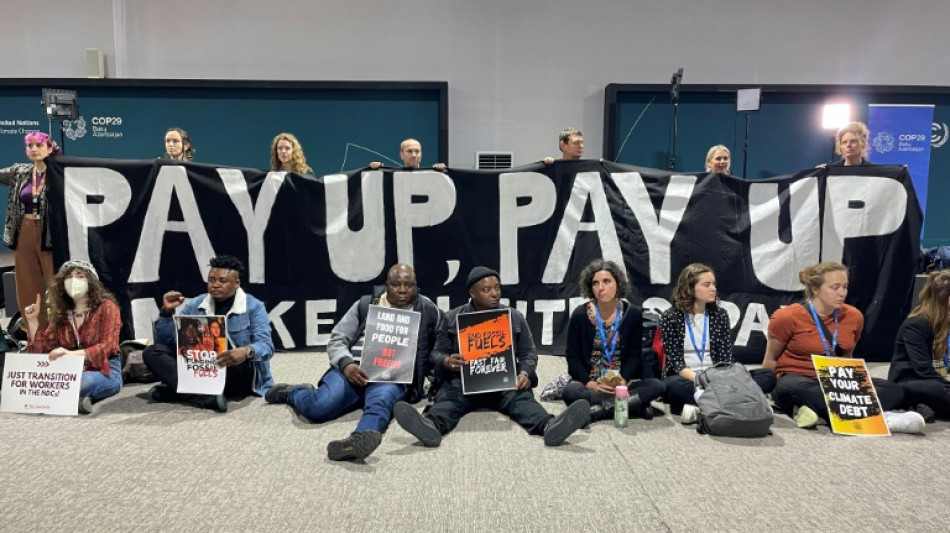
COP29 negotiators strive for deal after G20 'marching orders' / Photo: Laurent THOMET - AFP/File

 Kenya's economy faces climate change risks: World Bank

 Apple tops estimates in CEO Cook's final quarter, but shares fall

 Milei demands expulsion of foreigners expressing 'hate' against Argentina

 Italy's Po River valley on drought alert

 Prada profits pinched as growth hard to chase

 Stocks climb on earnings and rates, oil retreats

 US economic growth slows in second quarter, missing expectations

 Russia adds Telegram founder Durov to 'terrorist' blacklist

 Stocks diverge on earnings, as oil steadies

 Eurozone economy grows despite Middle East war

 Singapore group will develop 'most promising' Ebola vaccine

 Shell profit surges as Mideast war fuels oil prices

 Car maker Stellantis says back in profit in second quarter

 Samsung quarterly operating profit up 1,800% on AI boom

 South Korean stocks bounce after rout, oil holds gains on Mideast woes

 South Korea's women web sleuths fight AI deepfake porn

 Anything but programmable: New cost-efficient EC-power-supply-series for the DIN rail by CAMTEC PS
 Meta misses profit expectations, sticks to massive AI spending
 Campari - king of the spritz - hopes to conquer American heartland
 Air France-KLM and Lufthansa bid for Portugal's TAP airline

 Profits soar at Airbus as it delivers more planes

 Rheinmetall shares surge after armsmaker reports record profit
 FIFA hit by furious backlash over plans to sell stake in competitions

 MEXC Integrates World-Check to Fortify Institutional Grade Compliance Architecture
 Spain returns wildfire evacuees as France braces for worsening weather
Negotiators toiled Tuesday to break a deadlock at UN climate talks after G20 leaders acknowledged the need for trillions of dollars for poorer nations but left key sticking points unresolved.
With three days left in the COP29 conference, ministers haggling in Azerbaijan had been waiting for the G20 meeting in Rio de Janeiro to issue a declaration that might jump-start the stalled negotiations.
Activists and diplomats gave the text a mixed verdict, saying the statement lacked enough direction on climate finance and failed to explicitly mention the need to transition away from fossil fuels.
The lead negotiator of COP29 hosts Azerbaijan, Yalchin Rafiyev, said the G20 statement sent "positive signals" to the efforts in Baku.
"G20 delegations now have their marching orders for here in Baku," UN climate chief Simon Stiell said in a statement.
"We urgently need all nations to bypass the posturing and move swiftly towards common ground, across all issues," he said.
Rich nations are being urged to significantly raise their pledge of $100 billion a year to help developing countries adapt to climate change and transition to clean energy.
But efforts to finalise the deal in Baku are hampered by disputes over how much the deal should entail, who should pay for it, and what types of financing should be included.
Those key questions were not answered in the G20 statement.
"We were waiting for a boost. Our expectations were maybe too high," a European negotiator told AFP.
The declaration, however, recognises "the need for rapidly and substantially scaling up climate finance from billions to trillions from all sources".
It also states the need to increase international collaboration "with a view to scaling up public and private climate finance and investment for developing countries".
- 'Grants, not loans' -
Michai Robertson, a negotiator for the Alliance of Small Island States, said the G20 paragraph on climate finance "is not saying much".
"I don't know if it's sending that much hope to this process," he said.
"It now rests in the hands of ministers here, at least from our perspective. The leadership that some may have wanted from the G20, it hasn't really been able to materialise itself."
Adonia Ayebare, the Ugandan chairman of the G77+China grouping of developing nations, told AFP the Rio statement was a "good building block" for the climate talks.
But Ayebare said he was "not comfortable" with the wording saying the money should come from "all sources".
"We have been insisting that this has to be from public sources. Grants, not loans," Ayebare said.
Harsen Nyambe, head of the 55-nation African Union delegation at COP29, said the G20 "had a statement of goodwill".
"But it's up to the countries who are negotiating here at the end of the day to decide what they want to put forward for the globe," he told reporters.
- Can't 'backslide' -
A new draft deal on climate finance is expected by Wednesday night.
Some developing countries, which are the least responsible for global greenhouse gas emissions, want an annual commitment of $1.3 trillion.
"The reality of the situation is that 1.3 trillion pales in the face of the seven trillion that is spent annually on fossil fuel subsidies," Fiji's deputy prime minister, Biman Prasad, told COP29 delegates.
"The money is there. It is just in exactly the wrong place," he said.
Developed nations, facing their own debt problems and budget deficits, say the private sector must play a key role in climate finance.
The United States and European Union are also pushing for the donor base to be expanded to include countries such as China, which has become the world's second-biggest economy but is still officially listed as a developing nation.
Negotiators say the talks have also been held up by Saudi Arabia's resistance to any reference to last year's pledge at COP28 in the United Arab Emirates for the world to move away from fossil fuels.
"Let me state once again that we as a global community cannot afford to backslide," EU climate envoy Wopke Hoekstra said in a speech, without naming any country.
"We all must build on what we call the UAE consensus. There is simply no success without it," he said.
Y.Tengku--CPN