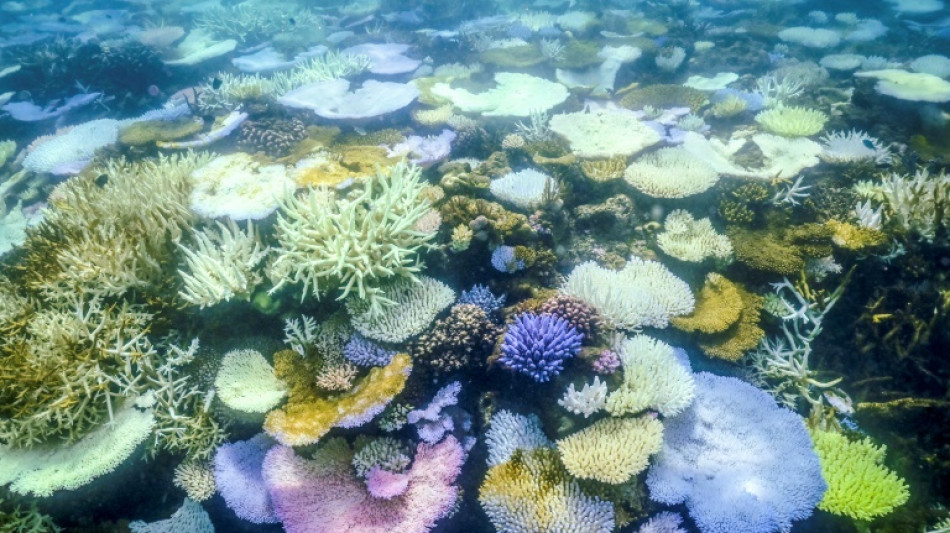
Parts of Great Barrier Reef suffer highest coral mortality on record / Photo: DAVID GRAY - AFP/File

 Kenya's economy faces climate change risks: World Bank

 Apple tops estimates in CEO Cook's final quarter, but shares fall

 Milei demands expulsion of foreigners expressing 'hate' against Argentina

 Italy's Po River valley on drought alert

 Prada profits pinched as growth hard to chase

 Stocks climb on earnings and rates, oil retreats

 US economic growth slows in second quarter, missing expectations

 Russia adds Telegram founder Durov to 'terrorist' blacklist

 Stocks diverge on earnings, as oil steadies

 Eurozone economy grows despite Middle East war
 Singapore group will develop 'most promising' Ebola vaccine

 Shell profit surges as Mideast war fuels oil prices

 Car maker Stellantis says back in profit in second quarter

 Samsung quarterly operating profit up 1,800% on AI boom

 South Korean stocks bounce after rout, oil holds gains on Mideast woes

 South Korea's women web sleuths fight AI deepfake porn

 Anything but programmable: New cost-efficient EC-power-supply-series for the DIN rail by CAMTEC PS

 Meta misses profit expectations, sticks to massive AI spending

 Campari - king of the spritz - hopes to conquer American heartland
 Air France-KLM and Lufthansa bid for Portugal's TAP airline

 Profits soar at Airbus as it delivers more planes

 Rheinmetall shares surge after armsmaker reports record profit
 FIFA hit by furious backlash over plans to sell stake in competitions

 MEXC Integrates World-Check to Fortify Institutional Grade Compliance Architecture
 Spain returns wildfire evacuees as France braces for worsening weather

Parts of the Great Barrer Reef have suffered the highest coral mortality on record, Australian research showed Tuesday, with scientists fearing the rest of it has suffered a similar fate.
The Australian Institute of Marine Science said surveys of 12 reefs found up to 72 percent coral mortality, thanks to a summer of mass bleaching, two cyclones, and flooding.
In one northern section of the reef, about a third of hard coral had died, the "largest annual decline" in 39 years of government monitoring, the agency said.
Often dubbed the world's largest living structure, the Great Barrier Reef is a 2,300 kilometre (1,400-mile) expanse of tropical corals that house a stunning array of biodiversity.
But repeated mass bleaching events have threatened to rob the tourist drawcard of its wonder, turning banks of once-vibrant corals into a sickly shade of white.
Bleaching occurs when water temperatures rise and the coral expels microscopic algae, known as zooxanthellae, to survive.
If high temperatures persist, the coral can eventually turn white and die.
This year had already been confirmed as the fifth mass bleaching on the reef in the past eight years.
But this latest survey also found a rapid growing type of coral -- known as acropora -- had suffered the highest rate of death.
This coral is quick to grow, but one of the first to bleach.
- 'Worst fears' -
Lead researcher Mike Emslie told public broadcaster ABC the past summer was "one of the most severe events" across the Great Barrier Reef, with heat stress levels surpassing previous events.
"These are serious impacts. These are serious losses," he said.
WWF-Australia's head of oceans Richard Leck said the initial surveys confirmed his "worst fears".
"The Great Barrier Reef can bounce back but there are limits to its resilience," he said.
"It can't get repeatedly hammered like this. We are fast approaching a tipping point."
Leck added the area surveyed was "relatively small" and feared that when the full report was released next year "similar levels of mortality" would be observed.
He said that it reinforced Australia's need to commit to stronger emission reduction targets of at least 90 percent below 2005 levels by 2035 and move away from fossil fuels.
The country is one of the world's largest gas and coal exporters and has only recently set targets to become carbon neutral.
A.Agostinelli--CPN