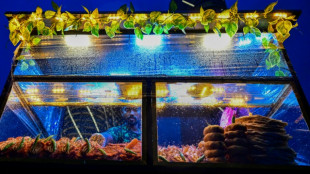
Leftist voices seek to be heard at Rio's G20 summit / Photo: Mauro PIMENTEL - AFP

 Three killed by storm in southern India

 Two hundred 'Cruise for life' passengers stranded in Cambodia

 Billionaire Ambani's Jio jumps 21% in market debut after record India IPO

 Sri Lanka's Tamil farmers fight to reclaim land after civil war

 'They don't care about us': Trump food aid cuts leave Americans struggling and angry

 Palestinian activist Khalil returns to Columbia after US detention

 Youths testify about 'despair' in unprecedented Canadian climate trial

 Storied Paris department store seeks bankruptcy protection
 Boeing shares tumble after it releases cautious growth forecast
 Boeing reports smaller loss as it aims for stable output growth

 Dangote, Nigeria's oil tycoon rewriting Africa's story

 Kane says Ballon d'Or win 'feels like a dream' as tributes pour in

 Mercedes-Benz cuts 2026 profit outlook on tough China market
Che Guevara stares out from a printed t-shirt worn by Miguel Hernandez as he walks through the streets of Rio de Janeiro, where left-wing activists hope to make their voices heard at an upcoming G20 summit.
Hernandez, a 33-year-old Venezuelan campaigner for human rights and the environment, was in the city in response to a call by Brazilian President Luiz Inacio Lula da Silva for civil society to show up ahead of the summit happening Monday and Tuesday.
"The movements are discussing what has caused the whole climate crisis: industrial development, capitalist development," he said.
"They are looking for proposals that stop or control" these problems, he said.
Lula, who grew up in poverty, is championing a Global Alliance against Hunger and Poverty that he will officially launch at the summit on Monday.
Ahead of that, he will attend Saturday's closing session of the three-day G20 Social event his government organized in Rio for 40,000 activists in an open-air square not far from where the summit will be held.
At that closing session, Lula will receive a document with demands formulated by the civil society groups with the idea of integrating them -- or at least the issues -- into the final summit declaration by G20 leaders.
- Wariness at Trump -
The subjects covered are as diverse as the faces and voices holding forth on them at the G20 Social.
"It is very important knowing that we are being heard in some form," said Maiara Viana, a 25-year-old teacher.
Indigenous peoples, black communities, students, unionists, youths from Brazilian favelas and LGBTQ activists spent the days debating a range of topics including strategies to confront racism, inequality and imperialism, along with protecting access to water and gender rights.
The evenings of the G20 Social were given over to vibrant music festivals.
"I hope that everything we approve is sent on and carried out, because we came to debate, to listen and to tackle issues that are really important for society," said Claudio Oliveria, a 62-year-old security guard.
While the atmosphere was colorful and varied, many were alarmed at what they viewed as a near-term threat: the return of Donald Trump as US president in two months' time, after his election victory.
Trump ran on a campaign of climate change skepticism, trade protectionism, an opposition to what he viewed as "woke" gender politics and a wariness of international organizations.
"There is going to be a really big change," said Elisangela da Silva, a 45-year-old involved in urban agriculture in northern Brazil. "We'll see how it goes, but I don't think good things will come of it."
"We're a bit on our guard, but in the face of any kind of threat, we will also take a step forward," she said.
A.Agostinelli--CPN