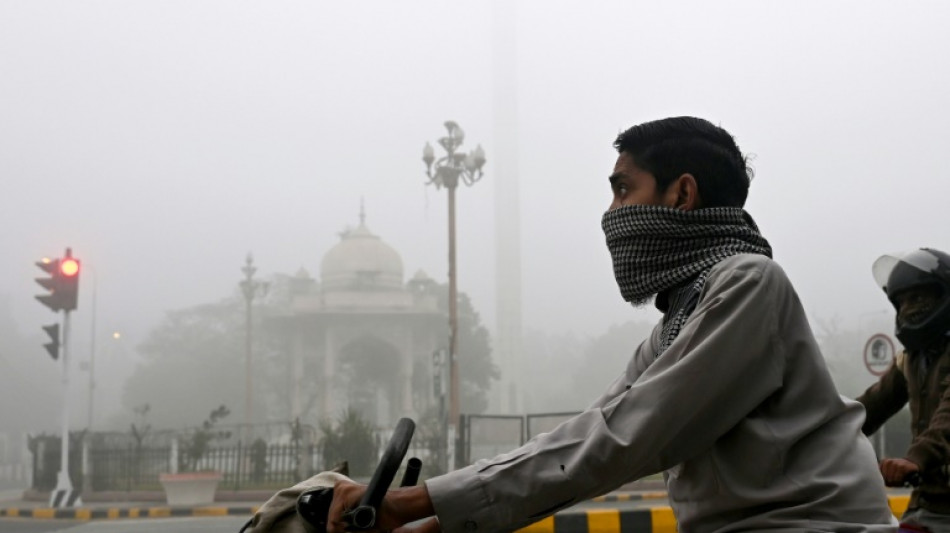
Pakistan's policies hazy as it fights smog / Photo: Arif ALI - AFP

 Kenya's economy faces climate change risks: World Bank

 Apple tops estimates in CEO Cook's final quarter, but shares fall

 Milei demands expulsion of foreigners expressing 'hate' against Argentina

 Italy's Po River valley on drought alert

 Prada profits pinched as growth hard to chase

 Stocks climb on earnings and rates, oil retreats

 US economic growth slows in second quarter, missing expectations

 Russia adds Telegram founder Durov to 'terrorist' blacklist

 Stocks diverge on earnings, as oil steadies

 Eurozone economy grows despite Middle East war
 Singapore group will develop 'most promising' Ebola vaccine
 Shell profit surges as Mideast war fuels oil prices
 Car maker Stellantis says back in profit in second quarter

 Samsung quarterly operating profit up 1,800% on AI boom

 South Korean stocks bounce after rout, oil holds gains on Mideast woes

 South Korea's women web sleuths fight AI deepfake porn

 Anything but programmable: New cost-efficient EC-power-supply-series for the DIN rail by CAMTEC PS
 Meta misses profit expectations, sticks to massive AI spending

 Campari - king of the spritz - hopes to conquer American heartland
 Air France-KLM and Lufthansa bid for Portugal's TAP airline

 Profits soar at Airbus as it delivers more planes

 Rheinmetall shares surge after armsmaker reports record profit
 FIFA hit by furious backlash over plans to sell stake in competitions

 MEXC Integrates World-Check to Fortify Institutional Grade Compliance Architecture
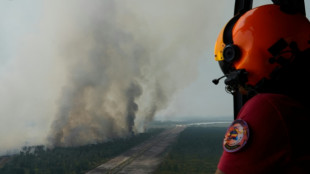 Spain returns wildfire evacuees as France braces for worsening weather

From banning tuk-tuks and barbecues to demolishing old brick kilns, Pakistan's government is pushing a series of measures to fight record-breaking smog.
But environmental activists and experts warn that the efforts hardly begin to fix a problem that leaves the country choking every winter, with Punjab, a region of almost 130 million people bordering India, bearing the brunt of it.
A mix of low-grade fuel emissions from factories and vehicles, exacerbated by agricultural stubble burning, blanket the city each winter, trapped by cooler temperatures and slow-moving winds.
The UN food agency FAO pinpoints transport as the main source of air pollutant emissions, followed by industry and agriculture.
Punjab minister Marriyum Aurangzeb, who has declared a "war against smog", has deployed police to fine farmers who use the slash-and-burn technique.
Officials are also targeting companies that fail to comply with orders to modernise their infrastructure.
"It is a good starting point", the Pakistan Air Quality Experts (PAQx) group, a coalition of 27 professionals spanning public health, environmental science, law, and economics, wrote in a letter to the government.
But more urgent action was necessary against the worst polluters, the group said, suggesting immediate curbs on heavy vehicles circulating at certain hours or a nation-wide shutdown of all brick kilns, old and new.
Ahmad Rafay Alam, one of Pakistan's leading environment lawyers, said the government has "not understood the problem completely".
"It should (improve the quality of) petrol, move to renewables, improve the industry, otherwise, we're just showing something for the sake of showing it," he said.
- Cost hurdle -
More than 24 million vehicles ply the streets in Punjab, a province served by a weak public transportation infrastructure.
"We need to upgrade the vehicle fleet," Alam said.
But many Pakistanis are also unable to afford more modern and less-polluting options in a country where the World Bank reports 40 percent of the population lives below the poverty line.
In the brick-making industry, one of Pakistan's biggest sectors, employers and employees have shown incomprehension at the government's actions.
Officials have shut down 700 of the country's 25,000 brick kilns because they have not switched to more energy-efficient versions touted to reduce air particle output.
Employer Sajid Ali Shah told AFP that the government "replaced the old technology that we worked with for over 50 years with a new one, but many do not even know how to use the new technology".
Worker Muhammad Imran, 40, said the old kilns "used to cost us almost $1000, the new one is almost $6000".
A similar picture emerged in the farming sector.
Officials want the agriculture sector to switch to fertilisers instead of the slash-and-burn technique, but farmers say that is too costly.
"We plough, burn and then water (the fields) for good results. There's no other way," Fida Hussain, a 35-year-old farmer told AFP, after he finished burning his rice fields.
Deforestation also continues to gather pace to make way for new bridges and roads.
Every year, Pakistan loses almost 27,000 hectares (270 square kilometres) of natural forest area, according to the World Bank.
- Children paying price -
With the smog far from lifting, doctors are reporting a health emergency.
Air pollution can trigger strokes, heart disease, lung cancer and other respiratory diseases, according to the World Health Organisation (WHO).
More than 35,000 patients have been reported in the five major public hospitals of Lahore during the past week, Pakistan's official news agency APP reported.
Children are often hardest hit, with UNICEF noting that "prior to these record-breaking levels of air pollution, about 12 percent of deaths in children under five in Pakistan were due to air pollution".
To limit the damage, the provincial government shut down schools and public spaces in Punjab's major cities till 17 November, disrupting the learning of almost 16 million children.
"It's unfortunate that the children are paying the price when it should be industry, energy production and automobile use that should be upgraded or shut down," Alam said.
But Aurangzeb warned: "Even if we enforce our smog mitigation plan... it will not bring an overnight change".
H.Cho--CPN