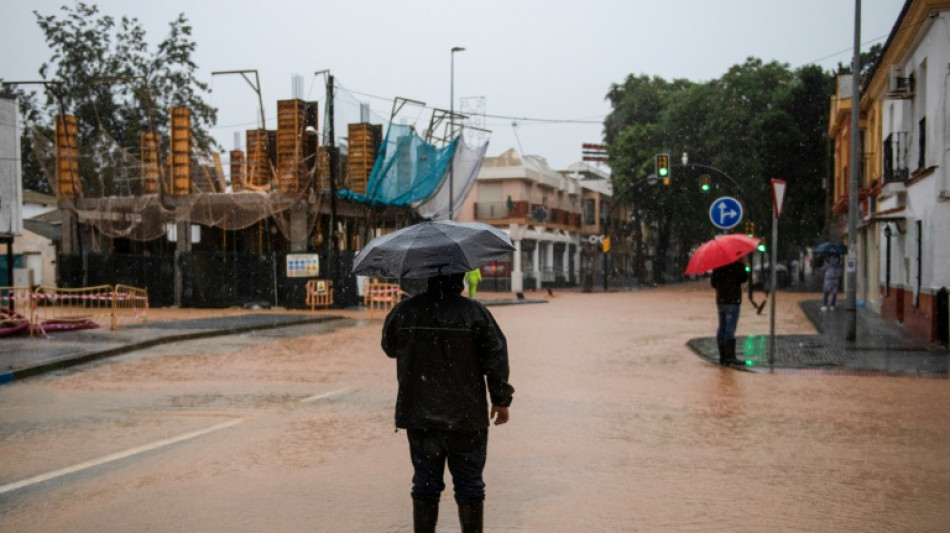
Spain flood epicentre under highest alert for fresh rain / Photo: JORGE GUERRERO - AFP

 Kenya's economy faces climate change risks: World Bank

 Apple tops estimates in CEO Cook's final quarter, but shares fall

 Milei demands expulsion of foreigners expressing 'hate' against Argentina

 Italy's Po River valley on drought alert

 Prada profits pinched as growth hard to chase
 Stocks climb on earnings and rates, oil retreats

 US economic growth slows in second quarter, missing expectations

 Russia adds Telegram founder Durov to 'terrorist' blacklist

 Stocks diverge on earnings, as oil steadies

 Eurozone economy grows despite Middle East war

 Singapore group will develop 'most promising' Ebola vaccine

 Shell profit surges as Mideast war fuels oil prices

 Car maker Stellantis says back in profit in second quarter

 Samsung quarterly operating profit up 1,800% on AI boom

 South Korean stocks bounce after rout, oil holds gains on Mideast woes

 South Korea's women web sleuths fight AI deepfake porn

 Anything but programmable: New cost-efficient EC-power-supply-series for the DIN rail by CAMTEC PS

 Meta misses profit expectations, sticks to massive AI spending

 Campari - king of the spritz - hopes to conquer American heartland
 Air France-KLM and Lufthansa bid for Portugal's TAP airline

 Profits soar at Airbus as it delivers more planes

 Rheinmetall shares surge after armsmaker reports record profit
 FIFA hit by furious backlash over plans to sell stake in competitions

 MEXC Integrates World-Check to Fortify Institutional Grade Compliance Architecture

 Spain returns wildfire evacuees as France braces for worsening weather

Spain's national weather agency put parts of the eastern Valencia region under the highest alert level for rain on Wednesday, two weeks after floods killed more than 200 people there.
Other parts of Spain also on high alert evacuated thousands of residents and closed schools as torrential rains lashed the European country again.
National weather agency AEMET issued a red alert lasting until midday (1100 GMT) on Thursday for the Valencia coast, with up to 180 millimetres of rain predicted to fall in 12 hours.
AEMET also placed the southern province of Malaga and the northeastern Catalonia region on red alert for rains expected to last until Friday.
Emergency services in Andalusia said more than 1,000 homes and almost 3,000 residents had been evacuated in and around the city of Malaga.
Footage on social media showed Malaga's normally bustling commercial centre deserted and cars ploughing through rising water that had submerged roads.
Ester Espinosa, a 47-year-old resident of Malaga's Campanillas suburb, told AFP residents were erecting a barricade to fend off the water.
"It hasn't been exaggerated at all," added Ida Maria Ledesma Martin, a 39-year-old social educator who said police had warned residents that morning.
The high-speed line connecting Madrid and Malaga as well as regional services were suspended, national railway operator Renfe said, while the local metro was shut.
Malaga airport cancelled one flight and diverted five others, operator Aena wrote on X. Local television images showed its entrance had been inundated.
The start of the Billie Jean King Cup tennis finals between Spain and Poland in Malaga was also postponed.
- Malaga 'paralysed' -
"Today Malaga is paralysed... if there is intense rain in a short period of time, there are no capacities or infrastructure that can cope," the Andalusia region's leader Juanma Moreno told reporters.
The rain meant schools and universities closed across large parts of Valencia, Andalusia and Catalonia.
Authorities in the Valencia region restricted road travel to "essential vehicles" in the worst-affected municipalities for 24 hours.
The Valencia-Barcelona train line was partially suspended due to the rain, railway infrastructure operator Adif said.
Officials in the Valencia region have warned sewage systems already clogged with mud could struggle to cope with a fresh storm.
The October 29 catastrophe killed 223 people, mostly in the Valencia region, wrecked infrastructure, gutted buildings and submerged fields. The final bill is expected to soar to tens of billions of euros.
Many people in the destroyed town of Paiporta had barricaded their homes with planks or sandbags to try to protect them from fresh flooding, an AFP journalist saw.
Both storms to hit Spain in recent weeks are the result of a sudden cold drop, known in Spanish as a "gota fria".
Cold air moving over the warm waters of the Mediterranean Sea allows the hotter, moist air at the surface to rise quickly, producing intense rain clouds.
Scientists warn human-induced climate change is increasing the ferocity, frequency and length of such extreme weather events.
U.Ndiaye--CPN