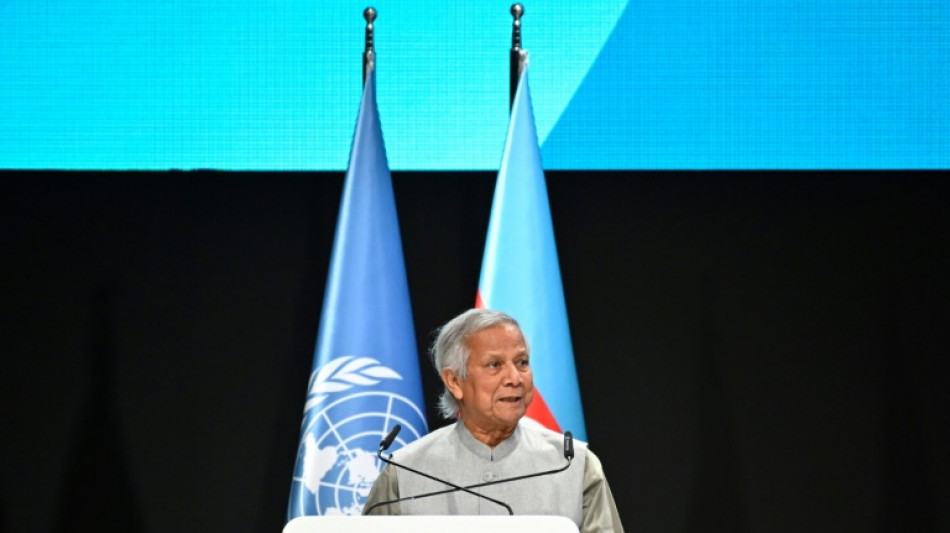
'Very humiliating': Bangladesh's Yunus seethes over climate cash fight / Photo: Alexander NEMENOV - AFP

 Kenya's economy faces climate change risks: World Bank

 Apple tops estimates in CEO Cook's final quarter, but shares fall

 Milei demands expulsion of foreigners expressing 'hate' against Argentina

 Italy's Po River valley on drought alert

 Prada profits pinched as growth hard to chase

 Stocks climb on earnings and rates, oil retreats

 US economic growth slows in second quarter, missing expectations

 Russia adds Telegram founder Durov to 'terrorist' blacklist

 Stocks diverge on earnings, as oil steadies

 Eurozone economy grows despite Middle East war

 Singapore group will develop 'most promising' Ebola vaccine

 Shell profit surges as Mideast war fuels oil prices

 Car maker Stellantis says back in profit in second quarter

 Samsung quarterly operating profit up 1,800% on AI boom

 South Korean stocks bounce after rout, oil holds gains on Mideast woes

 South Korea's women web sleuths fight AI deepfake porn

 Anything but programmable: New cost-efficient EC-power-supply-series for the DIN rail by CAMTEC PS

 Meta misses profit expectations, sticks to massive AI spending

 Campari - king of the spritz - hopes to conquer American heartland
 Air France-KLM and Lufthansa bid for Portugal's TAP airline

 Profits soar at Airbus as it delivers more planes

 Rheinmetall shares surge after armsmaker reports record profit
 FIFA hit by furious backlash over plans to sell stake in competitions

 MEXC Integrates World-Check to Fortify Institutional Grade Compliance Architecture
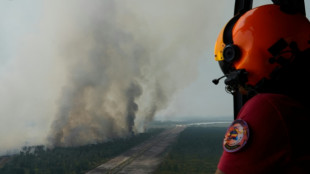 Spain returns wildfire evacuees as France braces for worsening weather

In the three months since becoming Bangladesh's interim leader following a student-led revolution, Muhammad Yunus has endured political turmoil, impatient cries for elections, and destructive flooding across the low-lying nation.
Now, the Nobel Peace Prize winner has been thrust into a brawl over money to help poorer countries deal with climate change -- and he is not pleased about it.
The 84-year-old micro-finance pioneer, who took over after the toppling of autocratic leader Sheikh Hasina in August, likened the haggling at the UN COP29 climate summit to a "fish market".
"I think that's very humiliating, for nations to come and ask for money to fix... (the) problem that others caused for them," Yunus told AFP in an interview in Azerbaijan, which is hosting the talks.
"Why should we be dragged here to negotiate? You know the problem."
Nations hope to land a deal at COP29 that boosts funding for climate action in developing nations like Bangladesh, which are least responsible for global warming, but most at its mercy.
Some want $1 trillion a year to cover the enormous cost of shifting their economies to clean energy, and adapting to ever-more erratic and extreme weather.
But rich countries -- whose rise to prosperity and associated carbon emissions have driven global warming -- are reluctant to commit such large sums and want others to chip in.
The talks have hit a wall, frustrating leaders of climate-imperilled nations who left behind populations in dire straits to travel to Baku.
Among them is Yunus, who said his riverine homeland had been smashed by six punishing floods -- "each one worse than the previous" -- in the short time since he took over.
Hundreds of thousands of people were forced into emergency shelters in the floods, which also destroyed rice crops.
- 'You figure it out' -
Bangladesh is among the world's most vulnerable nations to climate change, with large areas made up of deltas where the Ganges and the Brahmaputra rivers wind towards the sea.
The country of 170 million is particularly at risk of devastating floods and cyclones -- disasters that only stand to accelerate as the planet keeps warming.
Yunus said it was "not a secret" that rich nations would have to help poorer ones adapt and they should "figure out how much is needed -- not me".
"This is not something we are demanding out of your generosity. We're asking because you are the cause of this problem," he said bluntly.
Yunus said juggling a peaceful democratic transition and a floods response was "difficult" enough and adding a flight to Baku to feud over climate finance didn't help.
Impatience for elections in Bangladesh has gained pace since Hasina's ouster, and the silver-haired technocrat said he shared concerns for peace and security in the nation of 170 million.
A free and fair vote would come as promised, he said, but the speed of democratic reforms "will decide how quick the election will be".
He wouldn't offer a date or timeline, but said the caretaker administration was hoping to build "a quick consensus".
"We are the interim government, so our period should be as short as possible," he said.
M.Davis--CPN