
Tech's green wave hits choppy waters / Photo: Odd ANDERSEN - AFP

 Kenya's economy faces climate change risks: World Bank

 Apple tops estimates in CEO Cook's final quarter, but shares fall

 Milei demands expulsion of foreigners expressing 'hate' against Argentina

 Italy's Po River valley on drought alert

 Prada profits pinched as growth hard to chase

 Stocks climb on earnings and rates, oil retreats

 US economic growth slows in second quarter, missing expectations

 Russia adds Telegram founder Durov to 'terrorist' blacklist

 Stocks diverge on earnings, as oil steadies

 Eurozone economy grows despite Middle East war

 Singapore group will develop 'most promising' Ebola vaccine

 Shell profit surges as Mideast war fuels oil prices

 Car maker Stellantis says back in profit in second quarter

 Samsung quarterly operating profit up 1,800% on AI boom

 South Korean stocks bounce after rout, oil holds gains on Mideast woes

 South Korea's women web sleuths fight AI deepfake porn

 Anything but programmable: New cost-efficient EC-power-supply-series for the DIN rail by CAMTEC PS

 Meta misses profit expectations, sticks to massive AI spending

 Campari - king of the spritz - hopes to conquer American heartland

 Air France-KLM and Lufthansa bid for Portugal's TAP airline

 Profits soar at Airbus as it delivers more planes

 Rheinmetall shares surge after armsmaker reports record profit

 FIFA hit by furious backlash over plans to sell stake in competitions

 MEXC Integrates World-Check to Fortify Institutional Grade Compliance Architecture

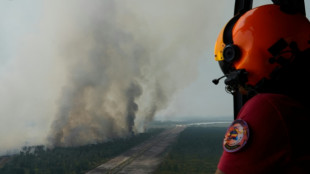 Spain returns wildfire evacuees as France braces for worsening weather

Tech entrepreneurs have spent years selling the dream that we can save the planet without changing our ways, but the current focus of innovation is dividing experts and investors.
The tech industry loves splashy world-saving ideas and spends billions on the hunt for new energy sources, often clashing with calls from activists and experts simply to use less energy.
The Web Summit in Lisbon this week, one of Europe's biggest tech events, gave top billing to a Californian firm called Twelve that claims to be able to make sustainable jet fuel out of the carbon dioxide in the air.
"In a lot of ways we're mimicking trees and plants," Twelve cofounder Etosha Cave told the audience, describing a process that takes carbon dioxide out of the atmosphere and converts it into fuel.
Cave painted a picture of a future where her company's tech could power long-haul flights and even help exploit mineral wealth on Mars -- a utopian vision that has helped her firm raise some $650 million.
The interviewer on stage with Cave told her it "sounds like magic".
Climate expert Mike Berners-Lee, a professor at the University of Lancaster in the UK, told AFP that world-changing claims about sustainable fuel or new energy sources needed to be viewed sceptically.
"Everyone's looking for a silver bullet that would mean we wouldn't have to do anything difficult," he said.
More broadly, the green wave in tech is entering a tricky period.
While Twelve and other major startups are attracting massive investment, Bloomberg recently reported that funding for climate tech was on track to fall 50 percent this year compared with last year.
- Big losses -
And climate tech has long been subject to the whims of politics and global economic trends.
The current green wave is the second this century.
The first -- now called Clean Tech 1.0 -- was fostered by US politician Al Gore, whose calls for funding were met with an estimated $25 billion of investments.
The period ended in 2011 after the global financial crisis ended cheap loans and China ramped up its solar panel output, wiping out most US startups and roughly half of investors' cash.
But those investments were not wasted.
They led to an era of inexpensive solar and wind power and laid the foundations for the electric vehicle revolution.
Clean Tech 2.0 began around 2018 as companies and governments committed to net-zero carbon targets laid out by the 2015 Paris Climate Agreement.
However, the US has re-elected Donald Trump as president with support from many leaders in the tech industry.
Trump -- an avowed climate-change denier whose campaigning slogan on fossil fuels was "dig baby dig" -- withdrew the US from the agreement in his first term and analysts believe he will do the same again.
And the global fight against climate change is still fraught, with national leaders meeting for the UN's COP29 climate summit in Azerbaijan this week divided on the idea of phasing out fossil fuels, the main driver of global warming.
- 'Severe reservations' -
All this leaves climate tech in a precarious moment, and startups without world-saving narratives are scrambling to get funding from a smaller pot.
Web Summit hosted dozens of them, hawking everything from blockchain-backed "virtual power plants" to smart widgets for stopping household leaks.
While some experts are cynical about the utility of these "shark tank" style events, Elisabeth Gilmore, a professor of environmental engineering at Carleton University in Canada, said she had no problem with young entrepreneurs making big claims.
"These innovations should be eyebrow-raising," she told AFP.
She said events like the Web Summit could focus minds, but cautioned that entrepreneurs must look beyond the profit motive and make products that help communities.
Berners-Lee questioned whether some of the most eye-catching ideas could be as good as they sounded.
"If these are real solutions that are ready to go, if they're as good as they look, they would be scaling up like crazy," he said.
Sustainable jet fuel, he said, was one of the toughest nuts to crack and would need major breakthroughs in storage and power usage.
Cave conceded on stage that Twelve needed "utility-level" renewables as well as power from the grid for her firm's plants, though she said it used far less land and energy than biofuels.
More broadly, Berners-Lee questioned whether the search for new power sources should even be an aim for humanity.
"I would have severe reservations about giving humanity an unlimited energy supply beyond carbon -- we're causing enough damage with the energy we've already got," he said.
C.Smith--CPN