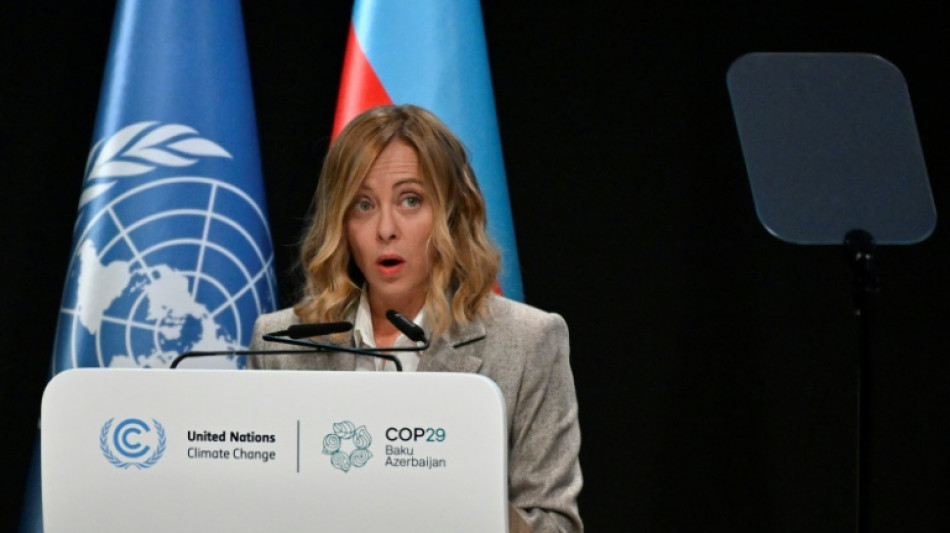
Stark warning on emissions as leaders divided at COP29 / Photo: Alexander NEMENOV - AFP

 Kenya's economy faces climate change risks: World Bank

 Apple tops estimates in CEO Cook's final quarter, but shares fall

 Milei demands expulsion of foreigners expressing 'hate' against Argentina

 Italy's Po River valley on drought alert

 Prada profits pinched as growth hard to chase

 Stocks climb on earnings and rates, oil retreats

 US economic growth slows in second quarter, missing expectations

 Russia adds Telegram founder Durov to 'terrorist' blacklist

 Stocks diverge on earnings, as oil steadies

 Eurozone economy grows despite Middle East war

 Singapore group will develop 'most promising' Ebola vaccine

 Shell profit surges as Mideast war fuels oil prices

 Car maker Stellantis says back in profit in second quarter

 Samsung quarterly operating profit up 1,800% on AI boom

 South Korean stocks bounce after rout, oil holds gains on Mideast woes

 South Korea's women web sleuths fight AI deepfake porn

 Anything but programmable: New cost-efficient EC-power-supply-series for the DIN rail by CAMTEC PS

 Meta misses profit expectations, sticks to massive AI spending

 Campari - king of the spritz - hopes to conquer American heartland

 Air France-KLM and Lufthansa bid for Portugal's TAP airline

 Profits soar at Airbus as it delivers more planes

 Rheinmetall shares surge after armsmaker reports record profit
 FIFA hit by furious backlash over plans to sell stake in competitions

 MEXC Integrates World-Check to Fortify Institutional Grade Compliance Architecture

 Spain returns wildfire evacuees as France braces for worsening weather

Global leaders offered competing visions on how to tackle climate change at UN-led talks on Wednesday as a new report warned that the world must reach carbon neutrality much sooner than planned.
Planet-warming carbon dioxide emissions from oil, gas and coal rose to record highs this year, according to preliminary research from an international network of scientists at the Global Carbon Project.
The report came as leaders gathered in Azerbaijan for COP29 climate talks aimed at reaching a deal to boost funding for poorer nations so they can adapt to climate shocks and transition to cleaner energy.
The research found that to meet the Paris agreement's ambitious goal of limiting warming to 1.5 degrees Celsius, the world now needs to reach net-zero CO2 emissions by the late 2030s -- instead of 2050.
"This is what the presidency has been promoting since the beginning of this year -- the time window is narrowing, shrinking -- and we need to act urgently," Yalchin Rafiyev, Azerbaijan's lead negotiator for COP29, told AFP.
"There are still possibilities for keeping 1.5C within reach", and striking a deal on climate finance "will definitely pave the way for us to realise this opportunity".
The warning comes with growing concern about the future of global climate action after the election of Donald Trump, who has vowed to again pull the United States out of the Paris agreement after taking over the presidency in January.
Some leaders in Baku defended fossil fuels during two days of speeches, while others from countries plagued by climate disasters warned that they were running out of time.
Some of the strongest words came from Albanian Prime Minister Edi Rama, who complained that "our speeches full of good words about climate change, change nothing".
Rama skewered the many leaders who skipped this year's event, saying their absences added "insult to injury".
- 'Slower' path -
Italian Prime Minister Giorgia Meloni, meanwhile, urged a "realistic global outlook" that did not prioritise decarbonisation over "our production and social system's sustainability".
"We must protect nature, with man at its core. An approach that is too ideological and not pragmatic on this matter risks taking us off the road to success," the far-right leader said.
"Currently, there is no single alternative to fossil fuel supply."
And Greek Prime Minister Kyriakos Mitsotakis warned that countries "cannot drive ourselves into industrial oblivion".
Those views stood in sharp contrast to the line from countries beset by climate catastrophes and rising sea levels.
Tuvalu's Prime Minister Feleti Penitala Teo insisted that for Pacific island nations like his, "there is simply no time to waste".
He urged countries to "deliver a clear signal that the world is promptly phasing out fossil fuel".
- Money fight -
As leaders spoke, negotiators released a fresh draft deal on finance that includes a raft of options to raise funding but leaves unresolved sticking points that have long delayed an agreement.
Most developing countries favour an annual commitment from wealthy countries of at least $1.3 trillion.
This figure is more than 10 times the $100 billion annually that a small pool of developed countries -- among them the US, the EU and Japan -- currently pay.
Some donors are reluctant to promise large new amounts of public money from their budgets at a time when they face economic and political pressure at home.
They want instead to promise private sector mobilisation, an option NGOs describe as "wishful thinking".
"They always like to look at the private sector as the magic money tree," said Debbie Hillier, global climate policy lead for Mercy Corps.
US climate envoy John Podesta said a deal should include "new contributors" -- code for China, which is not labelled a developed nation despite being the world's second largest economy and largest polluter.
Already buried under debt, developing countries want new aid in the form of grants instead of loans.
Philip Davis, the prime minister of the Bahamas, which is vulnerable to hurricanes, said that small island nations have spent 18 times more on debt repayment than they have received in climate finance.
"The world has found the ability to finance wars, the ability to mobilise against pandemics," Davis said.
"Yet when it comes to addressing the most profound crisis of our time, the very survival of nations, where is that same ability?"
P.Petrenko--CPN