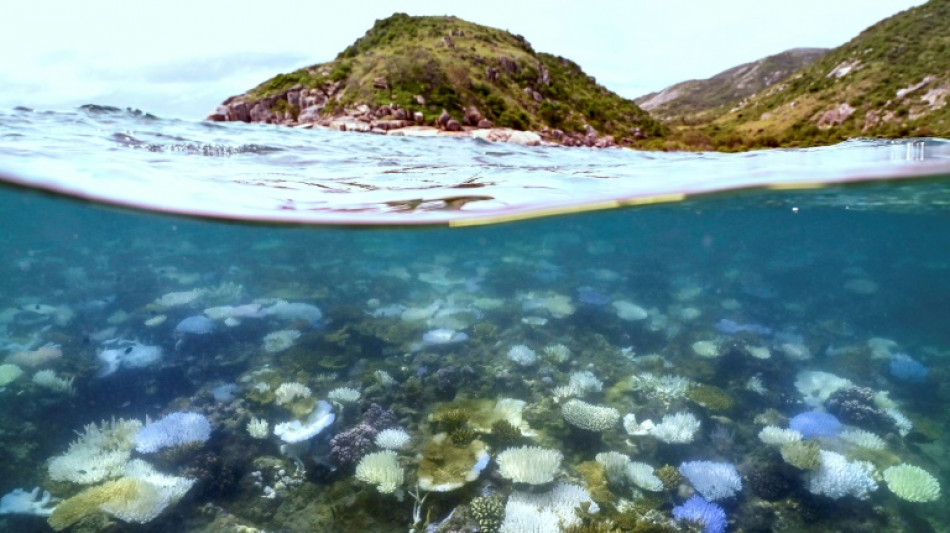
Nearly half of tropical coral species face extinction: report / Photo: DAVID GRAY - AFP/File

 Kenya's economy faces climate change risks: World Bank

 Apple tops estimates in CEO Cook's final quarter, but shares fall

 Milei demands expulsion of foreigners expressing 'hate' against Argentina

 Italy's Po River valley on drought alert

 Prada profits pinched as growth hard to chase

 Stocks climb on earnings and rates, oil retreats

 US economic growth slows in second quarter, missing expectations

 Russia adds Telegram founder Durov to 'terrorist' blacklist

 Stocks diverge on earnings, as oil steadies

 Eurozone economy grows despite Middle East war

 Singapore group will develop 'most promising' Ebola vaccine

 Shell profit surges as Mideast war fuels oil prices

 Car maker Stellantis says back in profit in second quarter

 Samsung quarterly operating profit up 1,800% on AI boom

 South Korean stocks bounce after rout, oil holds gains on Mideast woes

 South Korea's women web sleuths fight AI deepfake porn

 Anything but programmable: New cost-efficient EC-power-supply-series for the DIN rail by CAMTEC PS

 Meta misses profit expectations, sticks to massive AI spending

 Campari - king of the spritz - hopes to conquer American heartland

 Air France-KLM and Lufthansa bid for Portugal's TAP airline

 Profits soar at Airbus as it delivers more planes

 Rheinmetall shares surge after armsmaker reports record profit
 FIFA hit by furious backlash over plans to sell stake in competitions

 MEXC Integrates World-Check to Fortify Institutional Grade Compliance Architecture
 Spain returns wildfire evacuees as France braces for worsening weather

Almost half of all warm-water species of coral are threatened with extinction -- and climate change is the chief culprit, a new report said on Wednesday.
The updated risk assessment from the International Union for Conservation of Nature (IUCN) was announced at the COP29 climate summit in Azerbaijan, which is being skipped by the leaders of many top polluting nations.
Oceans have absorbed around 90 percent of the excess heat in the atmosphere due to the release of carbon dioxide and other greenhouse gases.
Rising ocean temperatures have spurred mass bleaching events at coral reefs across the world, threatening crucial ecosystems for marine life as well as the livelihoods of people who rely on them.
The updated assessment of the IUCN's Red List of Threatened Species looked at reef-building corals, which live in warm, shallow waters in tropical areas.
Its analysis found that 892 reef-building coral species are now considered threatened, representing 44 percent of the total.
This marked a significant increase from the last assessment in 2008, when a third of all species was listed as threatened.
The organisation is still assessing the extinction risk for cold-water coral, which lives in deeper, darker ocean waters, making it difficult to study.
The IUCN called on negotiators at the COP29 conference to act quickly to reduce planet-heating fossil fuel emissions.
"Healthy ecosystems like coral reefs are essential for human livelihoods -- providing food, stabilising coastlines, and storing carbon," IUCN chief Grethel Aguilar said in a statement.
"Climate change remains the leading threat to reef-building corals and is devastating the natural systems we depend on."
As well as global warming, pollution, disease, unsustainable fishing and agricultural runoff also threaten the world's coral.
Most reef-building coral is found across the Indo-Pacific region, such as Australia's Great Barrier Reef which suffered one its worst-ever bleaching events this year.
The IUCN's updated assessment included results from a study about reef-building coral in the Atlantic Ocean, which was published in the PLOS One journal on Wednesday.
That study found that almost one in three -- or 23 out of 85 -- species of Atlantic coral is critically endangered, more than previously thought.
Staghorn coral and elkhorn coral were given as examples of two critically endangered species in the Caribbean that have been hit hard by warming waters, pollution -- and hurricanes.
"Without relevant decisions from those with the power to change this trajectory, we will see the further loss of reefs, and progressive disappearance of coral species at larger and larger scales," warned IUCN coral specialist David Obura.
S.F.Lacroix--CPN