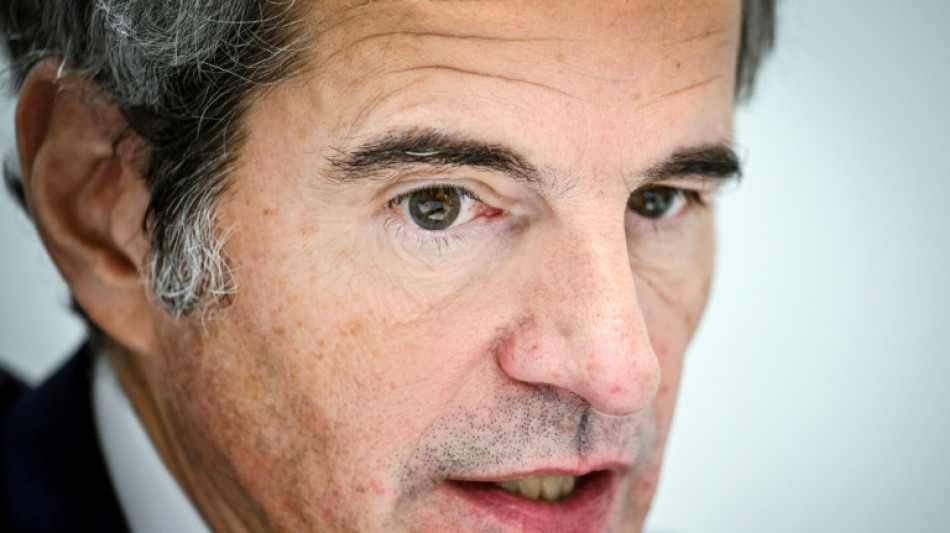
Climate cash should also go to nuclear, says UN atomic chief / Photo: Alexander NEMENOV - AFP

 Kenya's economy faces climate change risks: World Bank

 Apple tops estimates in CEO Cook's final quarter, but shares fall

 Milei demands expulsion of foreigners expressing 'hate' against Argentina

 Italy's Po River valley on drought alert

 Prada profits pinched as growth hard to chase

 Stocks climb on earnings and rates, oil retreats

 US economic growth slows in second quarter, missing expectations

 Russia adds Telegram founder Durov to 'terrorist' blacklist

 Stocks diverge on earnings, as oil steadies

 Eurozone economy grows despite Middle East war

 Singapore group will develop 'most promising' Ebola vaccine

 Shell profit surges as Mideast war fuels oil prices

 Car maker Stellantis says back in profit in second quarter

 Samsung quarterly operating profit up 1,800% on AI boom

 South Korean stocks bounce after rout, oil holds gains on Mideast woes

 South Korea's women web sleuths fight AI deepfake porn

 Anything but programmable: New cost-efficient EC-power-supply-series for the DIN rail by CAMTEC PS

 Meta misses profit expectations, sticks to massive AI spending

 Campari - king of the spritz - hopes to conquer American heartland

 Air France-KLM and Lufthansa bid for Portugal's TAP airline

 Profits soar at Airbus as it delivers more planes

 Rheinmetall shares surge after armsmaker reports record profit
 FIFA hit by furious backlash over plans to sell stake in competitions
 MEXC Integrates World-Check to Fortify Institutional Grade Compliance Architecture
 Spain returns wildfire evacuees as France braces for worsening weather
The head of the United Nations nuclear watchdog said Tuesday that atomic power should also be allowed to tap into climate change funds.
International Atomic Energy Agency (IAEA) chief Rafael Grossi said he wanted countries from Kenya to Malaysia to go for nuclear, while denying he was pushing for an "irresponsible race" towards civil atomic power.
Should nuclear get climate financing?
"It should. Already at COP28 in Dubai the international community -- not just nuclear countries -- agreed that nuclear energy needs to be accelerated.
We need to give ourselves the means to make things happen.
The dialogue with international financial institutions has started in a very positive way. I was at the World Bank this summer, and tomorrow we will meet with the EBRD (European Bank for Reconstruction and Development), as well as the Development Bank of Latin America.
Various financing bodies are beginning to see that markets are pushing in this direction.
We are obviously not a commercial lobby (but) a regulatory agency for everything related to nuclear safety, security, and non-proliferation. We are here to provide assurances and to oversee projects."
But banks don't directly back atomic projects?
"There are cultural, political and ideological barriers. We are coming out of decades of a negative narrative about nuclear, but it has to happen. I am the first to want to see results straight away."
Can nuclear help poorer nations decarbonise?
"That would be a very good thing. There are many countries -- such as Ghana, Kenya and Morocco -- that are interested in small modular reactors, for example, and they approach us saying, 'For us, this would be a good solution.'
Others, like those in Eastern Europe, could benefit from European funding and for whom energy security is crucial in reducing dependency on certain suppliers. So it depends on the model. In Asia, we have Malaysia, the Philippines... countries that genuinely need this."
But how many have safety authorities up to the job?
"Obviously, the agency does not endorse or promote programmes or projects that lack the institutional and technological fabric needed.
We have development models. The United Arab Emirates is a very, very interesting case. It's a country with financial resources but that initially had absolutely no infrastructure, nuclear regulations etc.
We have established programmes for newcomers to guide them step-by-step, through 19 chapters, until they establish nuclear capability."
That's what we have done. We are not going crazy, in an irresponsible race toward civil nuclear power. But there are a lot of things we can do."
H.Meyer--CPN