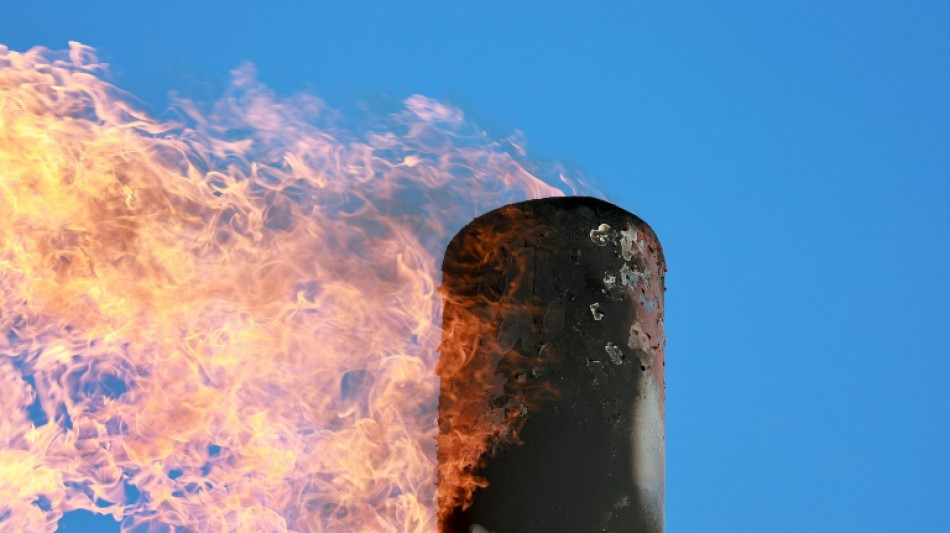
US finalizes waste methane fine on drillers, but future uncertain / Photo: JOE RAEDLE - GETTY IMAGES NORTH AMERICA/AFP/File

 Three killed by storm in southern India
 Two hundred 'Cruise for life' passengers stranded in Cambodia

 Billionaire Ambani's Jio jumps 21% in market debut after record India IPO

 Sri Lanka's Tamil farmers fight to reclaim land after civil war

 'They don't care about us': Trump food aid cuts leave Americans struggling and angry
 Palestinian activist Khalil returns to Columbia after US detention
 Youths testify about 'despair' in unprecedented Canadian climate trial

 Storied Paris department store seeks bankruptcy protection
 Boeing shares tumble after it releases cautious growth forecast
 Boeing reports smaller loss as it aims for stable output growth

 Dangote, Nigeria's oil tycoon rewriting Africa's story

 Kane says Ballon d'Or win 'feels like a dream' as tributes pour in

 Mercedes-Benz cuts 2026 profit outlook on tough China market
US President Joe Biden's outgoing government announced on Tuesday a rule to impose fees on the oil and gas industry for waste methane emissions from drilling operations, despite doubts it will take effect under his successor Donald Trump.
The Environmental Protection Agency's announcement coincides with the COP29 climate talks in Azerbaijan, where the United States' position has been weakened by the election victory of Trump, a climate change denier who has promised to withdraw from the landmark Paris Agreement once more.
"Super pollutant" methane is a potent greenhouse gas, trapping around 28 times as much heat as the equivalent amount of carbon dioxide over a hundred-year period.
Biden's administration made curbing methane a key priority both through domestic actions and international diplomacy, launching the Global Methane Pledge along with the EU in 2021 and engaging bilaterally with China on reduction efforts.
EPA Administrator Michael Regan hailed the rule, saying it would "improve efficiency in the oil and gas sector, support American jobs, protect clean air, and reinforce US leadership on the global stage."
It will not, however, take effect until it is published in the Federal Register -- a process that could take weeks.
Trump will be inaugurated as president in January and his EPA chief, whom he has named as former congressman Lee Zeldin, could review or rescind the measure.
The American Petroleum Institute (API) responded swiftly.
"This rule hampers our ability to meet the growing energy needs of American families and businesses and fails to advance meaningful emissions reduction," said API's Dustin Meyers, adding "we look forward to working with the incoming administration and new Congress to get this right."
Under the rule, certain high-emitting oil and gas drillers would be liable for penalties starting at $900 for every metric ton of wasteful methane emissions.
These charges would increase year-on-year until 2026, as mandated by the Inflation Reduction Act, Biden's signature climate law that was narrowly passed in 2022 by a Congress controlled by his party. Trump has vowed to dismantle the law.
With Republicans likely to control Congress, repeal of the law is a possibility, though analysts predict weakening it is more likely.
Methane emissions from oil and gas drilling occur through various means, including unintentional equipment leaks, deliberate venting to relieve pressure, and flaring.
Flaring is intended to convert excess methane to carbon dioxide, but the process is often incomplete, resulting in further methane release.
U.Ndiaye--CPN