Nations to submit boosted climate plans: what's at stake? / Photo: Giuseppe CACACE - AFP

 Kenya's economy faces climate change risks: World Bank

 Apple tops estimates in CEO Cook's final quarter, but shares fall

 Milei demands expulsion of foreigners expressing 'hate' against Argentina

 Italy's Po River valley on drought alert

 Prada profits pinched as growth hard to chase

 Stocks climb on earnings and rates, oil retreats

 US economic growth slows in second quarter, missing expectations

 Russia adds Telegram founder Durov to 'terrorist' blacklist

 Stocks diverge on earnings, as oil steadies

 Eurozone economy grows despite Middle East war

 Singapore group will develop 'most promising' Ebola vaccine

 Shell profit surges as Mideast war fuels oil prices

 Car maker Stellantis says back in profit in second quarter

 Samsung quarterly operating profit up 1,800% on AI boom

 South Korean stocks bounce after rout, oil holds gains on Mideast woes

 South Korea's women web sleuths fight AI deepfake porn

 Anything but programmable: New cost-efficient EC-power-supply-series for the DIN rail by CAMTEC PS

 Meta misses profit expectations, sticks to massive AI spending

 Campari - king of the spritz - hopes to conquer American heartland

 Air France-KLM and Lufthansa bid for Portugal's TAP airline

 Profits soar at Airbus as it delivers more planes

 Rheinmetall shares surge after armsmaker reports record profit

 FIFA hit by furious backlash over plans to sell stake in competitions

 MEXC Integrates World-Check to Fortify Institutional Grade Compliance Architecture

 Spain returns wildfire evacuees as France braces for worsening weather

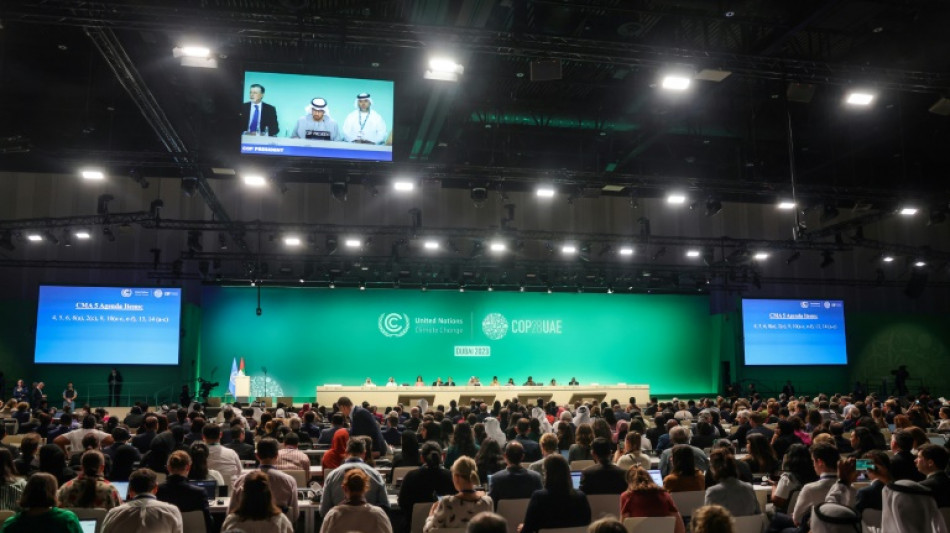
Nations have begun setting carbon-cutting targets for the decade ahead, and how ambitious these pledges are could make or break global efforts to avoid dangerous levels of climate change.
Nearly 200 countries are supposed to publish updated climate plans by early February, but so far only three have done so.
On Wednesday, the UK became the latest, announcing during the COP29 climate summit in Azerbaijan that it would raise its target to cut greenhouse gas emissions.
All eyes will be on other big polluters like China, India and the United States, though future US climate action is unclear following Donald Trump's election.
- Why do they matter? -
The world has agreed to try and limit global warming to 1.5 degrees Celsius above pre-industrial levels, but is nowhere near on track.
Above this threshold, scientists say humanity risks disastrous consequences from volatile weather to major ecological "tipping points" at land and sea.
Last month, the United Nations warned that even if all existing plans are implemented in full, temperatures would rise 2.6C by the century's end, a catastrophic outcome.
The UN says the next round of climate plans must show a "quantum leap" in ambition to avert the worst.
The G20 -- which accounts for 77 percent of total greenhouse gas emissions -- is under particular pressure to step up.
- Early movers -
Just before COP29 opened in Azerbaijan, the United Arab Emirates announced a 47 percent reduction in emissions by 2035 compared with 2019 in its updated climate plan.
Observers said the roadmap failed to account for exported emissions -- including those from its sales of crude oil abroad.
Next year's UN climate host, Brazil, has partly unveiled its plan, increasing its emissions reduction target from a 59 percent cut by 2035, from 2005 levels, to a 67 percent reduction.
It is expected to unveil a more complete plan during COP29.
Plans from other major emitters, like the European Union and China, are not expected until next year.
And the current US government could soon outline Washington's new pledge, despite questions over Trump following through once in office.
David Waskow, of the World Resources Institute, said it would help guide American cities, states and businesses wishing to continue climate action under Trump.
"It also sends an important signal internationally, a set of benchmarks for what the US ought to do," he added.
- What do countries need to do? -
By signing the Paris accord, nearly 200 nations agreed to halt rising temperatures "well below 2C" and strive for the safer goal of 1.5C.
But it did not prescribe how to get there.
The deal left it up to countries to voluntarily chart their own plans and targets, known as Nationally Determined Contributions (NDCs).
These include emission reduction targets and measures to achieve them, such as rolling out renewable energy, electrifying transport, and ending deforestation.
There is no set template for countries to follow but richer countries -- historically the largest emitters -- have a responsibility to pledge the deepest emission cuts.
The plans must be reviewed every five years, with each update supposed to be more ambitious than the last.
This time around countries are expected to improve their 2030 targets and outline economy-wide action they will take to 2035.
- What's the aim? -
An agreement at last year's COP28 climate summit "encouraged" countries to come forward with plans aligned with halting warming to 1.5C.
To have a hope of meeting that goal, emissions must be slashed 42 percent by 2030 and 57 percent by 2035, the UN's Environment Programme said last month.
Currently, however, emissions are continuing to rise.
Keeping 1.5C on track would require a collective effort "only ever seen following a global conflict", it added.
Without pulling together "on a scale and pace never seen before... the 1.5C goal will soon be dead," said UNEP executive director Inger Andersen.
The big moment for assessing progress towards the 1.5C goal comes at a crunch COP30 climate summit in Brazil next year.
- What about fossil fuels? -
Scientists and the International Energy Agency have said that developing new fossil fuel projects is incompatible with halting warming to 1.5C.
But many fossil fuel producing countries argue that new oil and gas projects will be needed as the world transitions to net zero emissions.
Countries are under pressure to outline in their updated plans how they intend to reduce their reliance on fossil fuels, something all nations agreed at last year's COP.
Y.Jeong--CPN