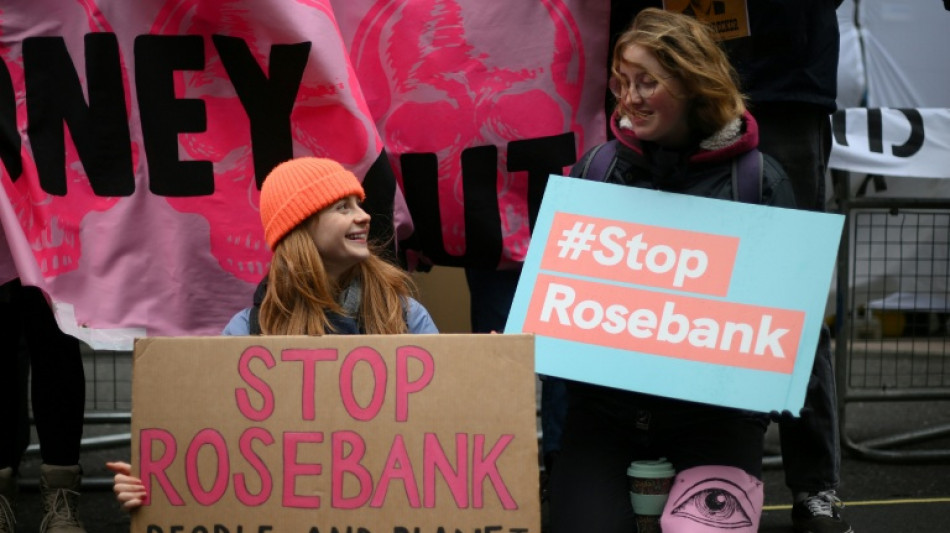
Court challenge begins against UK oil and gas field approvals / Photo: Daniel LEAL - AFP

 Kenya's economy faces climate change risks: World Bank

 Apple tops estimates in CEO Cook's final quarter, but shares fall

 Milei demands expulsion of foreigners expressing 'hate' against Argentina

 Italy's Po River valley on drought alert

 Prada profits pinched as growth hard to chase

 Stocks climb on earnings and rates, oil retreats

 US economic growth slows in second quarter, missing expectations

 Russia adds Telegram founder Durov to 'terrorist' blacklist

 Stocks diverge on earnings, as oil steadies

 Eurozone economy grows despite Middle East war

 Singapore group will develop 'most promising' Ebola vaccine

 Shell profit surges as Mideast war fuels oil prices

 Car maker Stellantis says back in profit in second quarter

 Samsung quarterly operating profit up 1,800% on AI boom

 South Korean stocks bounce after rout, oil holds gains on Mideast woes

 South Korea's women web sleuths fight AI deepfake porn

 Anything but programmable: New cost-efficient EC-power-supply-series for the DIN rail by CAMTEC PS

 Meta misses profit expectations, sticks to massive AI spending

 Campari - king of the spritz - hopes to conquer American heartland

 Air France-KLM and Lufthansa bid for Portugal's TAP airline

 Profits soar at Airbus as it delivers more planes

 Rheinmetall shares surge after armsmaker reports record profit
 FIFA hit by furious backlash over plans to sell stake in competitions

 MEXC Integrates World-Check to Fortify Institutional Grade Compliance Architecture

 Spain returns wildfire evacuees as France braces for worsening weather

Two environmental groups kicked off a legal challenge in Scotland on Tuesday to block the Rosebank and Jackdaw oil and gas fields in the North Sea, with activists optimistic of success.
"We're more confident than ever we can win," said environmental lawyer Tessa Khan before the case opened at the Court of Session in Edinburgh.
Her optimism was shared by hundreds of people who demonstrated outside the court, in celebratory mood given recent rulings that have put the future of the fields in doubt.
Campaign groups Uplift and Greenpeace argue that the UK government granted permissions unlawfully by failing to take into account all emissions from burning oil and gas.
A win for the campaigners would mean operators would have to resubmit environmental assessments for approval before drilling can start.
Former Scottish National Party lawmaker Tommy Sheppard called the case "the granddaddy because it is so big".
"The case will be applied to the decision-making process in general," he told AFP.
"There were 100 licences granted by the last Conservative government in its final dying months. All of them will now be under question."
Regulatory approval for drilling at the Rosebank oil field, 145 kilometres (90 miles) off the Shetland Islands in Scotland's far north, was granted last year.
It is the UK's largest untapped oil field, estimated to contain up to 300 million barrels. Drilling had been due to begin between 2026 and 2030.
The Jackdaw gas condensate field, approved in 2022, is being developed 155 miles east of the Scottish city of Aberdeen and was expected to start production next year.
Rosebank is owned by Norwegian energy giant Equinor and the UK's Ithaca Energy. Jackdaw is owned by Shell. Both say the developments are "vital" for UK energy security.
- Narrow window -
Khan, who is executive director of Uplift, said it had been a "David versus Goliath" battle at the start of the case, pitting campaigners on one side against the UK government and energy firms on the other.
But in July, the UK Supreme Court ruled that the previous Conservative government should have considered the carbon emissions of burning extracted oil and gas, not just of extracting it.
Then the incoming Labour government announced it would not contest the case, leaving the oil companies alone to fight legal challenges.
"We are on the precipice of a massive victory for the climate," said Uplift campaigner Lauren MacDonald.
Khan said there was a broader message to the oil industry: that they now have to take into account all greenhouse gas emissions, even those that occur indirectly.
"We now have a government that is really trying to re-establish the UK's climate credentials," she said. "The window for approval has really, really narrowed."
- Renewables -
Sheppard said the increased economic costs would force energy companies to look towards developing the renewables sector, provided the government gives the necessary investment and incentives.
At the same time, governments in oil-generating countries like Scotland must tread a fine line in balancing the longer term threats of rising temperatures with the shorter term risks of job losses in the sector.
Energy historian Ewan Gibbs, from the University of Glasgow, pointed to potential parallels with the breakdown of social cohesion caused by the closure of the UK's coal mines in the 1980s without a plan for those made redundant.
Prime Minister Keir Starmer, in Baku, Azerbaijan for the UN climate change summit, intends to decarbonise Britain's power grid by 2030 as part of government plans to reach net-zero greenhouse gas emissions by 2050.
Sheppard said it was important that those affected by net-zero transition plans be reskilled and retrained to enable them to benefit from new jobs being created by clean energy technologies.
D.Philippon--CPN