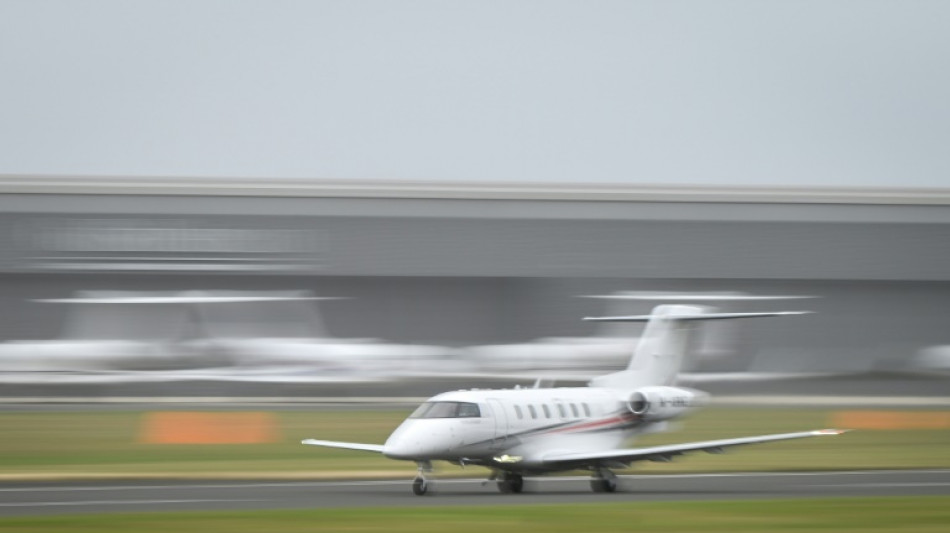
Private jet carbon emissions soar 46%: study / Photo: JUSTIN TALLIS - AFP

 Kenya's economy faces climate change risks: World Bank

 Apple tops estimates in CEO Cook's final quarter, but shares fall

 Milei demands expulsion of foreigners expressing 'hate' against Argentina

 Italy's Po River valley on drought alert

 Prada profits pinched as growth hard to chase

 Stocks climb on earnings and rates, oil retreats

 US economic growth slows in second quarter, missing expectations

 Russia adds Telegram founder Durov to 'terrorist' blacklist

 Stocks diverge on earnings, as oil steadies

 Eurozone economy grows despite Middle East war

 Singapore group will develop 'most promising' Ebola vaccine

 Shell profit surges as Mideast war fuels oil prices

 Car maker Stellantis says back in profit in second quarter

 Samsung quarterly operating profit up 1,800% on AI boom

 South Korean stocks bounce after rout, oil holds gains on Mideast woes

 South Korea's women web sleuths fight AI deepfake porn

 Anything but programmable: New cost-efficient EC-power-supply-series for the DIN rail by CAMTEC PS

 Meta misses profit expectations, sticks to massive AI spending

 Campari - king of the spritz - hopes to conquer American heartland

 Air France-KLM and Lufthansa bid for Portugal's TAP airline

 Profits soar at Airbus as it delivers more planes

 Rheinmetall shares surge after armsmaker reports record profit

 FIFA hit by furious backlash over plans to sell stake in competitions

 MEXC Integrates World-Check to Fortify Institutional Grade Compliance Architecture

 Spain returns wildfire evacuees as France braces for worsening weather

The carbon footprint from private jet travel grew 46 percent between 2019 and 2023 and will keep rising unless the ultra-luxury industry is regulated, according to new research published Thursday.
Carbon dioxide emissions from private aviation peaked over the European summer and around major global events like the World Cup, Cannes Film Festival and UN climate summits, the study found.
The transport of choice for the rich and famous, private jets are the most energy-intense form of flying and the industry has long been a target of climate protesters.
Private aviation was responsible for 15.6 million tonnes of CO2 emissions in 2023, wrote the study's authors from Swedish, Danish and German universities.
This represented less than two percent of commercial aviation's overall carbon emissions.
But private jets cater to just 256,000 people -- about 0.003 percent of the world's adult population -- meaning significantly higher emissions per passenger than commercial travel.
Researchers assessed flight tracker data from roughly 18.7 million individual charters flown between 2019 and 2023 representing the vast majority of global private aviation.
They found roughly half these trips were less than 500 kilometres (310 miles) and many were empty, en route to pickup or undertaking a delivery.
They also noted that private jets on very short trips "in many instances appear to replace cars for time gains or convenience".
"The analysis shows that individuals using PA (private aviation) emit disproportionally more than an average human," said the study published in the peer-reviewed journal Communications Earth & Environment.
Around two-thirds of the world's private jets are based in the United States, and the average passenger has a personal net worth of $123 million.
In 2023, considerable private jet traffic was associated with the Super Bowl, the World Economic Forum in Davos and the COP28 climate conference in Dubai.
Such gala events can attract "hundreds of individual flights" that generate "considerable emissions", the study said.
There was also "a clear seasonal trend of visitation peaking in summer" in luxury coastal locations like Ibiza and Nice, with journeys clustered around weekends.
The private jet industry is forecast to grow, with predictions the current fleet of 26,000 aircraft could grow roughly one-third by 2033.
This means private aviation will become increasingly important as a source of CO2 emissions in relative and absolute terms, the authors said.
"As sustainable aviation fuel use remains limited, and a majority of private aircraft owners do not plan to use it in the near future, it will be necessary to regulate the sector."
Private air travel "illustrates the policy conundrum of addressing the role of the affluent, as policymakers are reluctant to focus on the wealthy and powerful", the study added.
A.Leibowitz--CPN