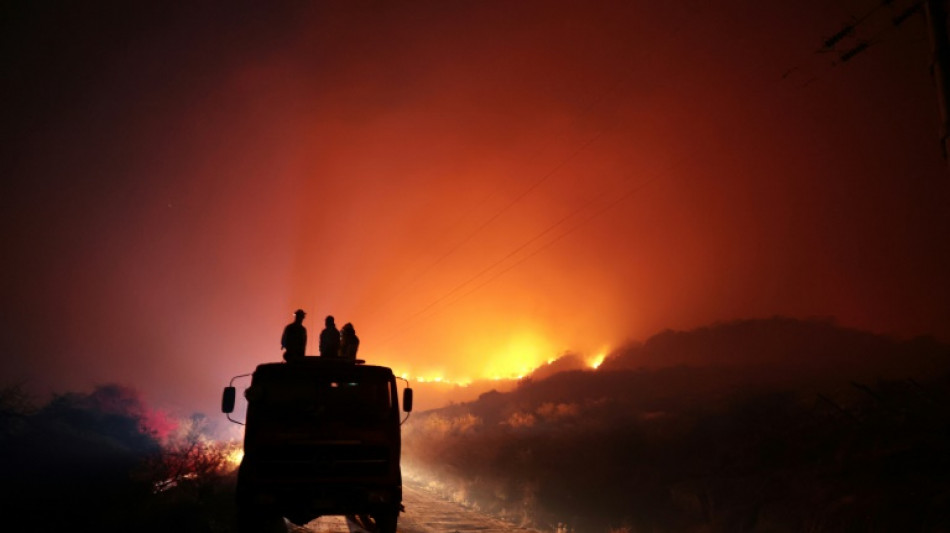
Nations gather for crunch climate talks in shadow of US vote / Photo: STRINGER - AFP

 Kenya's economy faces climate change risks: World Bank

 Amazon beats expectations with cloud and AI growth

 Blowout Microsoft results lift US stocks as oil retreats

 'Beginning of the end': Relief but no party as French wildfire winds down

 Southern Europe 'becoming more flammable' in hotter climate, experts say

 Mammoth bones found on parched bed of Danube in Bulgaria

 MEXC Lists Grvt (GRVT) with $60,000 Worth of GRVT and 10,000 USDT in Airdrop+ Rewards

 George and Amal Clooney flee French home due to wildfire

 MEXC Ventures Supports Alpha Arena's APAC Debut at Coinfest Bali

 AI data centre supplier Zhongji InnoLight slips on Hong Kong debut

 May, June heatwaves caused 2,877 extra deaths in England: govt

 BMW profit down a third as carmaker plans job cuts

 Seoul extends losses as most Asian markets drop, oil rises again

 Gambling.com Group Is Now Grandstand

 Meet the astronomer digging into the Milky Way's 'fossils'
 AI data centre supplier Zhongji InnoLight falls on Hong Kong debut

 Samsung operating profit up 1,800% in second quarter on AI boom

 Japanese population below 120 million for first time in decades

 US actor Jared Leto denies latest accusations of sexual assault
 Danube drops to 'historic lows' as fresh heatwave hits
 BTS pulls out of Grammys after Asian pop category introduction
 OpenAI says rogue AI agent attack hit other companies
 How an AFP beach snap became emblem of Europe's wildfire summer
 TRX Spot and Perpetuals Listing Launches on Backpack, Expanding Access to the TRON Ecosystem

 Nepal's tiger numbers climb 20 percent to estimated 429: survey
World leaders kick off UN climate talks next week, days after a knife edge US election that could send shockwaves through global efforts to limit dangerous warming.
The stakes are high for the COP29 conference in Azerbaijan where nations must agree a new target to fund climate action across huge swathes of the world.
It comes in a year likely to be the hottest in human history that has already witnessed a barrage of devastating floods, heatwaves and storms in all corners of the globe.
Nations are falling far short of what is needed to keep warming from hitting even more dangerous highs in the future.
But leaders arriving in Baku are wrestling with a host of challenges, including trade spats, economic uncertainty and conflicts in the Middle East and Ukraine.
Adding to the uncertainty, the US vote and potential return of Donald Trump, who pulled out of the Paris Agreement and has called climate change a "hoax", could ripple through the negotiations and beyond.
"You can imagine that if Trump is elected, and if the election outcome is clear by the time that we get to Baku, then there will be sort of a crisis moment," said Li Shuo, a Washington-based expert on climate diplomacy at the Asia Society Policy Institute.
He said that countries, likely including China, are preparing to send a "clear message" in support of global climate cooperation if Trump beats his rival Kamala Harris to the White House.
The UN talks are seen as critical to laying the groundwork for a major new round of climate commitments due early next year.
Current pledges would see the world blast past the internationally agreed limit of a 1.5 degrees Celsius rise in temperatures since the pre-industrial era.
"Decisions in Baku could profoundly shape the climate trajectory and whether 1.5 degrees remains within reach," said Cosima Cassel, of think tank E3G.
- Clash over cash -
Azerbaijan hosting the 11-22 November talks has drawn concerns over its heavy reliance on fossil fuels and its human rights record.
Countries last year committed to transition away from fossil fuels and triple renewables usage by 2030.
This year, negotiators must increase a $100 billion-a-year target to help poorer nations prepare for worsening climate impacts and wean off coal, oil and gas.
The overall amount of this new goal, where it comes from, and who has access are major points of contention.
Experts commissioned by the UN estimate that developing countries, excluding China, will need to spend $2.4 trillion per year by 2030 on climate priorities.
From that, $1 trillion must come from international public and private finance.
Wealthy existing donors, including the EU and US, have said new sources of money will have to be found, including from China and oil-rich Gulf states.
China –- today the world's largest polluter and second-largest economy –- does pay climate finance but on its own terms.
Between 2013 and 2022, China paid on average $4.5 billion a year to other developing countries, the World Resources Institute said in a September paper.
Money could also be raised by pollution tariffs, a wealth tax or ending fossil fuel subsidies, among other ideas.
Rachel Cleetus, policy director of the Climate and Energy programme at the Union of Concerned Scientists, said negotiators in Azerbaijan should aim for a $1 trillion deal.
This money "is not charity", Cleetus told AFP, adding that it should mostly come as aid or very low interest loans to avoid adding to developing nations' debt.
"Finance might sound like a technical issue, but we all know money talks," she told AFP.
"Nations either make those investments up front, or we'll be paying dearly for it after the fact, in disaster costs, in pollution costs. So this is a fork in the road. We have a choice."
- Green power -
Current climate pledges, even if implemented in full, would see the world lurch towards 2.6C warming by the end of the century -- threatening catastrophe for human societies and ecosystems, the UN Environment Programme has said.
A deal in Baku is seen as crucial to underpinning a set of more ambitious national pledges in the coming months.
Li said those future pledges could be impacted by the US vote, with countries, including China, waiting to see the outcome before finalising longer-term targets.
Beyond Baku, there is also an "increasing interconnection between climate and the economic agenda", he said, including trade tussles between clean energy powerhouse China and the US and Europe.
He said progress is more visible in "the green economy, who is winning the race when it comes to solar, wind, electric vehicles and energy storage".
St.Ch.Baker--CPN