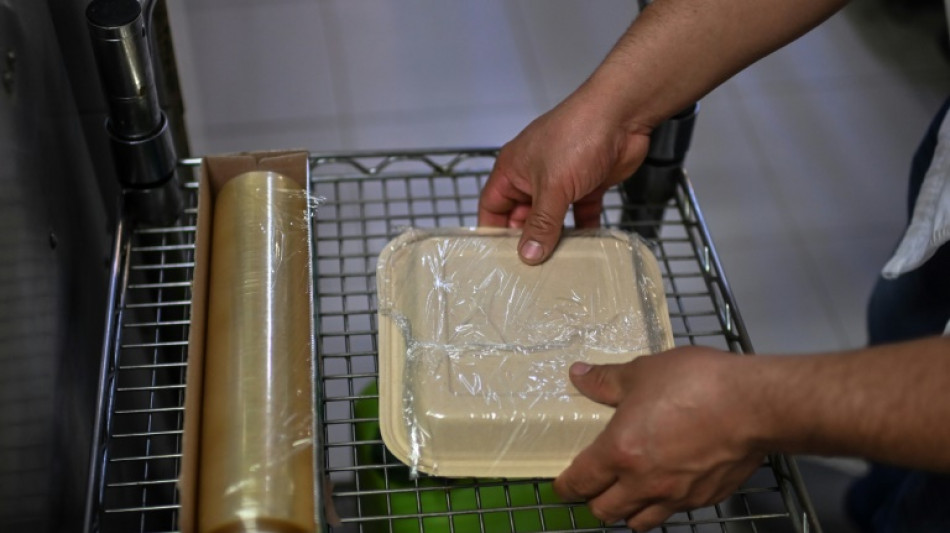
Are bioplastics really the wonder alternative to petro plastics? / Photo: PEDRO PARDO - AFP/File

 Kenya's economy faces climate change risks: World Bank

 Amazon beats expectations with cloud and AI growth

 Blowout Microsoft results lift US stocks as oil retreats

 'Beginning of the end': Relief but no party as French wildfire winds down

 Southern Europe 'becoming more flammable' in hotter climate, experts say

 Mammoth bones found on parched bed of Danube in Bulgaria

 MEXC Lists Grvt (GRVT) with $60,000 Worth of GRVT and 10,000 USDT in Airdrop+ Rewards
 George and Amal Clooney flee French home due to wildfire

 MEXC Ventures Supports Alpha Arena's APAC Debut at Coinfest Bali

 AI data centre supplier Zhongji InnoLight slips on Hong Kong debut
 May, June heatwaves caused 2,877 extra deaths in England: govt

 BMW profit down a third as carmaker plans job cuts
 Seoul extends losses as most Asian markets drop, oil rises again

 Gambling.com Group Is Now Grandstand

 Meet the astronomer digging into the Milky Way's 'fossils'

 AI data centre supplier Zhongji InnoLight falls on Hong Kong debut

 Samsung operating profit up 1,800% in second quarter on AI boom

 Japanese population below 120 million for first time in decades

 US actor Jared Leto denies latest accusations of sexual assault
 Danube drops to 'historic lows' as fresh heatwave hits

 BTS pulls out of Grammys after Asian pop category introduction

 OpenAI says rogue AI agent attack hit other companies

 How an AFP beach snap became emblem of Europe's wildfire summer

 TRX Spot and Perpetuals Listing Launches on Backpack, Expanding Access to the TRON Ecosystem

 Nepal's tiger numbers climb 20 percent to estimated 429: survey

Alternatives to petrochemical-based plastics are emerging, made from everything from banana leaves to tomato skins, especially for food packaging.
But questions remain about how biodegradable and compostable they are, as well as their impact on the environment.
- What is biosourced plastic? -
Biosourced means made with less petrol, using non-fossil agricultural products such as sugarcane waste, corn, or wheat starch. Primarily used in packaging, these biosourced plastics account for less than one percent of global plastic production.
But labs around the world are coming up with more and more new plastics derived from tomato skins or banana leaves.
The French chemicals company Arkema, for instance, is pushing PBAT, made from castor oil, which is used to make sports shoes and car interiors.
Bananatex is a biodegradable textile made from banana leaves that has been developed by a Swiss brand and its Taiwanese partners.
However, "biosourced doesn't necessarily have to be 100 percent" from natural materials, warned Christophe Doukhi de Boissoudy, president of the French association for biosourced compostables.
In Europe, the minimum 50 percent requirement to be considered biosourced "will rise to 60 percent in January 2025", he added.
- What is a bioplastic? -
The generic term "bioplastic" can be confusing, as it can mean either biosourced or compostable: the definition varies by country.
But in Europe, the term is clearly defined -- a bioplastic is a polymer that is both biosourced and compostable, either in soil or industrially.
Not all bioplastics completely degrade under natural conditions.
Some, like PLA (polylactic acid), need to be composted industrially at temperatures between 35 and 60 degrees Centigrade (140 degrees Fahrenheit).
One of the most highly developed bioplastics currently used in textiles or for food packaging, PLA was originally fossil-based but is now being made from fermented plant biomass (corn, beet or sugarcane).
"What alarms us is the speed at which China is advancing its legislation to convert its packaging to PLA, aiming to abandon petrochemical plastics, while Europe is stagnating," said Frederic Van Gansberghe, founder of Belgium-based bioplastics company Futerro, which has a factory in China and plans to open one in France in 2026.
- What environmental impact? -
In its "Atlas of Plastic", the Heinrich Boll Foundation estimates that most biosourced plastics are neither completely biodegradable or compostable, and "actually just sidestep the problem".
For Nathalie Gontard, research director at the French National Institute for Agriculture, Food and the Environment, biosourced plastic "has absolutely no benefit" because these polymers don't degrade in natural conditions but instead fragment into micro- and then nano-plastics.
"What matters is biodegradability under natural conditions," she said.
"Biodegradable" is not well-defined, she argued, as some use it for materials that completely degrade in a few months or years, while others refer to much longer periods.
The environmental benefit of biosourced plastic lies in how they reduce the CO2 emissions of the plastics sector. But caution is needed here, experts warn.
"Additional demand for land to grow the raw materials for biosourced plastics can lead to land-use changes or deforestation," the OECD warned, which in turn can increase CO2 emissions.
"By developing bioplastics, we place the burden of manufacturing these materials on agricultural land that should primarily serve to feed the population," insisted Pauline Debrabandere from the NGO Zero Waste.
D.Avraham--CPN