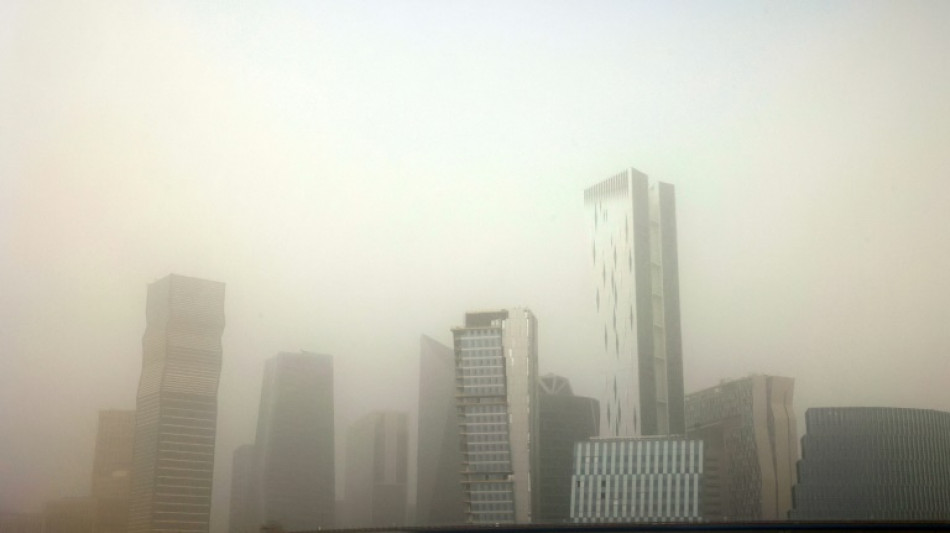
Mideast sandstorms snarl traffic, close schools, harm health / Photo: Fayez Nureldine - AFP

 Lights out in Laos as electricity exports surge

 Steven Strogatz weighs AI mathematics advances and their consequences for researchers

 Anthropic boss calls for AI slowdown, Altman and Musk agree

 French IT giant Capgemini sells subsidiary after row over ICE links

 Quebec Brokerage Qubit Insurance Announces New Data on Coverage Shortfalls as Rebuilding Costs Rise

 Lady Gaga welcomes first child with fiance: US media

 Bhutan business bets on hazelnuts for farming future

 'Widow's Bay' and 'The Pitt' are favorites for Emmys night

 Coastal erosion forces cancellation of California music festival

 Argentina's Dirty War rears its head in Venice film

 UK lawmakers throw out bill to legalise assisted dying

 US inflation steady in August, fueling Fed rate hike expectations

 New York marks 25th anniversary of 9/11 attacks

 Nepal flood reconstruction bill to be $4.78 bn: foreign ministry

 JUMO and Standard Bank launch Social Finance Framework to scale inclusive finance in Africa

 Doomsday tech: could AI really kill us all?

 French comedy show 'Call my agent' makes film comeback

 It's all coming back: Celine Dion fans gear up for Paris return

 Researchers eye AI revolution in natural disaster forecasts

 US braces for inflation report that may push Fed to hike rates

 Musk threatens legal action over documentary

 Latin America fact-check group asks Meta not to replace verification practice

 AI Risks to Enter 60–80% of Liability and Cyber Insurance Underwriting by 2028, ScienceSoft Predicts

 Tribal Launches Campfire, Letting Business and Technical Teams Build on Salesforce Together

 Stocks fall as fresh oil surge fans inflation fears

Sandstorms across the Middle East have delayed flights, closed schools and hospitalised thousands -- a phenomenon experts say could worsen as climate change warps regional weather patterns.
Saudi Arabia on Tuesday became the latest country blanketed with dust that slowed traffic and made iconic towers in the capital difficult to see from more than a few hundred metres (yards) away.
Electronic signs along Riyadh's highways warned drivers to reduce their speed because of the lower visibility, even as life largely went on as usual in the kingdom.
The national meteorology centre predicted that "surface dusty winds" originating in the east and bringing a thick grey haze would continue west towards the Muslim holy cities of Mecca and Medina.
Other countries have been grappling with the problem for longer: Neighbouring Iraq has experienced eight sandstorms since mid-April, fuelled by soil degradation, intense droughts and low rainfall linked to climate change.
The country's latest sandstorm on Monday enveloped the capital Baghdad in an orange glow, sent at least 4,000 people to hospital with breathing problems and led to the closure of airports, schools and public offices across the country.
Iran announced that it, too, was closing government offices and schools Tuesday, citing "unhealthy weather" conditions and sandstorms.
Average airborne concentration of the finest and most hazardous particles (PM2.5) was at 163 microgrammes per cubic metre Tuesday in Tehran, according to a government website.
That is more than six times the World Health Organisation's recommended maximum of 25 microgrammes per cubic metre.
In Kuwait, meanwhile, air traffic at the main airport was suspended for an hour and a half due to a dust storm Monday, and marine traffic in all three ports remained suspended as of Tuesday afternoon.
Kuwait's ministry of education said classes were suspended on Tuesday but would resume the following day.
- Response needed 'urgently' -
The Middle East has always been battered by dust and sandstorms, but they have become more frequent and intense in recent years.
The trend is associated with overgrazing and deforestation, overuse of river water and more dams.
Unseasonable masses of dry, cold air help explain the recent proliferation of sandstorms in eastern Syria and Iraq and "their transmission to the Arabian Peninsula", Hassan Abdallah from the WASM meteorological centre in Jordan told AFP.
By the time the sandstorms reach Saudi Arabia they tend to be less intense, he added.
Sandstorms are worsening regionally because of factors including low water levels in the Tigris and Euphrates rivers, large fluctuations in annual rainfall and disintegrating soil, he said.
In central Riyadh on Tuesday, sand layered cars and buildings, and residents struggled to keep it out of their homes.
"Working outside is very difficult because of the dirt," a Pakistani construction worker who gave his name as Kalimullah told AFP as he installed tiles.
"I try to wash my face from time to time," the 30-year-old added, wrapping a piece of cloth around his face to block the sand.
Saudi office worker Abdullah Al-Otaibi, 39, said he was grateful he works indoors.
"Dust storms are part of our culture and we are used to it, but some of them are severe," he said, rubbing his eyes as he hurried inside.
T.Morelli--CPN