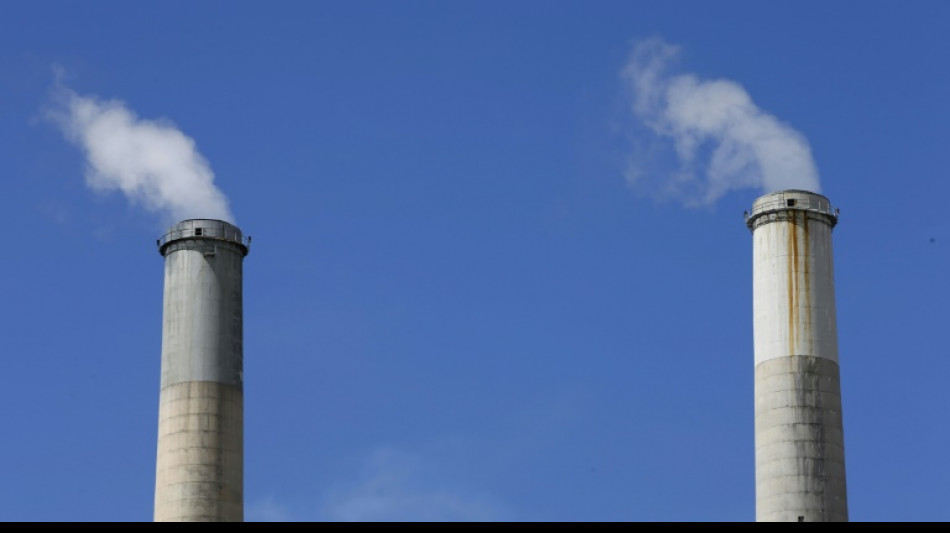
Carbon cuts 'miles short' of 2030 goal: UN / Photo: GEORGE FREY - GETTY IMAGES NORTH AMERICA/AFP/File

 Kenya's economy faces climate change risks: World Bank

 Amazon beats expectations with cloud and AI growth

 Blowout Microsoft results lift US stocks as oil retreats

 'Beginning of the end': Relief but no party as French wildfire winds down

 Southern Europe 'becoming more flammable' in hotter climate, experts say

 Mammoth bones found on parched bed of Danube in Bulgaria

 MEXC Lists Grvt (GRVT) with $60,000 Worth of GRVT and 10,000 USDT in Airdrop+ Rewards

 George and Amal Clooney flee French home due to wildfire

 MEXC Ventures Supports Alpha Arena's APAC Debut at Coinfest Bali

 AI data centre supplier Zhongji InnoLight slips on Hong Kong debut

 May, June heatwaves caused 2,877 extra deaths in England: govt

 BMW profit down a third as carmaker plans job cuts

 Seoul extends losses as most Asian markets drop, oil rises again

 Gambling.com Group Is Now Grandstand

 Meet the astronomer digging into the Milky Way's 'fossils'

 AI data centre supplier Zhongji InnoLight falls on Hong Kong debut

 Samsung operating profit up 1,800% in second quarter on AI boom

 Japanese population below 120 million for first time in decades

 US actor Jared Leto denies latest accusations of sexual assault

 Danube drops to 'historic lows' as fresh heatwave hits

 BTS pulls out of Grammys after Asian pop category introduction

 OpenAI says rogue AI agent attack hit other companies

 How an AFP beach snap became emblem of Europe's wildfire summer

 TRX Spot and Perpetuals Listing Launches on Backpack, Expanding Access to the TRON Ecosystem

 Nepal's tiger numbers climb 20 percent to estimated 429: survey
Greenhouse gas concentrations in the atmosphere reached new record highs in 2023, the UN warned on Monday, with countries falling "miles short" of what is needed to curb devastating global warming.
Levels of the three main greenhouse gases -- heat-trapping carbon dioxide, methane and nitrous oxide -- all increased yet again last year, said the World Meteorological Organization, the United Nation's weather and climate agency.
Carbon dioxide was accumulating in the atmosphere faster than ever, up more than 10 percent in two decades, it added.
And a separate report by UN climate change found that barely a dent is being made in the 43 percent emissions cut needed by 2030 to avert the worst of global warming.
Action as it stands would only lead to a 2.6 percent reduction this decade from 2019 levels.
"The report's findings are stark but not surprising –- current national climate plans fall miles short of what's needed to stop global heating from crippling every economy, and wrecking billions of lives and livelihoods across every country," said UN climate chief Simon Stiell.
The two reports come just weeks before the United Nations COP29 climate summit in Azerbaijan, and as nations prepare to submit updated national climate plans in early 2025.
"Bolder" plans to slash the pollution that drives warming will now have to be drawn up, Stiell said, calling for the end of "the era of inadequacy".
- 'Alarm bells' -
Under the 2015 Paris Agreement, countries agreed to cap global warming at "well below" two degrees Celsius above average levels measured between 1850 and 1900 -- and 1.5C if possible.
But so far their actions have failed to meet that challenge.
Existing national commitments would see 51.5 billion tonnes of CO2 and its equivalent in other greenhouse gases emitted in 2030 -- levels that would "guarantee a human and economic trainwreck for every country, without exception," Stiell said.
As long as emissions continue, greenhouse gases will keep accumulating in the atmosphere, raising global temperatures, WMO said.
Last year, global temperatures on land and sea were the highest in records dating as far back as 1850, it added.
WMO chief Celeste Saulo said the world was "clearly off track" to meet the Paris Agreement goal, adding that record greenhouse gas concentrations "should set alarm bells ringing among decision-makers".
"CO2 is accumulating in the atmosphere faster than at any time during human existence," the report said, adding that the current atmospheric CO2 level was 51 percent above that of the pre-industrial era.
- Sea levels 65 feet higher -
The last time the Earth experienced a comparable concentration of CO2 was three to five million years ago, when the temperature was two to three Centigrade warmer and the sea level was 10 to 20 metres (65 feet) higher than now, it said.
Given how long CO2 lasts in the atmosphere, current temperature levels will continue for decades, even if emissions rapidly shrink to net zero.
In 2023, CO2 concentrations were at 420 parts per million (ppm), methane at 1,934 parts per billion, and nitrous oxide at 336 parts per billion.
CO2 accounts for about 64 percent of the warming effect on the climate.
Its annual increase of 2.3 ppm marked the 12th consecutive year with an increase greater than two ppm -- a streak caused by "historically large fossil fuel CO2 emissions in the 2010s and 2020s", the report said.
Just under half of CO2 emissions remain in the atmosphere, while the rest are absorbed by the ocean and land ecosystems.
Climate change itself could soon "cause ecosystems to become larger sources of greenhouse gases", WMO deputy chief Ko Barret warned.
"Wildfires could release more carbon emissions into the atmosphere, whilst the warmer ocean might absorb less CO2. Consequently, more CO2 could stay in the atmosphere to accelerate global warming.
"These climate feedbacks are critical concerns to human society."
St.Ch.Baker--CPN