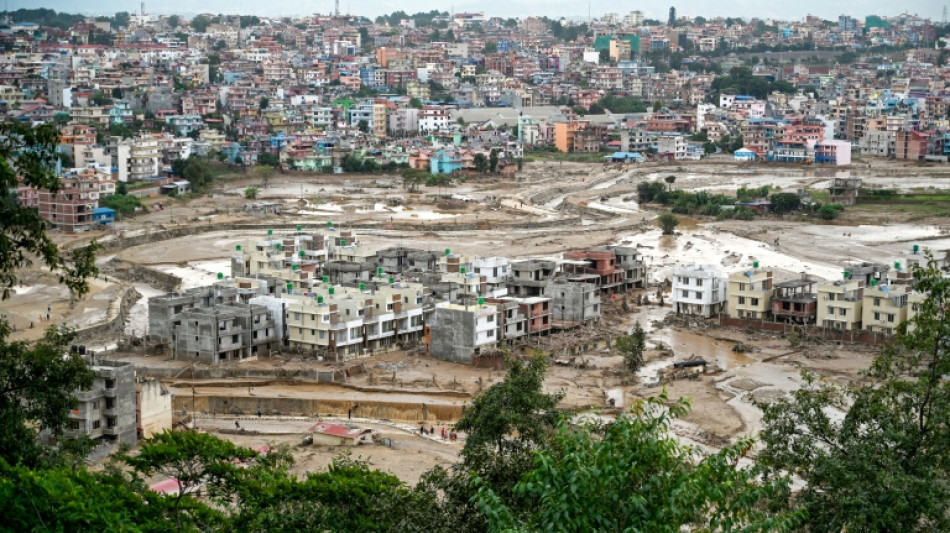
Climate change worsened deadly Nepal floods, scientists say / Photo: Prakash MATHEMA - AFP

 Kenya's economy faces climate change risks: World Bank

 Amazon beats expectations with cloud and AI growth

 Blowout Microsoft results lift US stocks as oil retreats

 'Beginning of the end': Relief but no party as French wildfire winds down

 Southern Europe 'becoming more flammable' in hotter climate, experts say

 Mammoth bones found on parched bed of Danube in Bulgaria

 MEXC Lists Grvt (GRVT) with $60,000 Worth of GRVT and 10,000 USDT in Airdrop+ Rewards

 George and Amal Clooney flee French home due to wildfire

 MEXC Ventures Supports Alpha Arena's APAC Debut at Coinfest Bali

 AI data centre supplier Zhongji InnoLight slips on Hong Kong debut

 May, June heatwaves caused 2,877 extra deaths in England: govt

 BMW profit down a third as carmaker plans job cuts

 Seoul extends losses as most Asian markets drop, oil rises again

 Gambling.com Group Is Now Grandstand

 Meet the astronomer digging into the Milky Way's 'fossils'

 AI data centre supplier Zhongji InnoLight falls on Hong Kong debut

 Samsung operating profit up 1,800% in second quarter on AI boom

 Japanese population below 120 million for first time in decades

 US actor Jared Leto denies latest accusations of sexual assault

 Danube drops to 'historic lows' as fresh heatwave hits

 BTS pulls out of Grammys after Asian pop category introduction

 OpenAI says rogue AI agent attack hit other companies

 How an AFP beach snap became emblem of Europe's wildfire summer

 TRX Spot and Perpetuals Listing Launches on Backpack, Expanding Access to the TRON Ecosystem

 Nepal's tiger numbers climb 20 percent to estimated 429: survey
Climate change, along with rapid urbanisation and deforestation, turbocharged floods in Nepal that killed more than 240 people last month, scientists said on Thursday.
Nepal suffered its worst flooding in decades in late September after ferocious monsoon rains swelled rivers, swamping entire neighbourhoods in the capital Kathmandu and other districts.
World Weather Attribution (WWA), a network of scientists who assess the role of human-induced climate change on extreme weather events, said the link between the intense rainfall and a warming planet was clear.
"If the atmosphere wasn't overloaded with fossil fuel emissions, these floods would have been less intense, less destructive and less deadly," said researcher Mariam Zachariah, from Imperial College London.
Their analysis found the relentless rain, which fell on saturated ground in the late monsoon, was made at least 10 percent heavier and 70 percent more likely by climate change.
They warned that such "explosive" rain bursts will "become even heavier, risking more destructive floods" if the world does not stop burning fossil fuels.
Lashing rain from September 26 sparked floods and landslides that killed 246 people and left 18 missing, according to Nepal's government.
WWA, which uses modelling to compare weather patterns in our world and one without human-induced climate change, said there was a high level of uncertainty in the results because of the complex rain dynamics in the small, mountainous region affected.
However, the results were in line with growing scientific evidence on large-scale extreme rain in a warming climate, in which the atmosphere holds more water.
The role of climate change was also compounded by other man-made problems, they said, including rapid urbanisation, with a nearly four-fold increase in built-up areas in Kathmandu since 1990.
That was coupled with major deforestation that disrupted the natural flow of water, with tree cover slashed by more than a quarter since 1989.
The floods smashed hydropower plants, washed away homes and ripped away bridges. It was the latest disastrous flood to hit the Himalayan nation this year.
"Climate change is no longer a distant threat," said Roshan Jha, Researcher at the Indian Institute of Technology in Mumbai.
"With every fraction of a degree of warming, the atmosphere can potentially hold more moisture, leading to much heavier downpours, and catastrophic floods like these."
Nepal has embarked on a giant hydropower dam building spree, generating 99 percent of its power, with output increasing fourfold in the past eight years.
It has signed deals to export surplus power to neighbouring coal-dependent India.
Earlier this month, the UN's World Meteorological Organization said that increasingly intense floods and droughts are a "distress signal" of what is to come as climate change makes the planet's water cycle ever more unpredictable.
WMO chief Celeste Saulo called water the "canary in the coal mine of climate change".
H.Müller--CPN