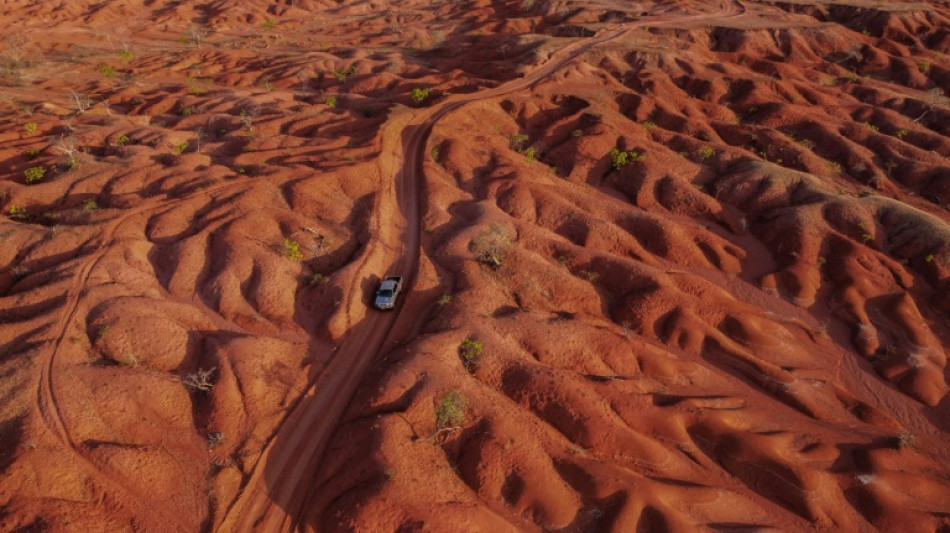
From Bolivia to Indonesia, deforestation continues apace / Photo: Nelson ALMEIDA - AFP/File

 Kenya's economy faces climate change risks: World Bank

 Anthropic's models gained unauthorized 'real-world' access during testing

 Apple tops estimates in CEO Cook's final quarter, but shares fall

 Milei demands expulsion of foreigners expressing 'hate' against Argentina

 Italy's Po River valley on drought alert

 Prada profits pinched as growth hard to chase

 Stocks climb on earnings and rates, oil retreats

 US economic growth slows in second quarter, missing expectations

 Russia adds Telegram founder Durov to 'terrorist' blacklist

 Stocks diverge on earnings, as oil steadies

 Eurozone economy grows despite Middle East war

 Singapore group will develop 'most promising' Ebola vaccine

 Shell profit surges as Mideast war fuels oil prices

 Car maker Stellantis says back in profit in second quarter

 Samsung quarterly operating profit up 1,800% on AI boom

 South Korean stocks bounce after rout, oil holds gains on Mideast woes

 South Korea's women web sleuths fight AI deepfake porn

 Anything but programmable: New cost-efficient EC-power-supply-series for the DIN rail by CAMTEC PS

 Meta misses profit expectations, sticks to massive AI spending

 Campari - king of the spritz - hopes to conquer American heartland

 Air France-KLM and Lufthansa bid for Portugal's TAP airline

 Profits soar at Airbus as it delivers more planes

 Rheinmetall shares surge after armsmaker reports record profit

 FIFA hit by furious backlash over plans to sell stake in competitions

 MEXC Integrates World-Check to Fortify Institutional Grade Compliance Architecture
Deforestation continued last year at a rate far beyond pledges to end the practice by 2030, according to a major study published Tuesday.
Forests nearly the size of Ireland were lost in 2023, according to two dozen research organisations, NGOs and advocacy groups, with 6.37 million hectares (15.7 million acres) of trees felled and burned.
This "significantly exceeded" levels that would have kept the world on track to eliminate deforestation by the end of the decade, a commitment made in 2021 by more than 140 leaders.
Forests are home to 80 percent of the world's terrestrial plant and animal species and crucial for regulating water cycles and sequestering CO2, the main greenhouse gas responsible for global warming.
"Globally, deforestation has gotten worse, not better, since the beginning of the decade," said Ivan Palmegiani, a biodiversity and land use consultant at Climate Focus and lead author of the "Forest Declaration Assessment" report.
"We're only six years away from a critical global deadline to end deforestation, and forests continue to be chopped down, degraded, and set ablaze at alarming rates."
In 2023, 3.7 million hectares of tropical primary forest -- particularly carbon rich and ecologically biodiverse environments -- disappeared, a figure that should have fallen significantly to meet the 2030 objective.
- Soya and nickel -
In high-risk regions, researchers pointed to backsliding in Bolivia and in Indonesia.
The report said there was an "alarming rise" in deforestation in Bolivia, which jumped 351 percent between 2015 and 2023.
The "trend shows no sign of abating", it added, with forests largely cleared for agriculture, notably for soya but also beef and sugar.
In Indonesia, deforestation slumped between 2020-2022 but started rising sharply last year.
Ironically, that is partly down to demand for materials often seen as eco-friendly, such as viscose for clothing, and a surge in nickel mining for electric vehicle batteries and renewable energy technologies.
There was better news from Brazil.
While it remains the country with the highest deforestation rates in the world, it has made key progress.
The situation has significantly improved in the Amazon, which has benefited from protective measures put in place by President Luiz Inacio Lula da Silva.
However, in the Cerrado, a key tropical savannah below the Amazon, deforestation has increased.
- Degraded forests -
The report also highlights the role of logging, road building and fires in forest degradation, when land is damaged but not razed entirely.
In 2022, the last year data was available, a forest area twice the size of Germany was degraded.
Erin Matson, senior consultant at Climate Focus, and co-author of the report, said "strong policies and strong enforcement" were needed.
"To meet global forest protection targets, we must make forest protection immune to political and economic whims," she said.
The report comes in the wake of the European Commission's proposal last week to postpone by a year (to the end of 2025) the entry into force of its anti-deforestation law, despite protests from NGOs.
"We have to fundamentally rethink our relationship with consumption and our models of production to shift away from a reliance on over exploiting natural resources," said Matson.
H.Müller--CPN