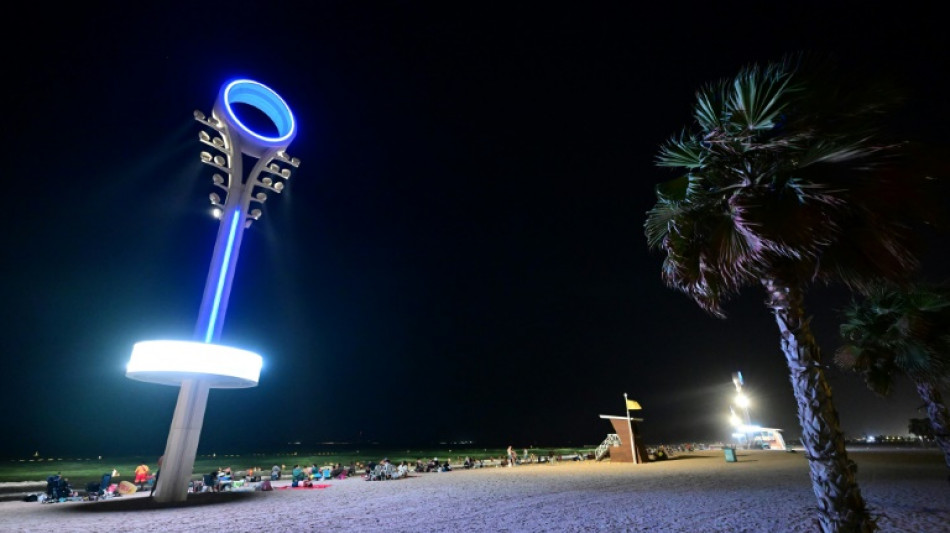
Too hot by day, Dubai's floodlit beaches are packed at night / Photo: Giuseppe CACACE - AFP

 Kenya's economy faces climate change risks: World Bank

 Anthropic's models gained unauthorized 'real-world' access during testing

 Apple tops estimates in CEO Cook's final quarter, but shares fall

 Milei demands expulsion of foreigners expressing 'hate' against Argentina

 Italy's Po River valley on drought alert

 Prada profits pinched as growth hard to chase

 Stocks climb on earnings and rates, oil retreats

 US economic growth slows in second quarter, missing expectations

 Russia adds Telegram founder Durov to 'terrorist' blacklist

 Stocks diverge on earnings, as oil steadies

 Eurozone economy grows despite Middle East war

 Singapore group will develop 'most promising' Ebola vaccine

 Shell profit surges as Mideast war fuels oil prices

 Car maker Stellantis says back in profit in second quarter

 Samsung quarterly operating profit up 1,800% on AI boom

 South Korean stocks bounce after rout, oil holds gains on Mideast woes

 South Korea's women web sleuths fight AI deepfake porn

 Anything but programmable: New cost-efficient EC-power-supply-series for the DIN rail by CAMTEC PS

 Meta misses profit expectations, sticks to massive AI spending

 Campari - king of the spritz - hopes to conquer American heartland

 Air France-KLM and Lufthansa bid for Portugal's TAP airline

 Profits soar at Airbus as it delivers more planes

 Rheinmetall shares surge after armsmaker reports record profit
 FIFA hit by furious backlash over plans to sell stake in competitions

 MEXC Integrates World-Check to Fortify Institutional Grade Compliance Architecture

Roasted by summer temperatures too hot for the beach, Dubai has turned to an innovative solution: opening them at night, complete with floodlights and lifeguards carrying night-vision binoculars.
The idea, in one of the world's hottest regions, with temperatures climbing ever higher through climate change, has proved popular -- more than one million people have visited the night beaches since last year, an official said.
Even with much of the region preoccupied with the widening conflict that pits Israel against Hamas, Hezbollah and Iran, the United Arab Emirates' giant neighbour, the night beaches remain busy on weekend evenings.
"The temperature drops down in the evening after the sun sets. So, yeah, it's amazing," said Mohammed, 32, from Pakistan, who brought his children to enjoy the sea without having to worry about the burning Gulf sun.
For residents of Dubai, a coast-hugging, desert metropolis of about 3.7 million people, the hot season from June to October is an annual trial.
With temperatures regularly topping 40 degrees Celsius (104 degrees Fahrenheit), often with high humidity, outdoor activities are severely limited.
The city now has more than 800 metres (yards) of designated night beaches fitted with shark nets and illuminated by giant, bright floodlights.
"While you're... bathing inside the water, you can see the sand even on your foot and your hands and everything," said Mohammed, who has lived in Dubai for a decade.
Lifeguards are posted 24 hours a day and, beyond the floodlights' glare, they use the night-vision binoculars to keep an eye on swimmers or kayakers further out in the water.
Officials are also testing an artificial intelligence camera system meant to detect when people are in distress.
- 'Feels like a bath' -
At nearly midnight on a recent Friday, with temperatures still above 30C (86F), Umm Suqeim beach was packed with people -- mainly expatriates, who make up about 90 percent of the UAE's population.
Mary Bayarka, a 38-year-old fitness coach from Belarus, was enjoying being outside after a "long, hot day", even if the Gulf seawater was a little warm.
"It feels like (I'm) in a bath," she said.
Nearby, Filipina saleswoman Laya Manko was burying her body in the sand. The beach is an escape for the 36-year-old, one of the hundreds of thousands of migrant workers who keep Dubai's economy ticking.
"Every weekend we come here to have fun," she said. "Sometimes we sleep here with my friends.
"Because you work hard in Dubai, you feel you need to relax. Yes, this is my stress reliever," said Manko.
For the authorities, the night beaches are another way to tempt tourists, especially in summer when the stifling heat usually keeps them indoors.
"I believe we are one of the only cities in the world to have such infrastructure on public beaches at night," said Hamad Shaker, an official from the Dubai municipality.
- Extreme weather -
Dubai used to empty out in summer as expats fled the heat in droves, said Manuela Gutberlet, a tourism researcher at the University of Breda in the Netherlands.
But with attractions such as the world's tallest building, giant malls and indoor amusement parks, it has become "a year-round urban destination", attracting more than 17 million visitors last year, she said.
However, climate change could limit its ambitions, Gutberlet warned, citing the unprecedented rains that paralysed the city for several days in April.
Extreme weather events and a further rise in temperatures could discourage some visitors, she said, highlighting the need to "adapt quickly to new risks".
Meanwhile, Frenchman Laziz Ahmed, 77, found himself on the night beach during his first holiday in Dubai, where he was visiting relatives.
"During the day, I don't go out much," he said, adding that in the evening "I make up for it".
C.Peyronnet--CPN