Italy targets climate activists in 'anti-Gandhi' demo clampdown / Photo: Piero CRUCIATTI - AFP

 Kenya's economy faces climate change risks: World Bank

 Anthropic's models gained unauthorized 'real-world' access during testing

 Apple tops estimates in CEO Cook's final quarter, but shares fall

 Milei demands expulsion of foreigners expressing 'hate' against Argentina

 Italy's Po River valley on drought alert

 Prada profits pinched as growth hard to chase

 Stocks climb on earnings and rates, oil retreats

 US economic growth slows in second quarter, missing expectations

 Russia adds Telegram founder Durov to 'terrorist' blacklist

 Stocks diverge on earnings, as oil steadies

 Eurozone economy grows despite Middle East war

 Singapore group will develop 'most promising' Ebola vaccine

 Shell profit surges as Mideast war fuels oil prices

 Car maker Stellantis says back in profit in second quarter

 Samsung quarterly operating profit up 1,800% on AI boom

 South Korean stocks bounce after rout, oil holds gains on Mideast woes

 South Korea's women web sleuths fight AI deepfake porn

 Anything but programmable: New cost-efficient EC-power-supply-series for the DIN rail by CAMTEC PS
 Meta misses profit expectations, sticks to massive AI spending

 Campari - king of the spritz - hopes to conquer American heartland
 Air France-KLM and Lufthansa bid for Portugal's TAP airline
 Profits soar at Airbus as it delivers more planes

 Rheinmetall shares surge after armsmaker reports record profit
 FIFA hit by furious backlash over plans to sell stake in competitions

 MEXC Integrates World-Check to Fortify Institutional Grade Compliance Architecture

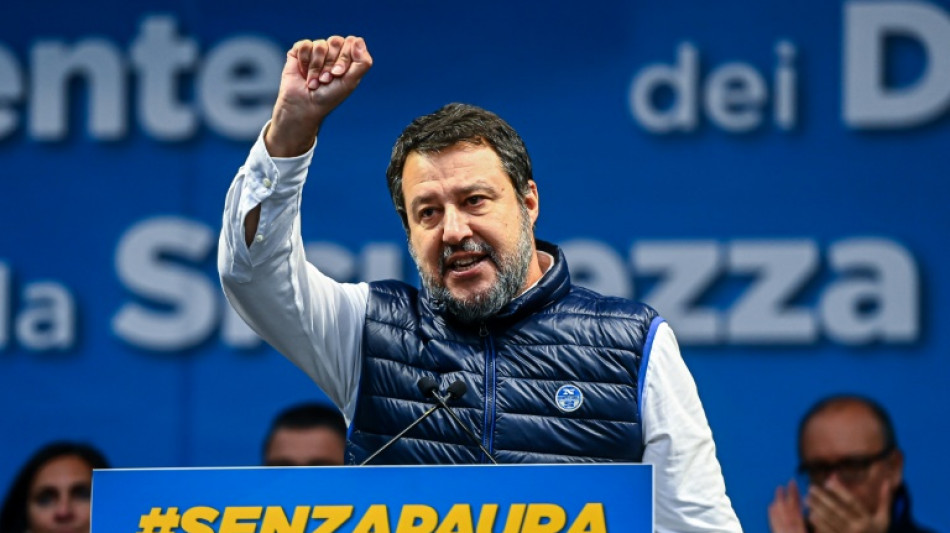
Blocking a road to protest inaction against climate change could soon be punishable with prison in Italy as Prime Minister Giorgia Meloni's hard-right government cracks down on demonstrations, even peaceful ones.
A new security law passed by MPs and facing final scrutiny in the Senate has been dubbed the "anti-Gandhi" law -- after pacifist Indian independence hero Mahatma Gandhi -- by critics for taking aim at demonstrations by people ranging from prisoners to climate activists.
It is specifically aimed at protests against two major infrastructure projects -- a high-speed, cross-border Turin-Lyon railway to France and a mooted bridge over the Strait of Messina to Sicily -- both championed by Deputy Prime Minister Matteo Salvini.
Salvini, who also has responsibility for transport and infrastructure, is a defender of the combustion engine and crusades against "climate terrorism", particularly the young members of the Last Generation, a climate group known for headline-grabbing protests.
Under the new law, blocking a road outside the authorised route of a demonstration could be punishable by up to two years in prison, up from the current penalty of a fine between 1,000 and 4,000 euros.
Critics see it as a deliberate attempt to silence dissent by Italy's most right-wing government since the end of World War II.
But Salvini, head of the far-right League party, rejected accusations of a "police state", insisting: "Good people have nothing to fear."
- 'Ideological madness' -
Meloni's post-fascist Brothers of Italy party took office in October 2022 after an election victory fuelled by anti-immigration, nationalist and populist rhetoric, forming a coalition with the League and the right-wing Forza Italia party.
The government has since passed numerous laws and measures designed to please their right-wing base, from legislation limiting the activities of charities that rescue migrants at sea to reinforcing an existing ban on surrogacy and clamping down on juvenile crime.
With the security law, "the government wants to charm the part of society that continues to vote mainly for far-right parties", many of them older people "who are much less sensitive to issues of civil rights, the labour crisis and climate change", said Anna Bonalume, a journalist who closely follows Salvini.
Opposition parties are up in arms.
"We have never faced such an attack on democratic civilisation such as that brought by the Meloni government," Giuseppe De Marzo, national coordinator of the Even Numbers Network of civil society groups, told AFP at a recent protest against the bill outside parliament.
The opposition Five Star Movement condemned it as a "deeply oppressive measure that has the explicit intention of intimidating... political and social dissent".
The bill also plans to lift a ban on jailing pregnant women or those with a child under one year old, and to penalise prisoners who protest against their conditions.
Italy is ranked the sixth-worst European country for prison overcrowding, with 109 inmates for every 100 places, according to the Council of Europe.
But the law would make it an offence to demonstrate in a prison, even through "passive resistance", such as disobeying an order.
On the flip side, the legislation proposes the filming of police interrogations.
"The security bill is a real attack on democracy and the rule of law," said the Green and Left Alliance.
The secretary general of the centre-left More Europe, MP Riccardo Magi, called it "ideological madness".
St.Ch.Baker--CPN