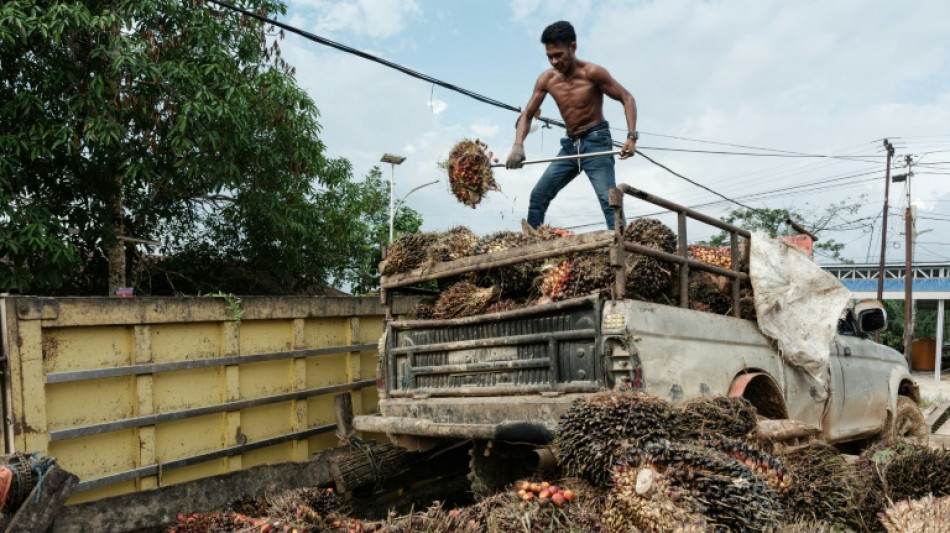
Relief in Brazil, Asia over delay to EU deforestation rules / Photo: Yasuyoshi CHIBA - AFP/File

 Kenya's economy faces climate change risks: World Bank

 Anthropic's models gained unauthorized 'real-world' access during testing

 Apple tops estimates in CEO Cook's final quarter, but shares fall

 Milei demands expulsion of foreigners expressing 'hate' against Argentina

 Italy's Po River valley on drought alert

 Prada profits pinched as growth hard to chase

 Stocks climb on earnings and rates, oil retreats

 US economic growth slows in second quarter, missing expectations

 Russia adds Telegram founder Durov to 'terrorist' blacklist

 Stocks diverge on earnings, as oil steadies

 Eurozone economy grows despite Middle East war

 Singapore group will develop 'most promising' Ebola vaccine

 Shell profit surges as Mideast war fuels oil prices

 Car maker Stellantis says back in profit in second quarter

 Samsung quarterly operating profit up 1,800% on AI boom

 South Korean stocks bounce after rout, oil holds gains on Mideast woes

 South Korea's women web sleuths fight AI deepfake porn

 Anything but programmable: New cost-efficient EC-power-supply-series for the DIN rail by CAMTEC PS

 Meta misses profit expectations, sticks to massive AI spending

 Campari - king of the spritz - hopes to conquer American heartland

 Air France-KLM and Lufthansa bid for Portugal's TAP airline

 Profits soar at Airbus as it delivers more planes

 Rheinmetall shares surge after armsmaker reports record profit

 FIFA hit by furious backlash over plans to sell stake in competitions

 MEXC Integrates World-Check to Fortify Institutional Grade Compliance Architecture

Brazil's government on Thursday joined Asian palm oil and coffee producers in welcoming a European Union decision to delay implementation of new anti-deforestation rules which had faced strong global pushback.
Brazil, the United States and other countries had criticized the law -- which aims to prevent the import of products that drive deforestation -- as being too complex, arguing it would particularly hurt small-scale producers.
It had been due to take effect at the end of 2024 but the European Commission on Wednesday proposed delaying implementation for large companies until the end of 2025.
Small businesses will have until June 2026 to comply.
Welcoming the postponement, Brazil's agriculture ministry told AFP it was the fruit of "international dialogue, in which Brazil had a key role in underlining the concerns of our producers."
The ministry added that Brazil, home to about two-thirds of the Amazon rainforest, huge chunks of which have been felled for agriculture, remained "firmly committed to environmental preservation" and would seek to "ensure fair adaptation to the new European rules."
Asian commodity producers also expressed relief over the extension but environmentalist groups voiced outrage.
Greenpeace declared EU chief Ursula von der Leyen "might as well have wielded the chainsaw herself" to the forests.
The Brazilian Climate Observatory called the extension a "shameful step backwards" which jeopardized the fight against deforestation as the country chokes from the smoke from thousands of fires caused mainly by clearing the Amazon.
"Europe is deliberately renouncing an instrument that could help reduce the pressure on natural ecosystems and carbon dioxide emissions from deforestation," it said in a statement.
The EU's new law requires exporters of timber, cattle, cocoa, soy, palm oil, rubber, coffee -- and items derived from those products -- to certify their goods were not produced on land deforested after December 2020.
The EU is the second-biggest market for the targeted products after China.
Brazil in September asked the EU to postpone the legislation, complaining that the "punitive" rules increased production and export costs, especially for smallholders.
Germany and other countries in Asia, Africa and Latin America had also insisted that companies needed more time to prepare.
- Divided opinions -
Nguyen Xuan Loi, head of Vietnamese coffee exporter An Thai Group, hailed the delay as a "positive move."
"In reality, Vietnam has been strictly managing deforestation issues," he told AFP. "There are hardly any violations anymore."
There was also relief in some sectors in Indonesia, the world's largest palm oil producer, a key driver of deforestation.
"Our calls have been listened to," said Eddy Martono, chairman of the country's leading palm oil association.
Indonesian environmental group WALHI said however it could "not imagine how much more land-clearing or deforestation the one-year delay could cause in West Kalimantan and other places like Papua."
EU imports accounted for 16 percent of deforestation linked to global trade in 2017, according to WWF.
When the law was adopted in 2023 it was hailed as a major breakthrough to protect nature and the climate.
Under the law, firms importing the merchandise to the 27-nation EU will be responsible for tracking their supply chains to prove goods did not originate from deforested zones, relying on geolocation and satellite data.
Exporting countries considered high-risk would have at least nine percent of products sent to the EU subjected to checks.
The postponement of the law has yet to be approved by the European Parliament and member states.
burs-cb/bgs
A.Leibowitz--CPN