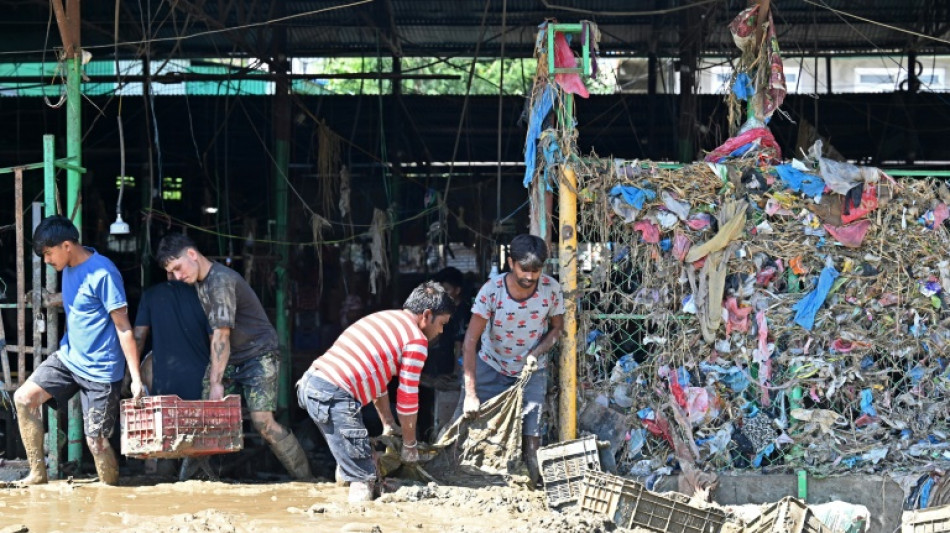
Nepal's urban poor count cost of 'nightmare' floods / Photo: Prakash MATHEMA - AFP

 Kenya's economy faces climate change risks: World Bank

 Cables and cooling bring AI windfall to Indian suppliers

 Anthropic's models gained unauthorized 'real-world' access during testing

 Apple tops estimates in CEO Cook's final quarter, but shares fall

 Milei demands expulsion of foreigners expressing 'hate' against Argentina

 Italy's Po River valley on drought alert

 Prada profits pinched as growth hard to chase

 Stocks climb on earnings and rates, oil retreats

 US economic growth slows in second quarter, missing expectations

 Russia adds Telegram founder Durov to 'terrorist' blacklist

 Stocks diverge on earnings, as oil steadies

 Eurozone economy grows despite Middle East war

 Singapore group will develop 'most promising' Ebola vaccine

 Shell profit surges as Mideast war fuels oil prices

 Car maker Stellantis says back in profit in second quarter

 Samsung quarterly operating profit up 1,800% on AI boom

 South Korean stocks bounce after rout, oil holds gains on Mideast woes

 South Korea's women web sleuths fight AI deepfake porn

 Anything but programmable: New cost-efficient EC-power-supply-series for the DIN rail by CAMTEC PS

 Meta misses profit expectations, sticks to massive AI spending

 Campari - king of the spritz - hopes to conquer American heartland

 Air France-KLM and Lufthansa bid for Portugal's TAP airline

 Profits soar at Airbus as it delivers more planes

 Rheinmetall shares surge after armsmaker reports record profit
 FIFA hit by furious backlash over plans to sell stake in competitions

When floodwaters submerged large swathes of Nepal's capital, Indra Prasad Timilsina was able to save the three cows that keep his family fed -- but everything else was claimed by the river.
The slum he calls home in Kathmandu is one of several neighbourhoods devastated by pounding weekend rains that disproportionately hit the city's poorest and vulnerable inhabitants.
The Bagmati river and its tributaries which criss-cross the Kathmandu valley, broke their banks during the downpour, pummelling flimsy wood and sheet metal shacks that house thousands of people along their shorelines.
"This is like a nightmare. I have never seen such an extreme flood in my life," the 65-year-old told AFP.
"Everything is gone," he added. "If you are dead, you don't have to worry about anything. But if you survive, you have to face these problems."
Timilsina makes a modest living by the river in Tripureshwor selling milk from his cows, including to his neighbours -- many of whom left poverty-stricken villages in rural Nepal to eke out a precarious livelihood on the city's margins.
He and his wife fled their homes shortly after midnight on Saturday as the river lapped at their feet -- enough time to lead the cattle to higher ground, but not to gather the rest of their meagre possessions.
The couple returned to what was left of their homes alongside hundreds of others cleaning mud-caked walls, scooping buckets of water off the floor and salvaging whatever bags of food had not been spoiled.
Timilsina said the waters had spoiled the nine bags of animal feed he had stockpiled for his cows.
"We can survive," he said, "but if I don't feed them soon, they'll die."
- 'Wrecked by rising waters' -
Nearly 200 people across the capital and elsewhere in Nepal were killed in the weekend's floods, with nearly three dozen more still missing.
Army search and rescue teams carried more than 4,000 people to safety and relief crews are working frantically to clear highways around the capital blocked by debris from landslides.
Entire neighbourhoods around Kathmandu were inundated, damaging schools and medical clinics including many servicing the city of nearly one million people's poorest residents.
Not far from Timilsina's home, more than two dozen computers at a community-run school were wrecked by the rising waters.
"They are of no use now," teacher Shyam Bihari Mishra told AFP. "Our students will be deprived of education."
Deadly rain-related floods and landslides are common across South Asia during the monsoon season between June and September.
Experts say climate change is increasing their frequency and severity.
Parts of Kathmandu saw about 240 millimetres (9.4 inches) of rain in the 24 hours to Saturday morning, the most intense downpour in more than two decades.
Even without the record rainfall, monsoon floods are a regular fact of life for the estimated 29,000 squatters among Kathmandu's urban poor, who build by riverbanks for lack of affordable shelter elsewhere.
"This year alone we've run up to our roof several times," Bishnu Maya Shrestha, 62, told AFP.
"But we didn't expect the flood to swell to swallow all our houses this time."
P.Kolisnyk--CPN