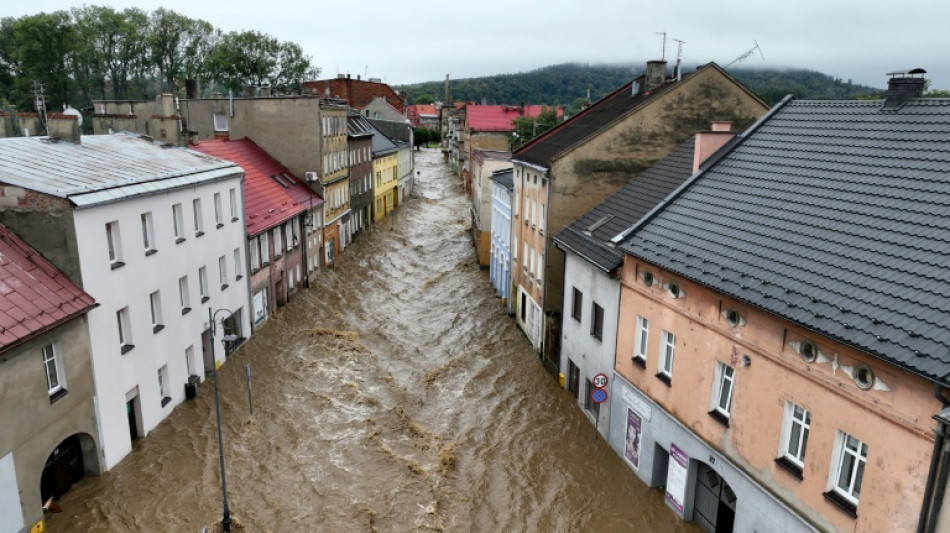
Hurricanes, storms, typhoons... Is September wetter than usual? / Photo: Sergei GAPON - AFP

 Kenya's economy faces climate change risks: World Bank

 Cables and cooling bring AI windfall to Indian suppliers

 Anthropic's models gained unauthorized 'real-world' access during testing

 Apple tops estimates in CEO Cook's final quarter, but shares fall

 Milei demands expulsion of foreigners expressing 'hate' against Argentina

 Italy's Po River valley on drought alert

 Prada profits pinched as growth hard to chase

 Stocks climb on earnings and rates, oil retreats

 US economic growth slows in second quarter, missing expectations

 Russia adds Telegram founder Durov to 'terrorist' blacklist

 Stocks diverge on earnings, as oil steadies

 Eurozone economy grows despite Middle East war

 Singapore group will develop 'most promising' Ebola vaccine

 Shell profit surges as Mideast war fuels oil prices

 Car maker Stellantis says back in profit in second quarter

 Samsung quarterly operating profit up 1,800% on AI boom

 South Korean stocks bounce after rout, oil holds gains on Mideast woes

 South Korea's women web sleuths fight AI deepfake porn

 Anything but programmable: New cost-efficient EC-power-supply-series for the DIN rail by CAMTEC PS

 Meta misses profit expectations, sticks to massive AI spending

 Campari - king of the spritz - hopes to conquer American heartland

 Air France-KLM and Lufthansa bid for Portugal's TAP airline

 Profits soar at Airbus as it delivers more planes

 Rheinmetall shares surge after armsmaker reports record profit

 FIFA hit by furious backlash over plans to sell stake in competitions

With typhoon Yagi battering Asia, storm Boris drenching parts of Europe, extreme flooding in the Sahel and hurricane Helene racing towards Florida, September so far has been a very wet month.
But while scientists can link some extreme weather events directly to human-caused global warming, it remains too early to draw clear conclusions about this sodden month.
"You will always have some sort of extreme weather events, but their intensity has been magnified by global warming, especially in the context of rainfall," Paulo Ceppi from Imperial College London's Grantham Institute told AFP on Thursday.
"That's probably one of the common drivers of these different events in very different parts of the world."
Early indications from monthly data show some record-breaking precipitation levels in the regions affected.
In central Europe, the torrential rains accompanying storm Boris were "the heaviest ever recorded" in the region, according to the World Weather Attribution (WWA) network of scientists, inundating homes and farmland.
Global warming has doubled the likelihood of severe four-day downpours since the pre-industrial era and the costs of climate change are "accelerating", WWA said in a report published Wednesday.
Meanwhile in Japan's city of Wajima, more than 120 millimetres (4.7 inches) of rainfall per hour from typhoon Yagi was recorded on the morning of September 21 -- the heaviest rain since comparative data became available in 1929.
- Hotter, and wetter? -
"Attributing different weather patterns around the world at the same time to climate change is very challenging," said Liz Stephens, science lead at the Red Cross Red Crescent Climate Centre.
"But the fundamental principle remains that for every 1 degree Celsius of warming the atmosphere can hold seven percent more moisture," she told AFP.
With global warming on track to exceed 1.5 degrees Celsius above pre-industrial times "you can do the math pretty quickly and that will have a measurable impact," said Ceppi from the Grantham Institute.
The 2024 northern summer saw the highest global temperatures ever recorded, beating last year's record, according to the EU's climate monitor Copernicus.
A hotter planet, in other words, could also signal a wetter one.
The sweltering summer in the Mediterranean this year "gives a lot of extra evaporation, pumping more water vapour into Europe if the conditions are right and allowing for all that moisture to be dumped in certain places," Ceppi said.
"The global temperatures -- both over the land and the ocean -- were anomalously high during August-September despite La Nina-like conditions evolving in the Pacific," Roxy Mathew Koll at the Indian Institute of Tropical Meteorology told AFP.
"Anomalously high temperatures assist in supplying additional heat and moisture for storms and weather systems to intensify."
La Nina refers to a naturally-occurring climate phenomenon that cools the ocean surface temperatures in large swathes of the tropical Pacific Ocean, coupled with winds, rains and changes in atmospheric pressure.
In many locations, especially in the tropics, La Nina produces the opposite climate impacts to El Nino, which heats up the surface of the oceans, leading to drought in some parts of the world and triggering heavy downpours elsewhere.
Currently, "neutral" conditions prevail, meaning neither El Nino nor La Nina are present.
Large swaths of South America and Southern Africa suffered from drought in 2024.
The global September update from Copernicus is due early next month and will provide hard data on precipitation levels.
L.Peeters--CPN