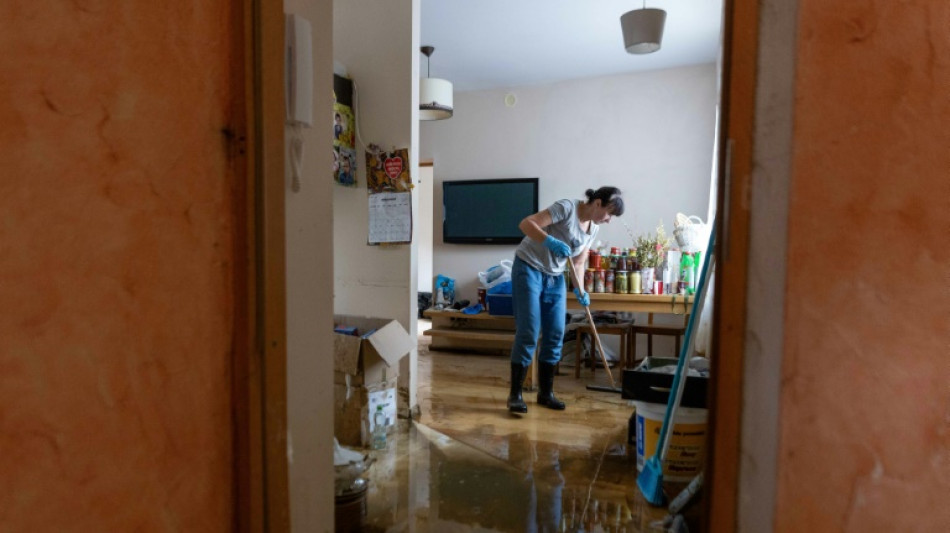
Mud, loss and despair after Polish floods / Photo: Wojtek RADWANSKI - AFP

 Kenya's economy faces climate change risks: World Bank
 Cables and cooling bring AI windfall to Indian suppliers
 Anthropic's models gained unauthorized 'real-world' access during testing

 Apple tops estimates in CEO Cook's final quarter, but shares fall

 Milei demands expulsion of foreigners expressing 'hate' against Argentina

 Italy's Po River valley on drought alert

 Prada profits pinched as growth hard to chase

 Stocks climb on earnings and rates, oil retreats

 US economic growth slows in second quarter, missing expectations

 Russia adds Telegram founder Durov to 'terrorist' blacklist

 Stocks diverge on earnings, as oil steadies

 Eurozone economy grows despite Middle East war
 Singapore group will develop 'most promising' Ebola vaccine

 Shell profit surges as Mideast war fuels oil prices

 Car maker Stellantis says back in profit in second quarter

 Samsung quarterly operating profit up 1,800% on AI boom

 South Korean stocks bounce after rout, oil holds gains on Mideast woes

 South Korea's women web sleuths fight AI deepfake porn

 Anything but programmable: New cost-efficient EC-power-supply-series for the DIN rail by CAMTEC PS

 Meta misses profit expectations, sticks to massive AI spending

 Campari - king of the spritz - hopes to conquer American heartland
 Air France-KLM and Lufthansa bid for Portugal's TAP airline

 Profits soar at Airbus as it delivers more planes

 Rheinmetall shares surge after armsmaker reports record profit
 FIFA hit by furious backlash over plans to sell stake in competitions

On the verge of tears, tired and dejected, Agata and Sebastian Pioro cleaned their home in Glucholazy, southern Poland, this week of the mess left after the river flooded.
The walls inside were sweating, while outside the building the family's possessions were scattered by the waters unleashed by Storm Boris, which wreaked havoc this month on central Europe.
At least 24 people died in Austria, the Czech Republic, Poland and Romania from the flooding let loose by high winds and unusually heavy rainfall.
"It's indescribable what happened. This unimaginable rush of water that swept away everything in its path... ruthlessly," Agata Pioro told AFP.
The married couple and their daughters, 10 and 14, were at home when disaster struck. Powerless, they watched the water carry away their furniture, the fridge, the washing machine, their lives.
"To lose everything we've accumulated over the years so quickly, and to have our children witness it all, that will forever remain etched in their memory," Agata said, close to tears.
The building's foundations were unearthed by the waves, leading authorities to condemn the house.
The family left to stay with friends, but later returned to salvage what they could of their possessions.
"The water was flowing through the walls," said Sebastian Pioro, as he pointed at a stain about a metre (three feet) off the ground.
- Torrent -
The Biala river, which normally flows around 50 metres from their home, overflowed on September 15.
In just a matter of hours, the waters descended upon the picturesque town of Glucholazy, which was founded in the Middle Ages and has around 14,000 residents.
"It unleashed a real torrent, which suddenly spread across the main square," mayor Pawel Szymkowicz told AFP.
"Never before in the town's history did the water reach the square, even during the 1997 floods," he said.
The waters swept away two bridges, destroyed homes and schools and damaged every road they encountered.
Several wrecked cars stuffed with broken branches were strewn about the riverbank near the Pioros' house.
In terms of the town's infrastructure alone, there is around 250 million zloty ($65 million) in damage done, according to initial estimates, Szymkowicz said.
Poland's government said it had 23 billion zloty -- of national and European funds -- to help the areas affected recover and rebuild.
European Commission president Ursula von der Leyen last week announced 10 billion euros ($11 billion) in funds for member nations reeling from the "heartbreaking" devastation.
- 'Uncertainty' -
Hundreds of volunteers from across Poland have descended on Glucholazy to help residents clean their homes, and to distribute food such as bread and soup, while soldiers clear basements of the mud.
Almost all of this tourist town's businesses remain closed.
"I was lucky: I only got half a metre of water. I hope to reopen tomorrow or the day after," said Artur, owner of a natural medicine shop.
"But some of my neighbours say they won't ever reopen. They're unable to recover after the water ruined their businesses," the man in his 40s told AFP.
Also entrepreneurs, Agata and Sebastian Pioro fear for the future of their two menswear shops, one of which was practically wiped out.
"The worst is the uncertainty. We don't even know if we'll be able to live here because the house is half destroyed," Agata said, adding that she was concerned about future floods.
"Sometimes I think about finding my family another place on earth."
A.Leibowitz--CPN