
No peak oil demand 'on the horizon', phaseout a 'fantasy': OPEC / Photo: Olga MALTSEVA - AFP/File

 Kenya's economy faces climate change risks: World Bank

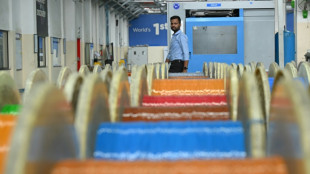 Cables and cooling bring AI windfall to Indian suppliers

 Anthropic's models gained unauthorized 'real-world' access during testing

 Apple tops estimates in CEO Cook's final quarter, but shares fall

 Milei demands expulsion of foreigners expressing 'hate' against Argentina

 Italy's Po River valley on drought alert

 Prada profits pinched as growth hard to chase

 Stocks climb on earnings and rates, oil retreats

 US economic growth slows in second quarter, missing expectations

 Russia adds Telegram founder Durov to 'terrorist' blacklist

 Stocks diverge on earnings, as oil steadies

 Eurozone economy grows despite Middle East war

 Singapore group will develop 'most promising' Ebola vaccine

 Shell profit surges as Mideast war fuels oil prices

 Car maker Stellantis says back in profit in second quarter

 Samsung quarterly operating profit up 1,800% on AI boom

 South Korean stocks bounce after rout, oil holds gains on Mideast woes

 South Korea's women web sleuths fight AI deepfake porn

 Anything but programmable: New cost-efficient EC-power-supply-series for the DIN rail by CAMTEC PS

 Meta misses profit expectations, sticks to massive AI spending

 Campari - king of the spritz - hopes to conquer American heartland

 Air France-KLM and Lufthansa bid for Portugal's TAP airline

 Profits soar at Airbus as it delivers more planes

 Rheinmetall shares surge after armsmaker reports record profit

 FIFA hit by furious backlash over plans to sell stake in competitions

OPEC said Tuesday that phasing out oil was a "fantasy", as the Saudi-led cartel forecast that demand would keep growing until at least 2050, a key year in the battle against climate change.
The oil cartel's prediction runs counter to the assessment of the Paris-based International Energy Agency, which sees demand for fossil fuels peaking this decade as the world turns to renewable energy and electric cars.
In the group's annual World Oil Outlook (WOO), OPEC Secretary General Haitham Al Ghais said oil and gas make up well over half of the energy mix today "and are expected to do the same in 2050".
"What the Outlook underscores is that the fantasy of phasing out oil and gas bears no relation to fact," Ghais said in the report's foreword.
"A realistic view of demand growth expectations necessitate adequate investments in oil and gas, today, tomorrow, and for many decades into the future," he added.
Demand for oil alone is expected to reach 120.1 million barrels per day (bpd) by 2050, up 17.5 percent from 102.2 million bpd in 2023, the report said.
OPEC also raised its forecast for 2045 to 118.9 million bpd, compared to 116 million bpd in last year's WOO, which did not look at 2050.
"There is no peak oil demand on the horizon," Ghais said.
At the UN COP28 climate summit last year -- hosted by OPEC member United Arab Emirates -- nations agreed on the goal of "transitioning away from fossil fuels" in order to achieve net zero emissions by 2050.
The landmark agreement also called for tripling renewable energy capacity globally by 2030.
The deal was reached after the Organization of the Petroleum Exporting Countries urged its members to reject language that "targets" fossil fuels after an earlier draft had included the words "phase out".
"While energy policy ambitions remain high, the outlook expects greater scrutiny and pushback on some overly ambitious policy targets, both from policymakers and populations," OPEC said in Tuesday's report.
"It is evident that energy security continues to be a paramount concern," the report said.
The report said demand growth was driven by the rising world population and growing demand from India and other non-OECD countries.
Among sectors, the strongest demand will come from petrochemicals, road transportation and aviation.
The WOO stressed that "all energy sources" need to expand, "with the exception of coal".
- Renewables soar -
While OPEC opposes a phaseout of fossil fuels, its report noted demand for renewables, mainly solar and wind power, will increase at the fastest rate, growing fivefold between 2023 and 2050.
But oil is expected to retain the largest share of the energy mix at 29.3 percent in 2050 compared to 30.9 percent last year, the WOO said.
Natural gas will overtake coal for second place, accounting for 24 percent of the mix by mid-century, slightly higher than in 2023.
The share of renewables will grow from 3.2 percent last year to 14 percent in 2050.
The report, however, said petrol vehicles "are expected to continue to dominate road transportation".
OPEC's numbers are at odds with the IEA, which advises its member countries -- mostly Western democracies -- on energy policy.
IEA Executive Director Fatih Birol told AFP last week that oil demand is slowing.
He attributed the growth of electric cars and the weakening of the Chinese economy as contributing to the slowdown in oil demand.
"The clean energy transition is moving fast and faster than many people realise," Birol said.
But he warned that "without moving away from the fossil fuels, you will never reach" the landmark Paris agreement's goal of limiting warming to 1.5 degrees Celsius from pre-industrial levels.
J.Bondarev--CPN